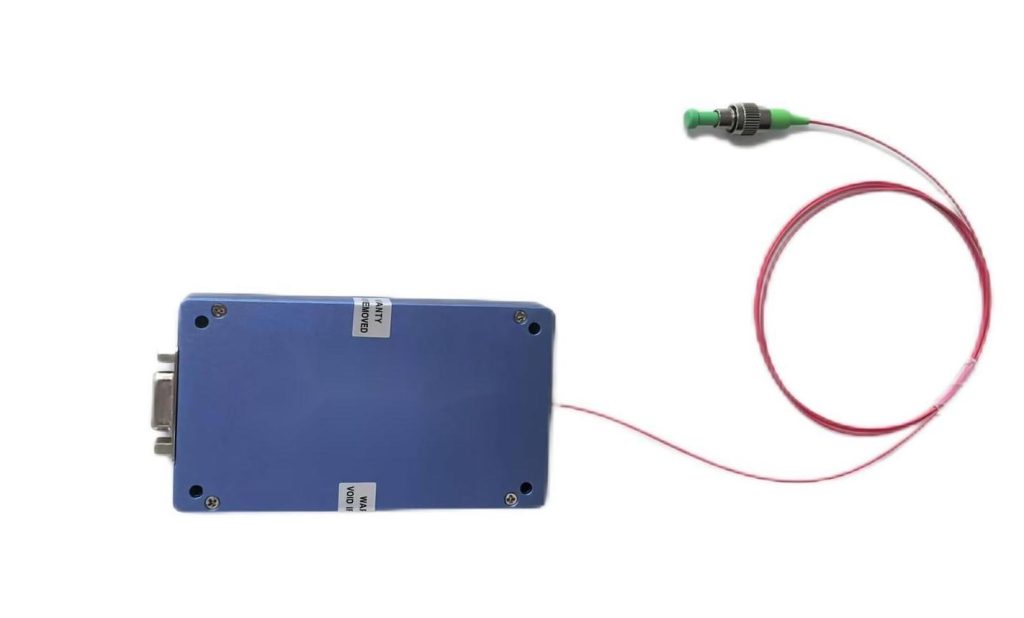
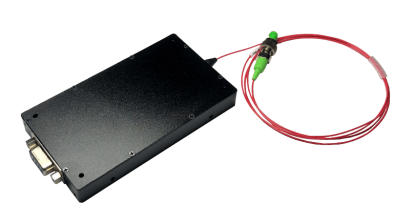
1550nm Narrow Linewidth Laser: Maximizing Coherence Length for Long-Range FMCW LiDAR
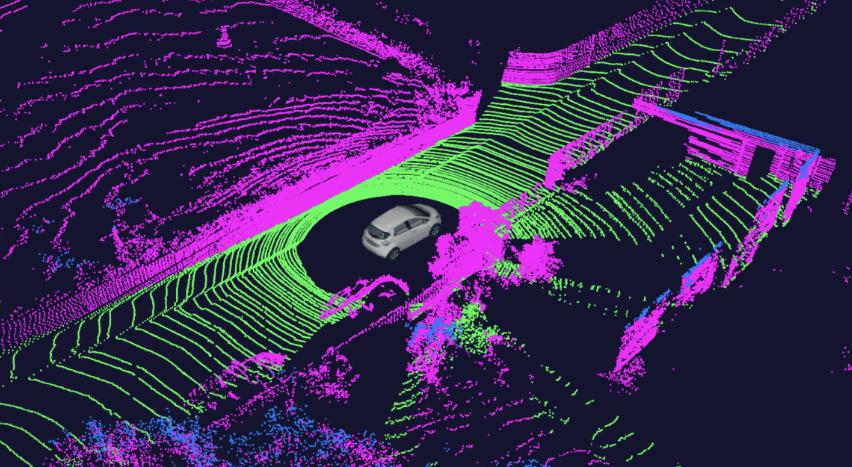
In the automotive and remote sensing mapping markets, the transition from Time of Flight (ToF) to Frequency Modulated Continuous Wave (FMCW) arises from the need for higher-quality data in complex environments. Although ToF systems are simpler to implement, they are prone to interference from solar noise and other lidar sensors. FMCW addresses this issue by measuring frequency offsets instead of pulse times, but this also shifts the technical burden onto the light source.
If the linewidth of the laser is too wide, the phase noise will swamp the signal before it returns from a target 300 meters away. For long-range detection, linewidth is not merely a technical parameter; it is also a physical limitation that determines the maximum detection distance. This blog will mainly analyze how a 1kHz ultra-narrow linewidth laser can eliminate these obstacles in the lidar architecture.
The Hard Physics: Why Linewidth Limits Your Range
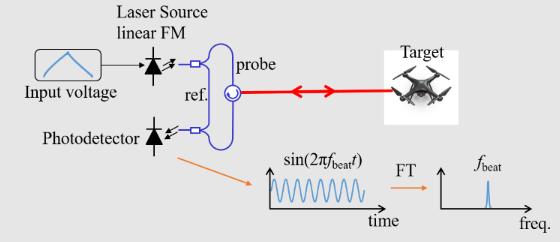
The core of the FMCW laser radar is interference. This system mixes the local oscillator (laser) with the reflected signal from the target. To enable the detector to extract the beat frequency, these two signals must maintain “coherence” – meaning they must maintain a stable phase relationship throughout the flight.
This is determined by the coherence length (Lc). It is defined by a simple physical law: the coherence length is equal to the speed of light divided by (π multiplied by the laser linewidth).
Formula: Lc = c / (π * Δv)
For instance, the theoretical coherence length of a standard 100kHz linewidth laser can reach kilometer-level. However, in the actual FMCW scanning, signal attenuation occurs earlier. When the target distance exceeds the coherence limit, the interference fringes disappear, and the receiver can only receive irrelevant noise.
By reducing the line width to 1kHz, the coherence length can be extended to several hundred kilometers. Although vehicles do not need to detect targets beyond 100 kilometers, such a huge “detection range” means that at 300 meters or 600 meters, the signal remains extremely clear. This high signal-to-noise ratio (SNR) enables developers to maintain centimeter-level ranging accuracy while using detectors with lower sensitivity (and lower cost).
Phase Noise and the Precision Floor
Even if you stay within the coherent length range, phase noise still affects accuracy. The phase noise in the laser directly translates into frequency jitter in the frequency modulation continuous wave (FMCW) ramp. In an FMCW system, frequency is proportional to distance. If the frequency fluctuates due to laser noise, the distance measurement results will also jitter.
Many 1550nm lasers available on the market are designed for simple communication, where the influence of phase noise is not significant. However, in LiDAR (Light Detection and Ranging), high phase noise forms a “noise base”, thereby masking small objects (such as pedestrians wearing dark clothes or tires on the road). Using a single-frequency DFB fiber laser can significantly reduce this noise base. Our 1550nm module is designed to suppress this phase jitter at the source, ensuring that the beat frequency (i.e., the signal indicating the object’s distance) remains stable and clear.
Frequency Linearity: Solving the “Wobble” in the Scan
Frequency Modulated Continuous Wave (FMCW) relies on perfect linear “chirp” or frequency scanning. If the laser’s scanning is not linear, the decoded distance will be incorrect. Although external modulators can be helpful, the key lies in the stability of the laser cavity itself.
One of the main challenges in the field of LiDAR is mode hopping. When the laser is scanning or exposed to temperature changes, the output may suddenly jump between internal modes, resulting in huge peaks of errors.
We specifically adopt a short-cavity Distributed Feedback (DFB) structure to prevent this from happening. Compared to long-cavity fiber lasers, this design inherently has stronger resistance to mode hopping. Combined with an integrated thermoelectric cooler (TEC), the laser can maintain its frequency linearity even when the external environment changes from a cold morning to a hot afternoon.
Why 1550nm is the Strategic Choice?
The wavelength conversion from 905nm to 1550nm is driven by “photon budget”. The light at 1550nm is absorbed by the cornea and lens before reaching the retina, so even at higher power levels (up to 40 times that of the 905nm system), it is basically safe for the eyes.
- Greater detection range: The higher allowable power enables it to have sufficient “penetrating power”, allowing it to detect low-reflectivity objects (such as dark tires) over a distance of 400 meters or more.
- Aerodynamic performance: The Mie scattering at 1550nm is lower. Compared to shorter wavelengths of light, it can better penetrate fog, smoke and dust.
- Precision and power: The narrow-linewidth 1550nm source combines powerful power with the “precision” of 1kHz coherence, enabling sub-centimeter accuracy even at highway driving speeds.
Integration Realities: VSWR and Optical Feedback
In actual laser radar components, light inevitably reflects back to the laser from the internal lens or scanning mirror. This is the main cause of system instability, and it often leads to unstable frequency slopes or widened line widths.
- Integrated isolation: Industrial modules must integrate high isolation degree optical isolators directly into the package.
- Linearity under stress: Our 1550nm light source has undergone “strengthening” treatment. Even in the presence of back reflection, it can ensure that the frequency scanning (or “chirp”) maintains perfect linearity.
- Plug-and-play integration: The internal protection mechanism does not require OEM integrators to design complex external isolation levels, thereby reducing system size and lowering costs.
To Summary
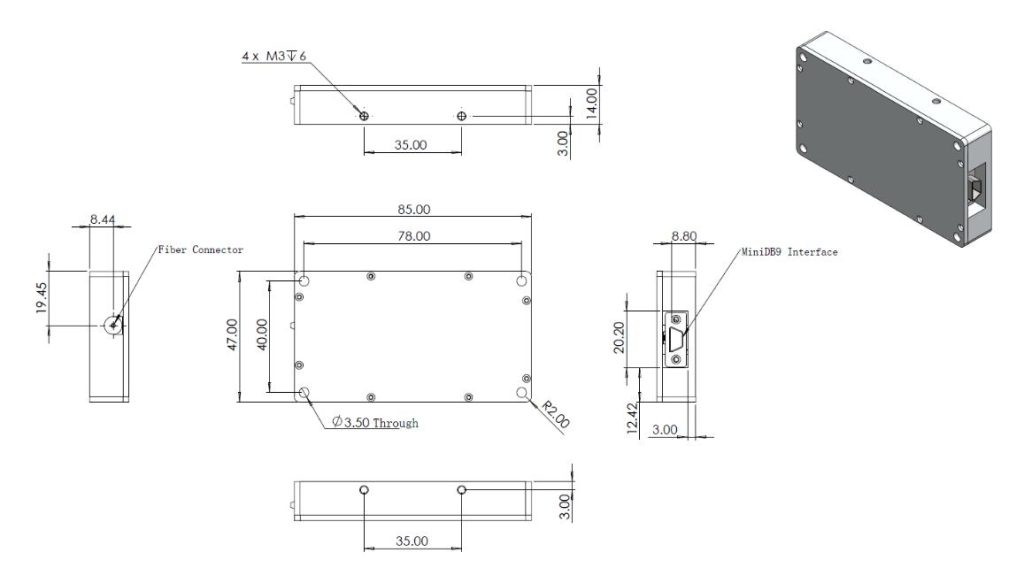
As a leading manufacturer of high-precision fiber lasers, SMART SCI&TECH provides the specialized 1550nm sources required to move FMCW LiDAR from the lab to the road. Our 1kHz ultra-narrow linewidth modules offer the phase stability and thermal reliability essential for long-range, sub-centimeter sensing. Don’t let laser noise limit your system’s potential.
Contact our engineering team today for a detailed phase noise report or to request a sample unit for your next-generation LiDAR platform.