
AOFS vs AOM: When Do You Need Frequency Shifting?
When selecting acoustic-optic devices for a laser system, a key issue is whether you need to control the light intensity, shift the frequency of the light wave, or both. Although acoustic-optic frequency shifters (AOFS) and acoustic-optic modulators (AOM) can achieve these functions, they are typically optimized for different system requirements.
Choosing the appropriate device depends on the specific application, the required frequency shift, the optical performance, and the configuration of the radio frequency (RF) driver. Understanding these differences can help laser manufacturers and system integrators avoid unnecessary complexity and select solutions that meet actual needs.
AOFS vs AOM: What Is the Real Difference?
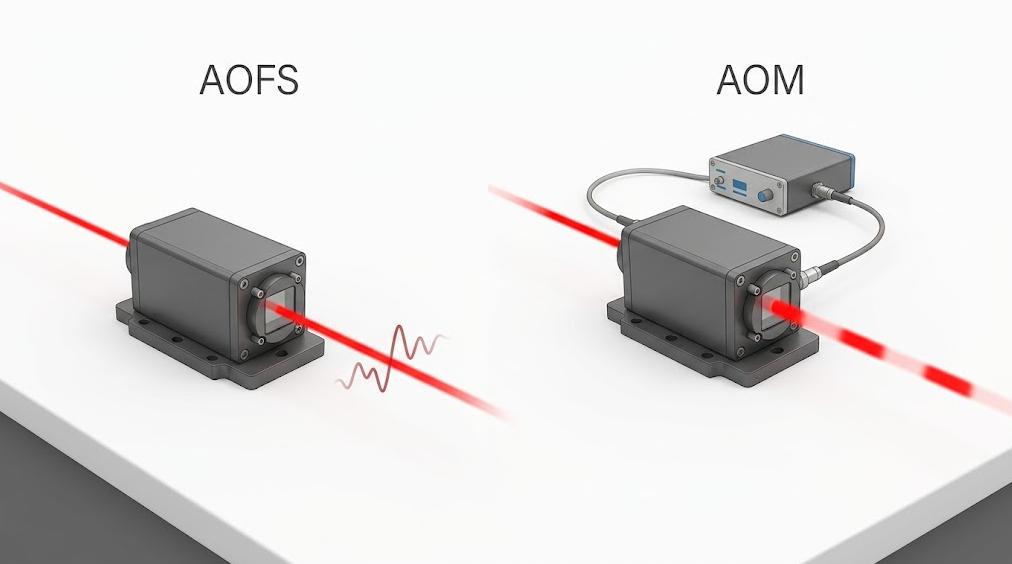
The AOFS (Acousto-Optic Frequency Shifter) and AOM (Acousto-Optic Modulator) devices both operate based on the acousto-optic effect. Radio frequency (RF) signals excite acoustic waves within the crystal, forming a moving diffraction grating, which then interacts with the incident laser beam.
The main differences between the two typically lie in their intended functions and system configurations rather than the underlying physical principles.
| Feature | AOFS | AOM |
| Primary purpose | Introduce a controlled optical frequency shift | Modulate optical intensity or switch a laser beam |
| Frequency shifting | A core design objective | Also occurs in the diffracted beam |
| Intensity control | Depends on device and drive configuration | A common application |
| Typical applications | Heterodyne detection, interferometry, frequency-offset systems | Laser switching, pulse selection, power modulation |
| Key selection factors | Frequency offset, stability, tuning requirements | Modulation speed, diffraction efficiency, optical power handling |
When AOM diffracts light, the frequency of the output light will shift, and the amount of this shift is related to the driving frequency of the sound wave. Depending on the different diffraction geometries and diffraction orders, this frequency shift can be either positive or negative.
Therefore, AOM is not inherently incapable of achieving frequency shift; in many systems, it can both perform frequency shift and intensity modulation. If frequency shift is the primary requirement and the design, specifications, and driving configuration of the device are more suitable for this task, then an AOFS can be considered.
To understand the physical mechanism behind this distinction, see our guide on how acousto-optic frequency shifting works.
When Do You Need Frequency Shifting?
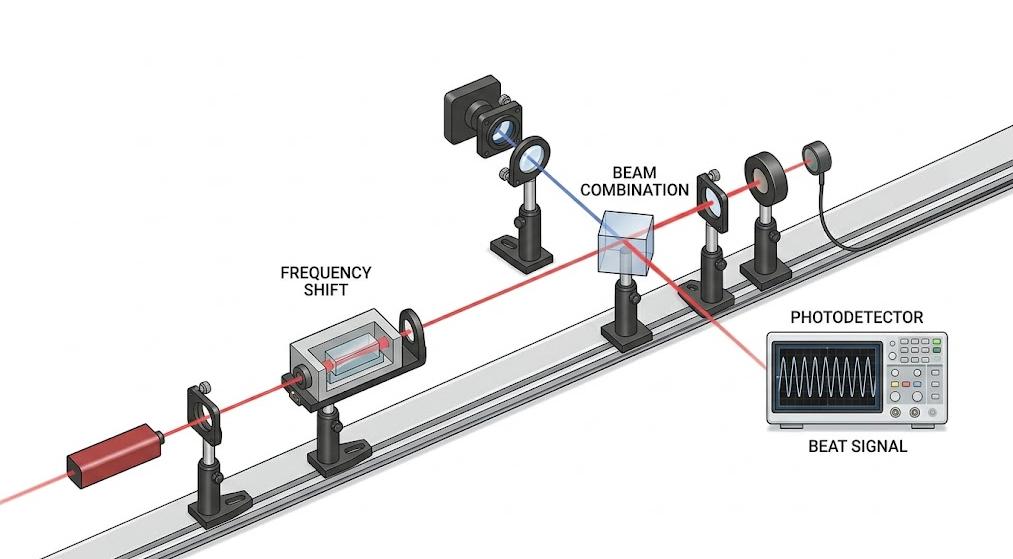
When the laser system needs to maintain a controlled frequency difference between the input and output light frequencies, frequency shifting becomes extremely important. This is fundamentally different from simple beam switching operations.
Homodyne and Coherent Detection
In homodyne detection, two light signals with a frequency difference can generate a beat frequency signal with a frequency equal to that difference. This frequency offset characteristic is highly valuable for the detection and analysis of signals.
Acousto-optic Frequency shifters (AOFS) introduce controlled frequency offsets between optical paths to establish a desired beat frequency. The specific frequency shift amount depends on the detector bandwidth, signal processing scheme, and measurement architecture.
Laser Doppler Measurement
The laser Doppler system is used to measure frequency or phase changes related to motion. In some configurations, artificially introducing frequency offset helps to separate the measurement signal from unnecessary low-frequency components or other signals.
Which device to choose depends on the required frequency shift amount, optical path layout, and measurement method. Not all Doppler measurement systems require an independent AOFS.
Cold Atoms and Quantum Experiments
Many atomic physics applications require precise control of the value of the laser frequency relative to the atomic transition frequency. Acousto-optic devices can provide frequency offsets for controlling detuning, generating multiple frequency components, or managing different optical paths.
For such systems, factors such as frequency range, repeatability, radio frequency (RF) control, and optical path alignment accuracy are all crucial.
Frequency Shift Interference Measurement
In interference measurement systems, by changing the optical frequency of one of the optical paths, a measurable beat frequency signal can be generated when the beams are recombined. This method helps to achieve phase measurement and signal extraction.
The required frequency shift amount and its stability should be determined based on the complete optical and electronic system, rather than solely based on the specifications of the AOFS or acousto-optic modulator (AOM).
When Is a Standard AOM Enough?
When the main goal is to control the laser intensity or switch the beam, the standard acoustic-optic modulator (AOM) is often a more practical choice.
Common applications include:
- Laser switching: By RF control, turn on or off the diffracted beam.
- Pulse selection: Select specific pulses or control the timing of the light output.
- Power modulation: Adjust the diffracted light power by changing the RF driving power.
Combination of modulation and frequency shift: While controlling the intensity of the diffracted beam, utilize its frequency shift characteristic.
If your system requires both specific frequency offsets and fast intensity modulation, AOM will often meet both requirements. The key lies in verifying the working frequency, diffraction geometry, driving conditions, modulation response, and optical performance of the device.
One should not blindly choose a dedicated acoustic-optic frequency shifter (AOFS) just because the application involves optical frequency conversion. If an AOM can meet the required frequency shift and modulation performance, it may provide a more convenient system integration solution.
Conversely, if frequency shift is the main function, one should evaluate whether the AOFS provides the most suitable combination in terms of frequency shift range, optical efficiency, stability, and system compatibility.
For more details on how these functions relate to one another, see AOM beam deflection and frequency shifting.
Five Specifications to Check Before Choosing
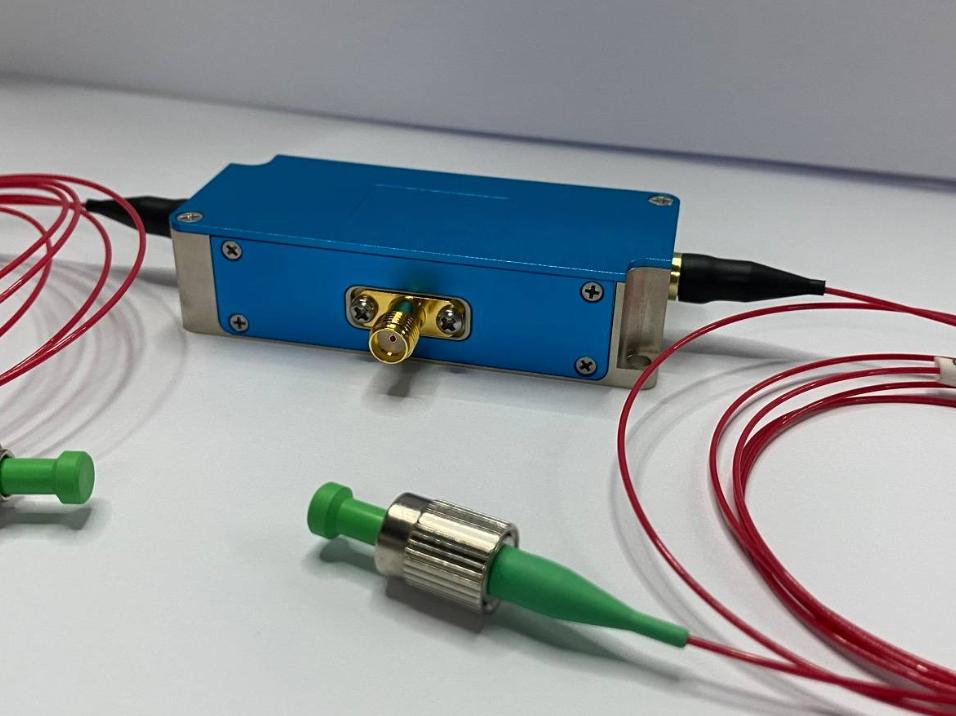
After understanding the application requirements, please compare the actual specifications of the equipment. Just the product name is not sufficient to determine its suitability.
1. Required frequency shift
Determine the required frequency offset and its direction. For diffracted beams, the frequency shift is usually related to the acoustic wave driving frequency, and its sign depends on the diffraction geometry and diffraction order.
2. Tuning range and bandwidth
Is the system requiring a fixed frequency offset or a tunable one? Check the radio frequency (RF) frequency range supported by the device and confirm that the device can operate properly within the required range without affecting other performance metrics.
3. Diffraction efficiency and optical loss
Diffraction efficiency determines the amount of optical power entering the selected diffraction order. Additionally, insertion loss, residual zero-order light, and the output power available for the subsequent optical system must also be considered.
4. Beam pointing and optical quality
Acoustic diffraction alters the propagation direction of the light beam. Please evaluate the output angle, beam quality, wavefront requirements, and alignment sensitivity, especially in interferometry or precision measurement systems.
5. RF driver compatibility
The RF driver must match the equipment’s operating frequency and power requirements. Additionally, check impedance matching, modulation capability, frequency control, and related heat dissipation/thermal management requirements.
The nominal frequency stability of the equipment is not equivalent to the final achieved optical frequency offset stability. Acoustic wave driving, temperature, control electronic equipment, and the overall system design all have an impact on performance.
Simple Decision Guide
Please refer to the following questions to narrow down the selection range:
- Do you only need to control the laser switch, or do you also need to adjust the laser intensity? It is recommended to first evaluate the acousto-optic modulator (AOM).
- Do you need controlled optical frequency shift? Please evaluate the acousto-optic frequency shifter (AOFS) or the AOM configuration that supports the required frequency shift amount.
- Do you need both frequency shift and intensity modulation functions? Please compare the advantages and disadvantages of the integrated solution and the dedicated frequency shift solution.
- Do you need adjustable or high-precision frequency shift control? Please examine the support for radio frequency (RF) range, control architecture, and frequency stability of the complete system.
- Are optical power and beam collimation crucial? Please compare the diffraction efficiency, output geometric characteristics, and beam quality of the selected models.
The best choice is the device that can meet all application requirements, rather than the one with the name that sounds the most “professional” or “special”.
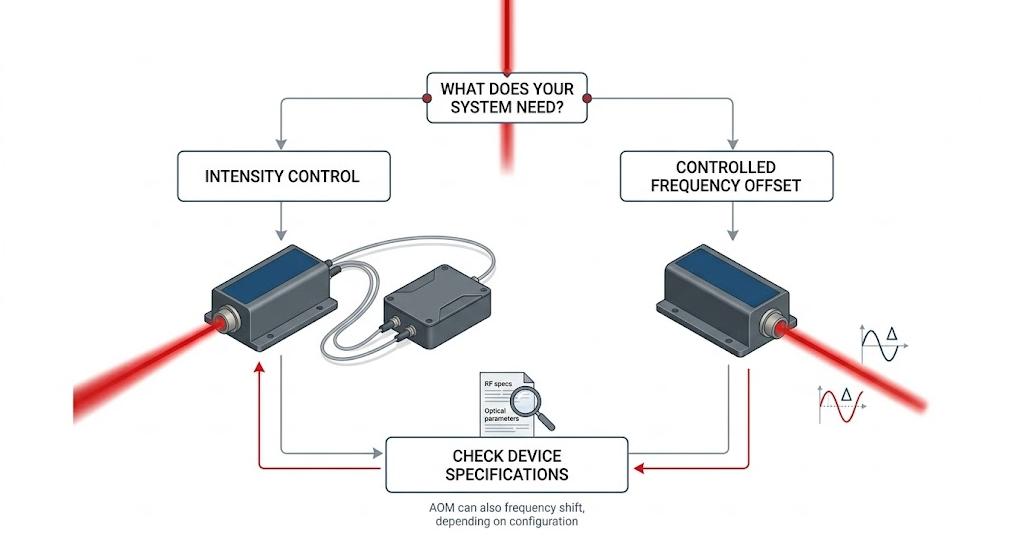
Conclusion: Choose the Device Around Your Laser System
AOFS and AOM devices share the same underlying acousto-optic principle, but their intended roles and optimized configurations can differ. An AOM is often a practical choice for laser switching and intensity modulation, while an AOFS is worth evaluating when controlled frequency shifting is the central requirement.
For laser equipment manufacturers and system integrators, start the selection process with the required frequency offset, optical power, modulation behavior, and system architecture. The device and RF driver should then be matched to those requirements.
Need help selecting an acousto-optic device for your application? Contact us with your operating wavelength, required frequency shift, optical power, and modulation requirements. Our team can help you evaluate suitable acousto-optic components and RF driver configurations for your laser system.