
AOM Rise Time vs Beam Diameter: Why Smaller Beams Switch Faster
If you need to speed up the switching speed of the acousto-optic modulator (AOM), changing the radio frequency or the driver is not always the preferred solution. The beam diameter inside the AOM is also crucial.
For a given AOM, a smaller beam typically results in a shorter rise time because the sound waves travel a shorter distance within the illuminated area. However, just how much speed can be improved by reducing the beam diameter? And what is the minimum size of the beam that can be considered too small?
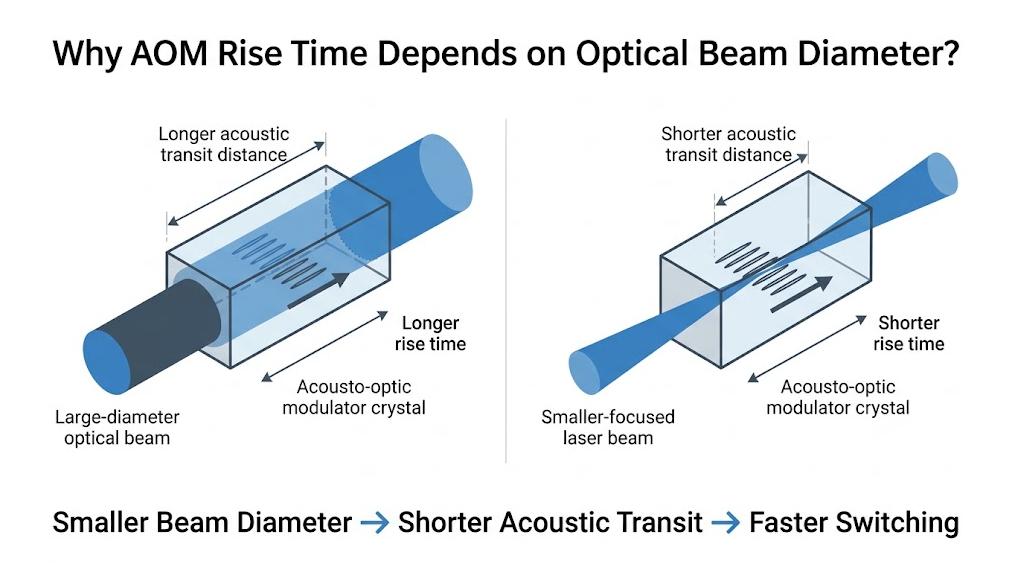
Why Does Beam Diameter Set the AOM Rise Time?
When sound waves propagate in a crystal, they form periodic refractive index modulation and produce diffraction.
Only when the sound waves completely cover the effective area of the light beam can the light beam reach a fully diffraction state.
Therefore, the diameter of the light beam is directly related to the propagation distance of the sound waves:
rise time ≈ light beam diameter / sound speed
For the same AOM and acoustic mode, the sound speed is basically fixed, so the light beam diameter becomes the main variable.
The larger the light beam, the longer the distance that the sound waves need to propagate, and the longer the rise time. The smaller the light beam, the shorter the interaction distance, and the faster the light output response.
This is why the data sheet of the AOM usually indicates both the rise time and the corresponding light beam diameter. The rise time is not an inherent parameter of the device; it also depends on the focusing mode of the light beam in the crystal.
How Much Faster Can a Smaller Beam Make Your AOM?
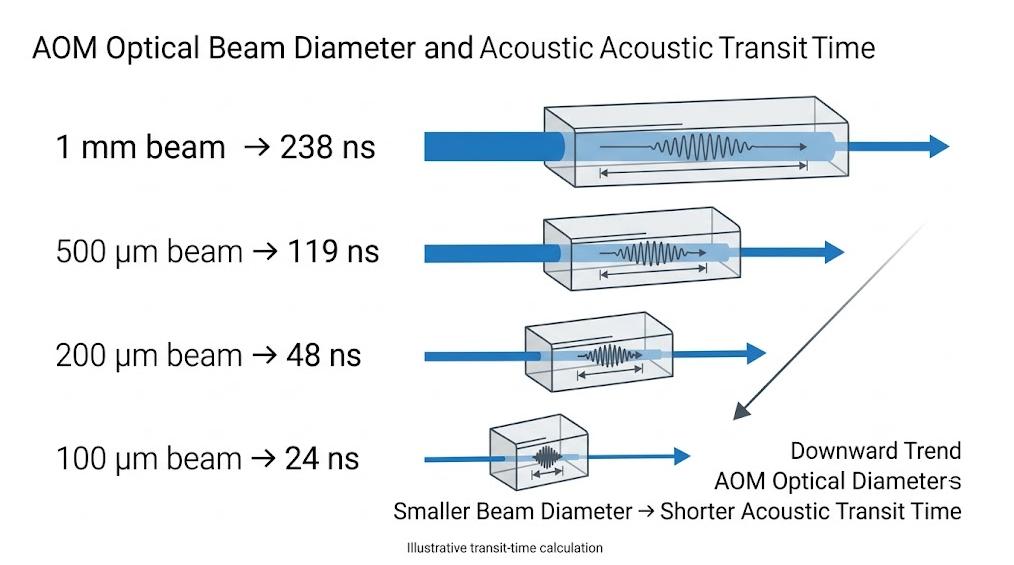
A simple example can make this relationship more intuitive.
Suppose the speed of sound in AOM is approximately 4.2 mm/μs. Ignoring other response limitations, the propagation time of the sound wave is approximately:
- 1 mm beam: 238 ns
- 0.5 mm beam: 119 ns
- 0.2 mm beam: 48 ns
- 0.1 mm beam: 24 ns
The key point is not the specific values, but the proportional relationship between them.
If the beam diameter is halved, the propagation distance of the sound wave is also halved. Under the same other conditions, the propagation time can also be approximately halved.
However, these values should not be regarded as the actual measured rise time of the AOM. The actual AOM uses a Gaussian beam instead of a uniform beam profile. Factors such as RF driver, transducer response, acoustic mode, and system alignment also affect the final result.
Nevertheless, this relationship can still serve as a useful engineering reference:
Smaller beam diameter → Shorter sound wave propagation time → Possibly faster AOM switching speed.
So Why Not Simply Focus the Beam as Small as Possible?
If the smaller beam can achieve a faster switching speed, it seems that by focusing the beam as closely as possible, the speed can be increased. However, in reality, this is usually not the best approach.
- Firstly, there is power density. With the laser power remaining constant, reducing the beam diameter will concentrate the power in a smaller area. For high-power lasers, this will increase the thermal load and the risk of optical damage.
- Secondly, there are diffraction efficiency and interaction geometry. Excessive focusing may not provide the ideal interaction conditions within the AOM aperture. Faster switching speed does not necessarily mean better overall performance.
- Thirdly, there is alignment sensitivity. The smaller beam waist requires more precise focusing and alignment. Even minor changes in the optical path can have a greater impact on coupling efficiency and performance.
Therefore, the goal is not to make the beam as small as possible, but to select the smallest beam diameter that meets the required rise time while maintaining acceptable power density, efficiency, and alignment requirements.
What Actually Determines the Fastest Rise Time You Can Get?
The beam diameter is important, but it is not the only factor limiting the switching speed of the AOM.
Acoustic velocity determines the propagation speed of sound waves in the crystal. For the same beam diameter, a higher speed of sound means a shorter propagation time.
The response of the RF driver and transducer response is also crucial. The switching speed of the AOM cannot be faster than the speed of the sound signal required for the RF system to establish. If the rise time of the RF power is too long, simply reducing the beam diameter may not bring a significant improvement.
The beam profile also affects the result. A real Gaussian beam does not have a clear edge, so the relationship between the nominal beam diameter and the actual measured rise time is more complex than a simple geometric calculation.
This also provides a practical troubleshooting rule:
If the calculated sound propagation time is significantly shorter than the measured rise time, then the beam diameter may no longer be the main bottleneck.
At this point, instead of continuing to reduce the beam diameter, it is better to check the RF driver, transducer response, acoustic configuration, and optical alignment.
Therefore, for ultra-high-speed applications, shortening the AOM rise time requires system-level optimization rather than simply pursuing a smaller beam diameter.
What Beam Diameter Should You Use?
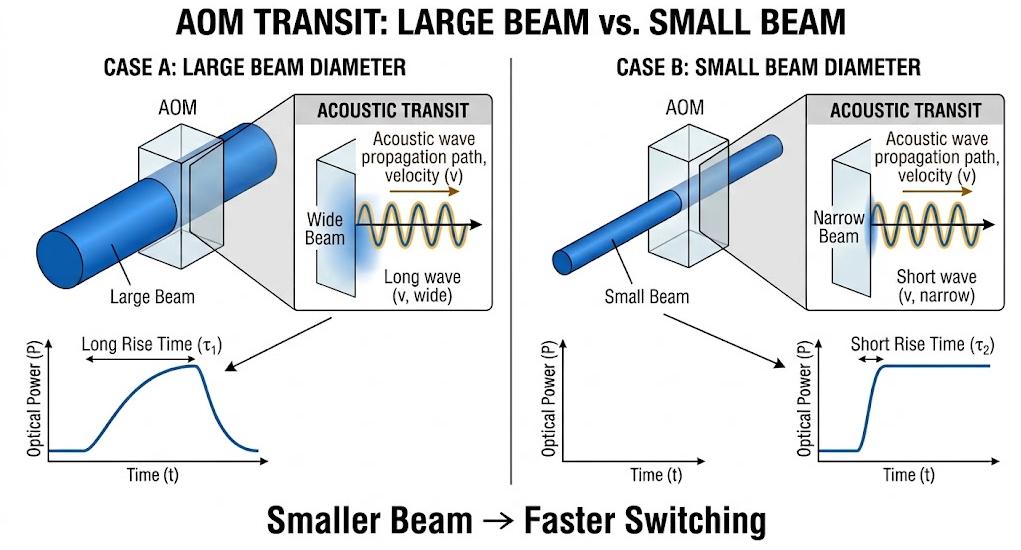
For acoustic-optic modulators (AOMs), there is no universal “optimal” beam diameter. If rapid switching is the primary consideration, a smaller beam can shorten the acoustic wave propagation time and rise time. However, the beam must also be large enough to ensure that the optical power density, diffraction efficiency, and alignment sensitivity remain within acceptable ranges.
A simple practical principle is as follows:
First, determine the required rise time, and then select the smallest beam that can reliably achieve that rise time.
To conclude, smaller beams usually enable AOM to switch faster because the sound wave travels a shorter distance. However, the rise time also depends on the sound speed, RF response, beam profile and system design.
The goal is not to have the smallest possible beam, but to find the optimal beam that meets the required speed, power and stability.