Comparing TeO₂ and Quartz in Acousto-Optic Q-Switch Design
Material selection is one of the most decisive factors in acousto-optic Q-switch design. Whether it will be used for building a compact scientific laser or a high-power industrial system, the performance of your Q-switch depends significantly on the crystal at its heart. Among all acousto-optic materials, TeO₂ (Tellurium Dioxide) and Quartz remain the most widely used due to their stability, maturity, and suitability across various laser wavelengths.
In this blog, SMART SCI&TECH provides a clear, engineering-focused comparison that enables you to choose the right material for your application.
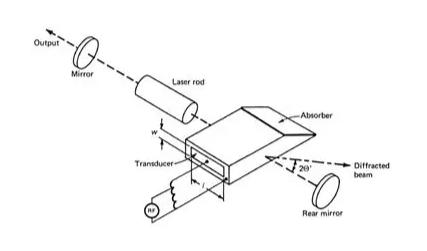
The type of materials used in the construction of a device’s acousto-optic Q-switch directly determines how effectively a device can convert radio frequency (RF) power into a steady optical pulse. The final output of the lasers of units of this type can vary in a number of ways due to the lasers’ varying acoustic velocity, optical transparency, thermal characteristics, and the strength of their interaction with acoustic waves. The use of more appropriate materials can contribute to the more uniform formation of a pulse and can contribute to a pulse with more predictable rise times. Uniformity can also be achieved in the pulse’s energy.
The incorrect selection of materials can put the laser at the mechanical limit of its capability. This incorrect selection can also be the cause of aberrations, unpredictable changes in pulse durations, and instabilities in the quality of the laser output. The mechanical limit of the laser works at a significantly higher RF power, which in turn increases the thermal load of the device. The appropriate selection of materials also increases the Q-switches’ efficiency, stability, and duration of operation.
Choose TeO₂for Acousto-Optic Q-Switch Applications
TeO₂is selected most frequently for acousto-optic Q-switches due to strong acousto-optic interaction with relatively low RF power compared to other materials. In addition, because of low acoustic velocity, there is an increased interaction time among the acoustic and optical waves, resulting in the generation of clean, high-quality pulses with high contrast and short rise times. If high efficiency and pulse quality are critical in a laser system, then TeO₂is the better technology.
Benefits of TeO₂ for Engineers:
- Acousto-optic figure of merit for efficient diffraction is high
- Acoustic velocity is low to allow faster rise times
- Transparency in the optical is high in the visible and NIR
- RF drive power is low in contrast to numerous other materials
- Strong interaction allows for smaller device sizes
Due to these benefits, TeO₂ is particularly great for mid-power DPSS lasers and also for systems where optical efficiency and pulse shape are critical, rather than just the power handling. For laser designers, TeO₂ allows more stable and defined pulses and offers more control over cavity dynamics, as it offers high performance in a reliable, predictable manner.
Choose Quartz for Acousto-Optic Q-Switch Applications
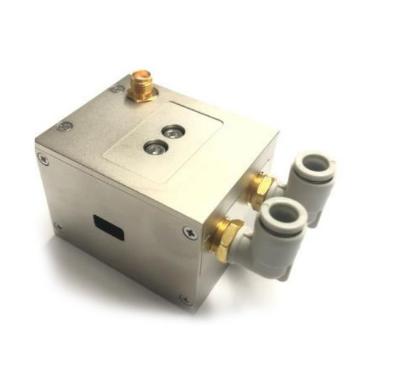
The qualities of quartz make it a great option in an acousto-optic Q-switch if long-term reliability, high-power handling, and thermal stability are the priorities. Its strong mechanical properties and high acoustic velocity let it sustain higher RF power and continuous operation without losing significant performance over time. Due to these qualities, quartz is the best fit in industrial and high-duty-cycle laser systems, on which the system’s reliability is critical.
The most notable characteristics of quartz are:
- High thermal stability, which improves mechanical & thermal performance.
- Usage of strong mechanical material, which promotes long-term durability.
- High durability of the materials used promotes long-term durability.
- Moderate level of diffusing light, which is acceptable in industrial & other general applications.
- More economical and can be produced in large quantities without a high upfront cost.
For high-power applications such as welding, industrial cutting, Nd: YAG fiber lasers, and lasers, quartz is the optimal choice. For designers of high-duty systems, quartz provides the durability and reliability, improving performance without large amounts of mechanical and thermal stress on the acousto-optic Q-switch.
Comparison of TeO₂ vs. Quartz in Acousto-Optic Q-Switch Design
Choosing between TeO₂ and Quartz for an Acousto-Optic Q-switch is all about figuring out the compromises between the two. TeO₂ has the most diffraction efficiency and the fastest response times while Quartz holds the best thermal stability and the capability to handle high powers. The table below shows the most important attributes of both, which helps the laser engineer and OEM designers determine which material fits best for their system’s needs.
| Performance Factor | TeO₂ | Quartz |
| Acoustic Velocity | Low → shorter rise time, better pulse shaping | High → supports high power and high repetition rates |
| Diffraction Efficiency | High | Medium |
| RF Power Requirement | Low | Higher |
| Thermal Stability | Moderate | Excellent |
| Mechanical Strength | Moderate | High |
| Optical Transparency | Excellent in visible & NIR | Good, slightly lower efficiency |
| Cost | Higher | More economical |
| Ideal Applications | Mid-power, research, precision lasers | High-power industrial lasers, OEM systems |
For conversing purposes, TeO2 is the go to for applications where being able to generate quick and efficient pulses is being sought after. Other than that, Quartz is best for high duty cycles, high powers, and high thermal challenge situations. Knowing which is which makes for an Acousto-Optic Q-Switch that works well while still keeping the pulse in the range you want while still providing for your system in the long run.
Summary: Which Material Wins?
No one answer is true for everyone with regard to what the most effective acousto-optic Q-switch material is.
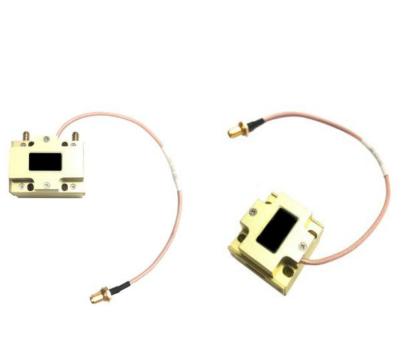
TeO₂ is the one that works best for research, mid-power, and precision lasers because it’s the best in terms of diffraction efficacy, and fast rise with, and is also able to accurately shape the pulses involved.
If you want to learn more about our acousto-optic Q-switch, please check our product page. If you want to learn more, please reach out to us at any time!