
How AOMs Control Laser Frequency in Cold Atom Experiments
In cold atom experiments, precise control of laser frequency is crucial for laser cooling, trapping, energy level preparation, and Raman transitions. Acousto-optic modulators (AOMs) can rapidly adjust the laser frequency and simultaneously control the optical power.
So, how does an AOM achieve laser frequency modulation? When researchers select an AOM for a cold atom device, what factors should they consider?
How Does an AOM Shift Laser Frequency?
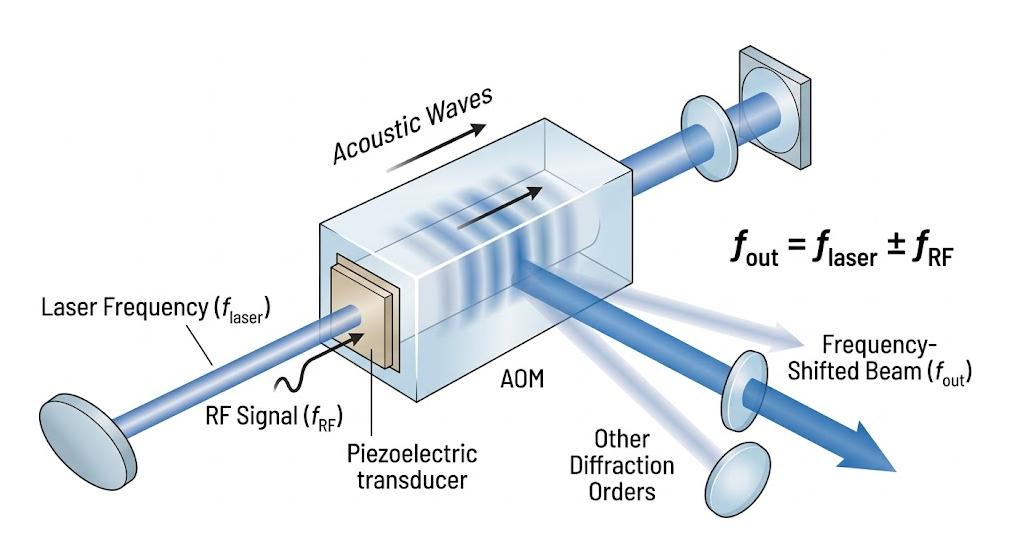
The acoustic-optic modulator (AOM) generates acoustic waves in the acoustic-optic crystal through a radio frequency (RF) signal, forming a moving diffraction grating and interacting with the incident laser beam.
The frequency of the diffraction beam is determined by the RF driving frequency. For the first-order diffraction beam:
f_out = f_laser ± f_RF
For instance, when the driving frequency of the AOM is 80 MHz, the first-order diffraction beam can deviate from the original laser frequency by approximately 80 MHz.
Adjusting the radio frequency can change the laser frequency, thereby controlling the detuning with atomic transitions, and is suitable for experiments that require rapid and precise tuning.
AOM can also adjust the optical power. Changing the radio frequency power will affect the diffraction efficiency, thereby controlling the intensity of the diffraction beam.
Why Are AOMs Used in Cold Atom Experiments?
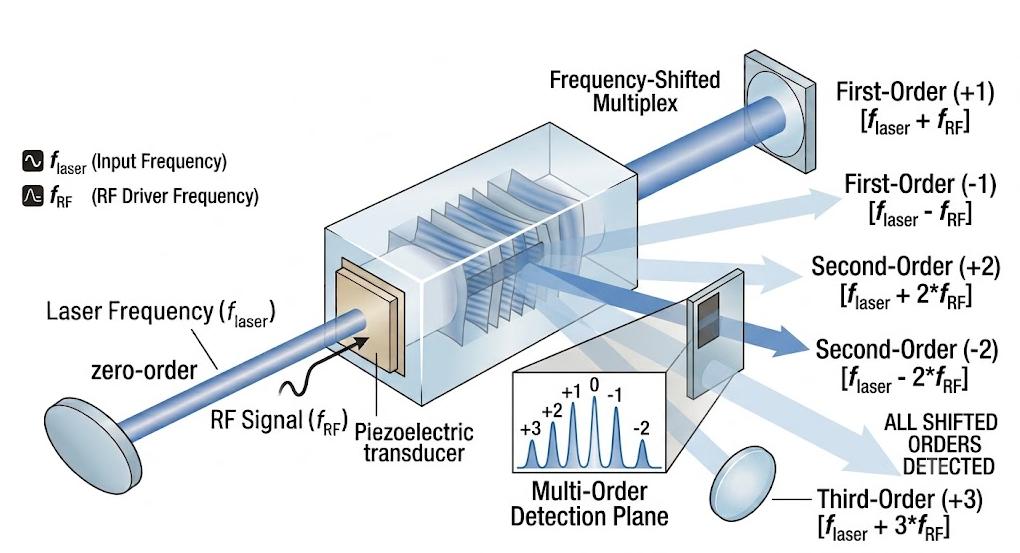
Different stages of cold atom experiments usually require different laser frequencies and optical powers. The acousto-optic modulator (AOM) can simultaneously achieve frequency offset and rapid optical switching in a compact optical setup.
| Application | AOM Function |
| MOT / Laser Cooling | Frequency detuning and power control |
| Repump | Fast beam switching and frequency shifting |
| Raman Transitions | Frequency shifting and frequency-difference control |
| State Preparation | Precise optical switching |
| Detection | Fast control of probe or detection beams |
In a magnetic optical trap (MOT), the cooling laser typically needs to be at a specific detuning from the atomic transition. The AOM can adjust the laser frequency to the required operating point and rapidly adjust the optical power during the experiment.
In Raman spectroscopy experiments, the AOM can also be used to generate and control the frequency difference between two laser beams.
Single-Pass or Double-Pass AOM?
The choice between single-pass and double-pass AOM mainly depends on the frequency tuning range and the stability of the beam pointing.
Single-pass AOM
In the single-pass configuration, the beam passes through the AOM once, and the frequency shift is approximately:
Δf = ±f_RF
The optical path is simple, and it is suitable for conventional frequency shifts and optical power control.
Double-pass AOM
In the double-pass configuration, the beam passes through the AOM twice, and the frequency shift is approximately:
Δf = ±2f_RF
Its main advantage is that when adjusting the RF frequency, the beam pointing changes less, which is conducive to maintaining a stable beam alignment. This is particularly important for cold atom experiments.
If the experiment requires a larger frequency tuning range while maintaining a stable beam pointing, double-pass AOM is usually a more suitable choice.
What AOM Parameters Matter?
When choosing an acousto-optic modulator (AOM) for cold atom experiments, the following parameters should be given priority consideration:
- RF frequency: This determines the frequency shift of the laser and should match the required frequency offset for the experiment.
- Frequency shift bandwidth: The larger the bandwidth, the more flexible it is to adjust the laser detuning or control the frequency difference between the two laser beams.
- Rise/fall time: This determines the switching speed of the AOM and enables rapid control of cooling, state preparation, and detection sequences.
- Blindness ratio: A higher blindness ratio can reduce the residual light when the AOM is off, improving the control accuracy of the experimental sequence.
- Insertion loss: A lower insertion loss can retain more laser power and is suitable for high-power applications.
- Optical power: The AOM should meet the power requirements of the laser and maintain stable diffraction performance.
For most cold atom experiments, fast switching, sufficient frequency shift bandwidth, low insertion loss, and high blindness ratio are the key considerations.
Why Choose a Fiber-Coupled AOM?
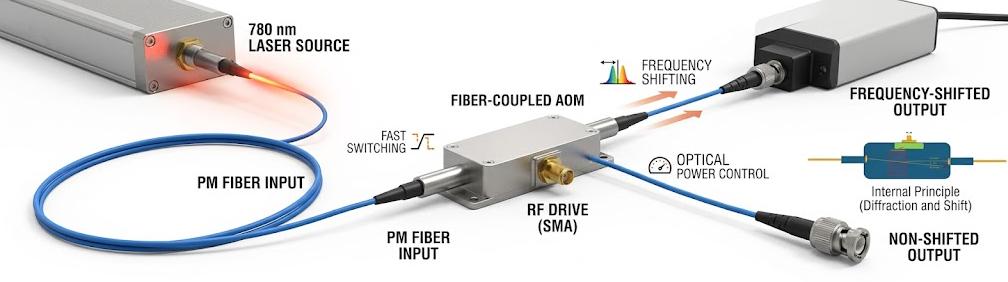
The fiber-coupled acousto-optic modulator(AOM) integrates frequency shift and optical modulation functions and transmits laser through optical fibers. Compared with free-space configurations, they can reduce the alignment requirements of the optical path and make the laser system more compact and easier to integrate.
This type of AOM is suitable for modular quantum optics and cold atom systems, and is particularly suitable for routing multiple laser sources to different experimental components.
For the 780 nm laser system commonly used in rubidium atom experiments, the fiber-coupled AOM can achieve frequency shift, rapid switching, and optical power control.
The 780 nm fiber AOM series from SMART SCI&TECH offers RF frequency options ranging from 80 MHz to 400 MHz, and features fast switching, wide frequency shift bandwidth, and high extinction ratio, making it suitable for high-demand optical applications.
How to Choose an AOM for Your Experiment?
Before choosing an acoustic-optic modulator (AOM), the following aspects can be evaluated:
- Laser wavelength: Does it match the working wavelength?
- RF frequency: How much frequency shift is required?
- Frequency shift bandwidth: What is the required tuning range?
- Light power: Can the AOM withstand the laser power?
- Switching speed: How fast is the beam switching required?
- Configuration: Choose fiber-coupled or free-space type?
- One-way or two-way: Is higher beam pointing stability required?
Matching these parameters according to experimental needs helps achieve stable frequency control and efficient optical modulation.
Selecting the appropriate AOM is an important step in building a stable and flexible cold atom and quantum optics laser system. SMART SCI&TECH offers fiber-coupled and free-space AOMs with various wavelengths, RF frequency, and light power specifications. Its 780 nm fiber AOM series is suitable for laser frequency shift, fast beam switching, and light power control.
If you need to select an AOM suitable for cold atom experiments, you can choose our corresponding solution based on the requirements of laser wavelength, RF frequency, bandwidth, and light power.