
How to Choose the Right AOM Frequency and RF Driver?
Optical and acoustic modulators (AOMs) are widely used in precise laser applications such as laser modulation, frequency offset, pulse selection, and Q-switching. When choosing an AOM, two important parameters are the operating frequency and the radio frequency (RF) driver.
The AOM frequency is not simply selected as a common value like 40 MHz or 80 MHz. The operating frequency, RF power, modulation speed, and bandwidth all need to be matched with the laser and the application requirements.
So, how to choose the appropriate AOM frequency and RF driver?
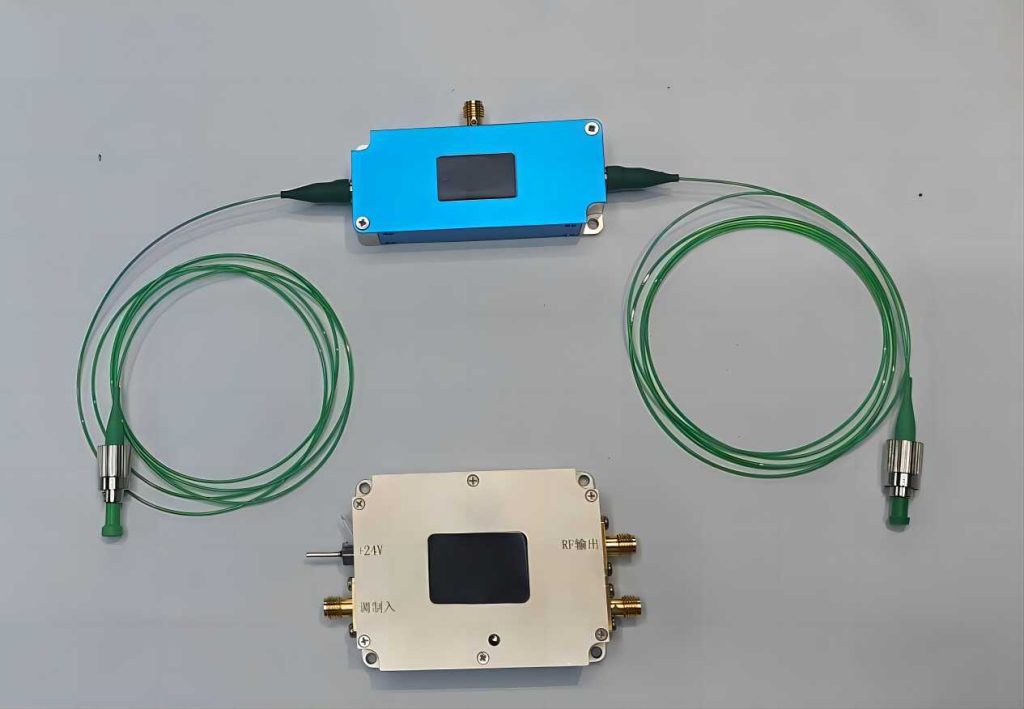
What AOM Frequency Do You Actually Need?
The operating frequency of AOM depends on the laser wavelength, application type and required optical performance, and there is no universal frequency applicable to all laser systems.
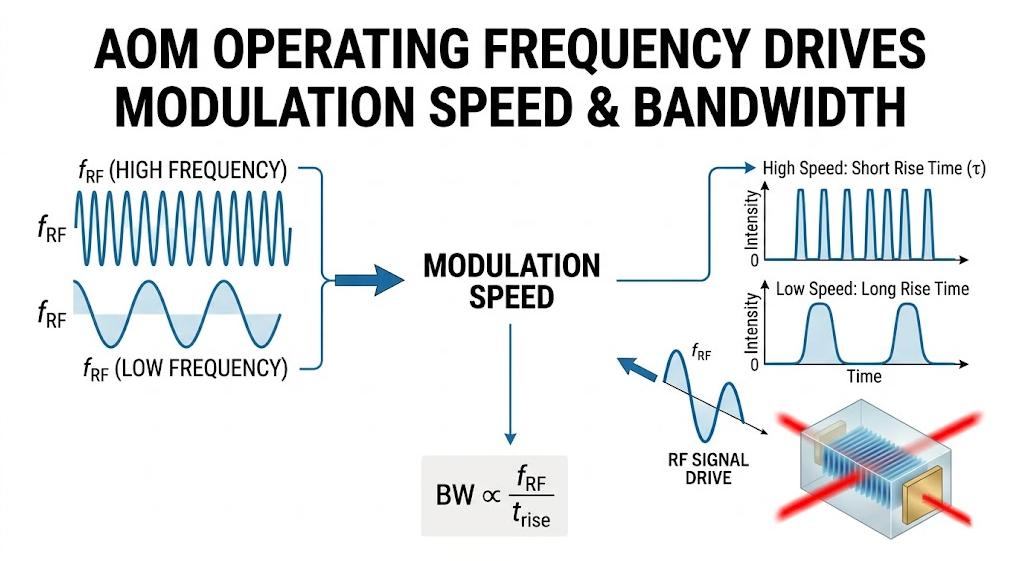
Match the Frequency to Your Laser and Application
Firstly, clarify the main functions of AOM in the laser system. Different applications have different requirements for AOM:
- Laser modulation: requires stable diffraction efficiency and fast response.
- Frequency offset: the operating frequency of AOM determines the required RF offset.
- Pulse selection: requires fast switching and precise time control.
- Q-switching: usually requires high optical power tolerance and fast response.
- Laser beam control: focuses more on stable diffraction performance and precise beam positioning.
The laser wavelength also needs to be considered. The AOM crystal and optical coating are usually designed for a specific wavelength range, so it is necessary to confirm the compatibility of AOM with the laser wavelength and optical power before proceeding.
After clarifying these requirements, determine the appropriate AOM configuration based on the recommended operating frequency provided by the manufacturer.
Consider Diffraction Efficiency and Modulation Speed
The operating frequency of AOM will affect its optical performance and dynamic response.
Operating within the designed frequency range helps to maintain efficient acoustic-optical interaction and stable diffraction efficiency. For high-speed modulation applications, the acoustic wave transit time and switching speed also need to be considered.
For example, the frequency suitable for continuous laser modulation may not be suitable for high-speed pulse selection.
Therefore, when choosing the frequency, one should take into account the diffraction efficiency, response speed and specific modulation requirements, rather than just focusing on the frequency value.
How Does AOM Frequency Affect RF Driver Selection?
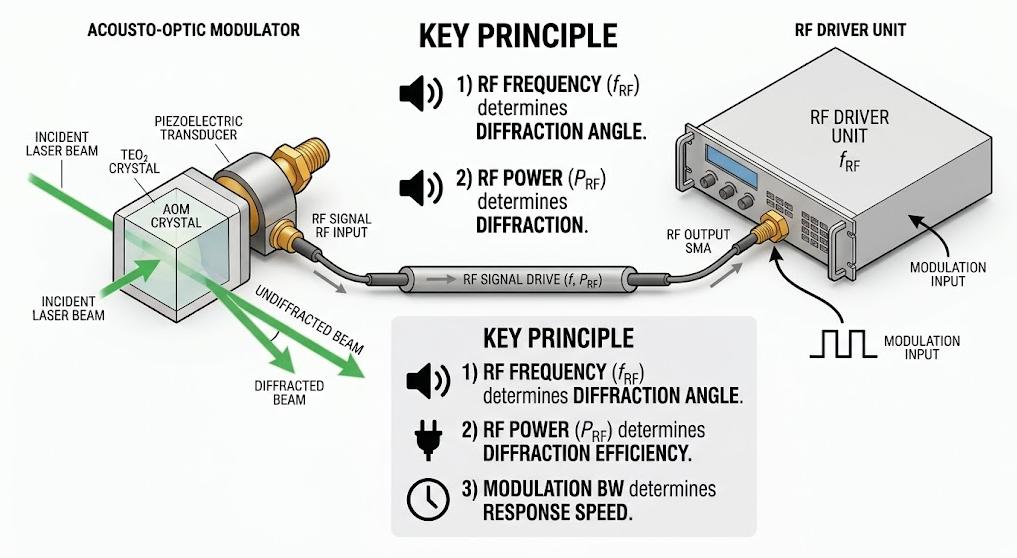
After determining the working frequency of the AOM, a matching radio frequency (RF) driver needs to be selected. The driver provides the RF signal to the AOM acoustic transducer, and its frequency and output characteristics directly affect the performance of the AOM.
RF Frequency Compatibility
First, it is necessary to confirm that the driver can stably and accurately generate the center frequency required by the AOM.
According to the application requirements, the following aspects should also be considered:
- Center frequency
- Operating frequency range
- Frequency stability
- Frequency tuning capability
For fixed-frequency applications, choosing a driver optimized for the AOM’s center frequency is usually sufficient. For frequency-adjustable applications, the driver needs to provide sufficient tuning range and bandwidth.
If the frequency of the AOM does not match that of the RF driver, it may lead to a decrease in diffraction efficiency and affect the system performance.
RF Power Requirements
RF power is another key parameter when selecting an AOM driver.
The required power depends on the design of the AOM, the crystal material, the transducer, the operating frequency, and the target diffraction efficiency. The RF driver should provide sufficient power to meet the optical performance requirements while avoiding exceeding the recommended operating range of the AOM.
Higher RF power is not necessarily better. Excessive power will increase device heating and thermal drift, but it may not necessarily lead to higher diffraction efficiency.
Therefore, the output power of the driver should match the RF power range recommended by the AOM manufacturer.
Modulation Bandwidth and Rise Time
For high-speed laser modulation, the dynamic performance of the RF driver is as important as the operating frequency. The main parameters include:
- Modulation bandwidth
- Rise time
- Fall time
- Switching speed
For pulse selection, Q-switching, and high-speed intensity modulation, frequency matching does not necessarily mean that the driver is suitable. If the modulation response is too slow, it may not be able to meet the high-speed switching requirements of the system.
Therefore, the AOM and RF driver should be comprehensively evaluated based on the required switching speed and modulation waveform.
How to Match an AOM With the Right RF Driver?
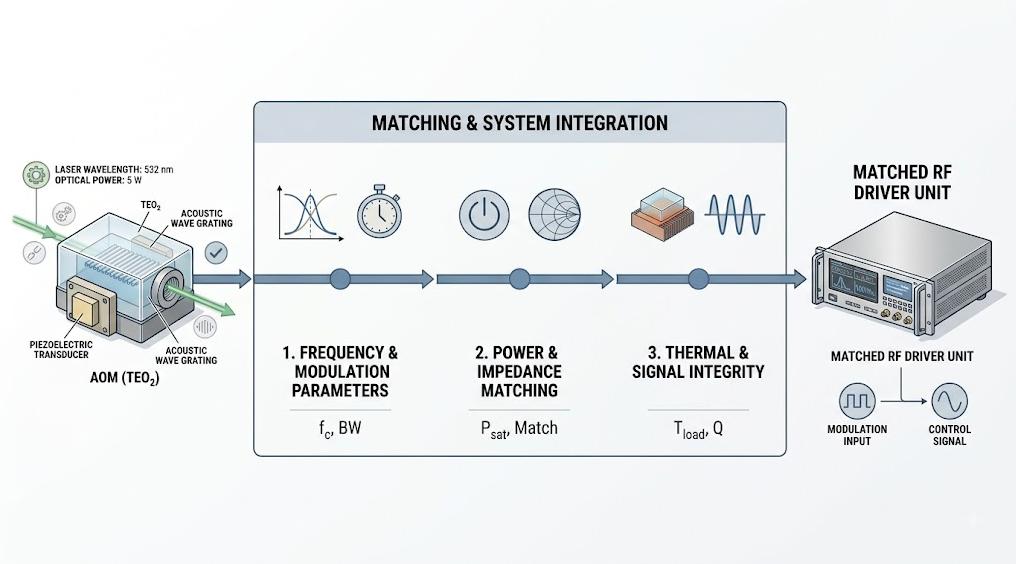
The AOM and the RF driver should be selected as a matched system. When choosing the RF driver, the following parameters should be carefully checked:
- Frequency compatibility: Confirm that the output frequency of the driver matches the center frequency or operating frequency of the AOM. When tuning is required, ensure that the tuning range of the driver covers the operating range of the AOM.
- RF power: Confirm the recommended RF input power for the AOM and ensure that the driver can provide sufficient power without exceeding the rated value of the AOM. Excessive RF power may increase heat generation, but it may not necessarily improve the diffraction efficiency.
- Bandwidth and modulation speed: For pulse selection, Q-switching, and high-speed laser modulation, the bandwidth and rise/fall times of the driver should meet the required switching speed.
- Impedance and RF interface: Confirm the impedance, connector type, and interface specifications to ensure effective RF power transmission between the AOM and the driver.
Matching these parameters helps maintain stable diffraction efficiency, reliable modulation performance, and long-term operational stability.
What Should You Check Before Ordering?
Before placing an order, confirm the following specifications with the manufacturer:
| Specification | What to Check |
| Laser Wavelength | Is the AOM optimized for your wavelength? |
| AOM Frequency | Does the frequency match your application? |
| Diffraction Efficiency | Does it meet your optical requirements? |
| Optical Power | Can the AOM handle the required power? |
| RF Frequency | Is it compatible with the AOM? |
| RF Output Power | Does the driver provide the required power? |
| Bandwidth | Is it sufficient for your modulation requirements? |
| Rise Time | Is the switching speed fast enough? |
| Impedance | Are the AOM and RF driver properly matched? |
If the application involves non-standard wavelengths, high power levels, special modulation requirements or specific RF frequencies, it is recommended to confirm the complete AOM and RF driver configuration with the manufacturer before finalizing the specifications.
Final
Selecting the appropriate AOM frequency is only the first step in building a reliable acoustic-optical system. The RF driver also needs to match the AOM in terms of frequency, RF power, bandwidth, modulation speed and impedance.
The AOM and RF driver should not be selected as separate components, but rather evaluated as a system considering the laser wavelength, optical power, diffraction requirements and modulation conditions.
For high-demand laser applications, a properly matched AOM and RF driver help maintain stable diffraction efficiency, reliable modulation performance and long-term operational stability.