
How to Match an AOM Driver With an RF Amplifier?
When choosing RF devices for an acousto-optic modulator (AOM), it is not only about matching the frequency but also about determining whether an AOM driver, an RF amplifier, or both are needed.
This depends on the specific requirements of the AOM and the output performance of the existing RF source.
A typical RF link is:
RF source/driver → RF amplifier → AOM
However, not all systems require an amplifier. The key is to ensure that the RF power and frequency required by the AOM match the output capability of the RF equipment.
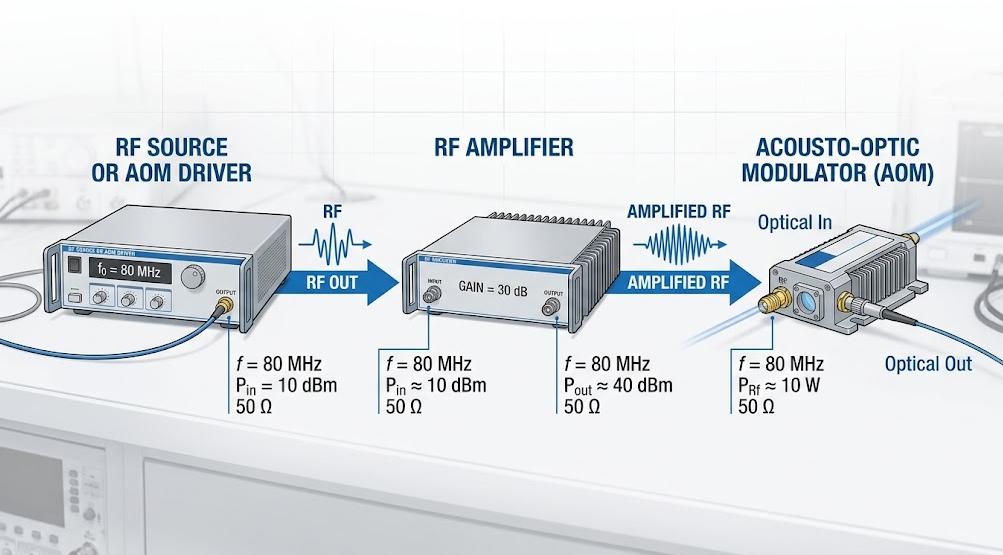
Do You Need an AOM Driver or an RF Amplifier?
When choosing RF components, start with the existing equipment.
If there is no RF signal source, an AOM RF driver is needed to generate the RF signal required by the AOM.
If there is an RF signal with matching frequency but insufficient power, an RF amplifier may be all that is needed.
For example, the AOM requires an 80 MHz, 2 W RF signal, while the existing RF signal source can provide 80 MHz, 0.5 W. In this case, the frequency is matched, but the power is insufficient. An RF amplifier can be added between the signal source and the AOM.
If the AOM driver itself can already provide an 80 MHz, 2 W RF signal, an additional amplifier is usually not necessary.
Therefore, do not assume that an amplifier is needed at the beginning. First, confirm the frequency and power requirements of the AOM, and then choose the RF component based on the output capability of the existing equipment.
Match the RF Frequency to the AOM
The acoustic-optic modulator (AOM) determines the required RF frequency.
Please refer to the data sheet of the AOM to understand its operating frequency. The RF driver or amplifier must support this frequency.
For example, if the operating frequency of the AOM is 80 MHz, an amplifier with a frequency range of 60–100 MHz might be a suitable choice.
However, even if the output power seems sufficient, an amplifier with a rated frequency range of only 100–500 MHz is not applicable.
The same principle applies to RF drivers: their output frequency must match the working frequency required by the AOM.
When choosing an RF amplifier, also check whether the specified output power and gain are available at your actual operating frequency. Just having a wide frequency range does not guarantee the required performance.
The correct RF frequency depends on the AOM, not on the amplifier you happen to have.
Match the RF Power — This Is Where Most Selection Errors Happen
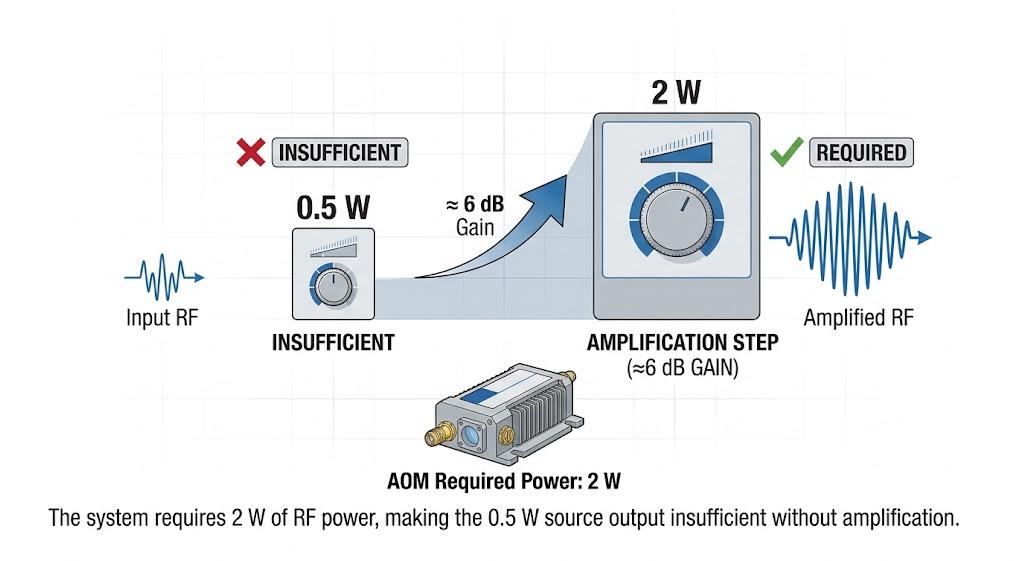
The RF power is usually an important factor when choosing an AOM. First, confirm the RF power recommended by the AOM manufacturer, and then compare it with the output power of the existing RF source or driver.
For example:
- The required RF power for the AOM: 2 W
- Output power of the RF source: 0.5 W
Due to insufficient output power, an RF amplifier needs to be added before the signal reaches the AOM.
The amplifier should meet the following conditions:
- It can receive the output power of the RF source;
- It can provide sufficient output power for the AOM;
- It can provide the required power at the desired frequency.
The required gain can be estimated by the following formula:
Gain (dB) = 10 × log₁₀(Pout / Pin)
For an input of 0.5 W and an output of 2 W:
10 × log₁₀(2 / 0.5) ≈ 6 dB
Therefore, ideally, about 6 dB of gain is sufficient to increase 0.5 W to 2 W.
When selecting the actual model, it is not recommended to have the amplifier continuously operate at its maximum output power. Reserving some power margin helps maintain system stability. Additionally, RF power is not necessarily the higher the better. Excessive power may overload the AOM and increase heat generation, without providing any additional performance improvement.
Don’t Match the Amplifier to the Driver Alone
A common misconception is to only verify the connection between the RF amplifier and the driver, while neglecting the entire RF link:
AOM requirement → RF source/driver → RF amplifier → AOM
At the AOM end, the following needs to be confirmed:
- Working frequency
- Recommended RF power
- Maximum RF power
The RF source or driver needs to be confirmed as follows:
- Output frequency
- Output power
- Required modulation function (if any)
The amplifier needs to be confirmed as follows:
- Frequency range
- Input power range
- Gain
- Maximum output power
For example, although an amplifier can output 20 W, it may not be suitable for an AOM that only requires 2 W. An excessively high gain may make it difficult for the amplifier to operate stably at the required output level.
Therefore, the goal is not to select the amplifier with the highest power, but to provide the RF power actually required by the AOM.
At the same time, the compatibility of the RF interface needs to be confirmed. Most AOM RF systems use a 50 Ω impedance, so the driver, amplifier, cable, and AOM interface should be matched. For high-frequency applications, the loss of the RF cable and the compatibility of the connector should also be considered.
A Simple Example: From AOM Specification to RF Selection

Assuming the system has the following requirements:
AOM operating frequency: 80 MHz
AOM RF power: 2 W
Existing RF source: 80 MHz, 0.5 W
The selection process is as follows.
- Step 1: Confirm the frequency. The amplifier must support 80 MHz.
- Step 2: Confirm the input power. The amplifier should be able to accept the approximately 0.5 W input power provided by the RF source.
- Step 3: Confirm the output power. The amplifier should provide at least 2 W of output power at 80 MHz and leave a reasonable power margin.
- Step 4: Confirm the gain. Ideally, increasing from 0.5 W to 2 W requires about 6 dB of gain.
- Step 5: Confirm the RF interface. Ensure compatibility of 50 Ω impedance, connectors, and cables.
In this example, using an RF amplifier is reasonable because the existing RF source frequency matches, but the output power is insufficient to drive the AOM.
If the existing AOM driver can already provide the required 2 W of power at 80 MHz, then typically no additional RF amplifier is needed.
Final
When matching the AOM driver with the RF amplifier, one should start from the requirements of the AOM rather than directly choosing the amplifier.
Determine the operating frequency and RF power required by the AOM, and then check the output frequency and power of the existing RF source or driver. If the frequency matches but the power is insufficient, select an appropriate amplifier based on the frequency range, input power, gain, and output power.
In summary:
AOM requirements → Check the driver/radio frequency source → Calculate the power gap → Select the amplifier → Verify the complete RF link
This method can avoid insufficient RF power and also avoid choosing an amplifier with excessive power.