
Sub-Shot-Noise Rydberg Atom Electromagnetically Induced Transparency Spectroscopy for Quantum-Enhanced Sensing
Research Background
One of the core objectives of quantum precision measurement is to surpass the Standard Quantum Limit (SQL) set by the Heisenberg Uncertainty Principle. In recent years, with the rapid development of quantum state preparation and manipulation technologies, the application of non-classical light fields and atomic entangled states has demonstrated immense potential in precision measurement and sensing technologies, such as high-sensitivity magnetic field measurement, gravitational wave detection, and plasma sensing.
The sensitivity metrics of microwave superheterodyne detection technology based on dressed Rydberg atoms are currently approaching the atomic SQL; thus, reducing laser shot noise has become a critical means of further enhancing microwave detection performance. Replacing coherent light fields with squeezed light fields can directly reduce optical readout noise, making it the most effective method for atomic sensing technology to exceed the shot-noise limit. However, effects such as absorption and scattering by the atomic medium prevent the squeezed light field from maintaining its quantum squeezing advantage, which severely limits the application of quantum-enhanced schemes in atomic-based quantum precision measurement and sensing technologies.
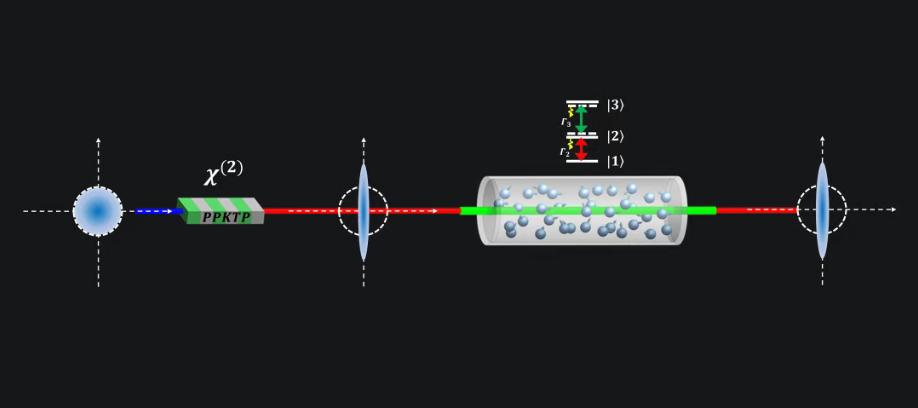
Introduction
Optical readout noise has long limited the further improvement of atomic quantum sensor sensitivity, becoming a bottleneck for performance breakthroughs. Utilizing squeezed light for quantum precision measurement and sensing beyond the photon shot-noise limit faces the challenge of squeezed state degradation caused by atomic medium absorption and scattering.
This work introduces a squeezed light field into Rydberg atom Electromagnetically Induced Transparency (EIT) spectroscopy for the first time. By replacing coherent probe light with squeezed light and maintaining sub-shot-noise characteristics in the optical readout, this study verifies the feasibility and superiority of Rydberg atoms as a low-noise quantum light-matter interface. This research provides key technical support for constructing quantum-enhanced atomic sensors. It opens a new experimental path for the development of high-sensitivity microwave electric field measurement and related quantum information technologies, possessing significant fundamental research value and application prospects.
Characteristics
The innovation of this study is reflected in the organic integration of quantum optics and atomic physics:
- First, by introducing a squeezed light field into the Rydberg EIT system, high-fidelity transmission of quantum noise squeezing within the atomic medium was achieved.
- Second, through a Doppler-matched velocity selection mechanism and two-photon resonant coupling, specific atomic velocity groups were effectively excited. By suppressing the absorption loss of squeezed light, high-fidelity transmission of the squeezed state was ensured.
- Third, this paper performs quantitative analysis of experimental data using a noise spectrum model based on Heisenberg–Langevin equations, identifying the dominant factors in squeezing degradation.
In summary, this work not only achieves the maintenance of squeezing for squeezed light in a Rydberg atom system for the first time but also provides a crucial technical path for quantum-enhanced microwave sensing.
Main Research Content
This work experimentally validates the coherent propagation of a squeezed light field in a velocity-selected Rydberg EIT system for the first time and maintains quantum noise-squeezing characteristics beyond the shot-noise limit in the transmitted field. In the experiment, a squeezed light field resonant with the atomic transition was prepared using a parametric down-conversion process, and selective excitation of specific atomic velocity groups was achieved by precisely tuning the Doppler-matched detuning of the coupling light. This velocity selection mechanism effectively suppressed the absorption and scattering losses of the squeezed light field by the atomic medium, thereby significantly enhancing the maintenance of squeezing and allowing the quantum noise squeezing characteristics to be preserved in the transmitted probe light.
Regarding theoretical analysis, two complementary methods were combined for systematic characterization and cross-validation: on one hand, the output noise spectrum including atomic noise contributions was derived based on Heisenberg–Langevin equations, revealing the effects of absorption, decoherence, and spontaneous emission noise in the atomic medium on squeezing maintenance. On the other hand, a two-mode squeezing model was introduced to provide an equivalent description of the transfer and evolution mechanisms of quantum noise during the light-atom coupling process. Through comparative analysis of experiments and theory, the dominant physical mechanisms affecting the propagation and maintenance of the squeezed light field in the Rydberg EIT medium were identified.
Technical Breakthroughs and Innovations
Focusing on the critical challenge of maintaining quantum noise during the propagation of squeezed light fields through atomic media, this work has achieved significant technical breakthroughs on both experimental and theoretical levels. Squeezed light fields are highly susceptible to effects such as absorption, scattering, and decoherence within the atomic absorption transition band, leading to rapid degradation of their quantum noise squeezing characteristics upon passing through the medium; this has severely restricted the practical application of squeezed light in atomic quantum sensing systems. Addressing this core bottleneck, this research experimentally demonstrates, for the first time, the coherent propagation of a squeezed light field within a velocity-selected Rydberg electromagnetically induced transparency (EIT) system, maintaining stable sub-shot-noise characteristics in the optical readout and providing crucial experimental validation for quantum-enhanced atomic sensing.
Regarding technical implementation, this work innovatively achieves precise matching between a squeezed light field generated via parametric down-conversion and a Rydberg EIT atomic system by introducing a Doppler-matched coupling light detuning strategy, which enables the selective excitation of specific atomic velocity groups (as shown in Fig. 1). This velocity selection mechanism effectively suppresses the absorption and scattering losses of the probe light by the atomic medium, significantly reducing atom-induced noise while maintaining EIT coherence. Consequently, it creates the necessary conditions for the low-loss propagation of squeezed light fields in atomic media, offering a feasible path for the high-fidelity coupling of non-classical light fields with atomic systems.
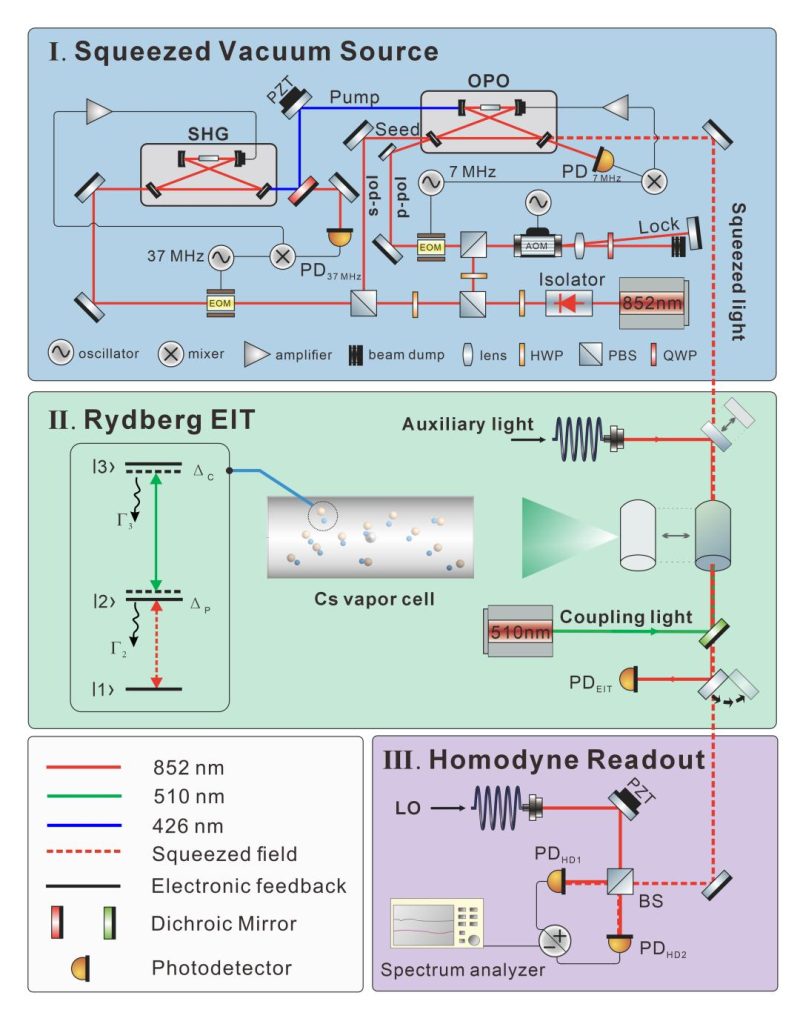
Fig. 1: Experimental setup for Rydberg electromagnetically induced transparency in a quantum system.
I. Squeezed vacuum source, generating a squeezed vacuum light field near-resonant with the Cesium D2 line.
II. Rydberg atom EIT spectroscopy apparatus. III. Balanced homodyne readout system employing two photodiodes (PDHD1 and PDHD2) to measure the noise level in the probe field.
At the theoretical modeling level, this study employs an analytical framework combining Heisenberg-Langevin equations with a two-mode squeezing model to systematically characterize the noise evolution mechanism of the squeezed light field within the Rydberg EIT medium. Through the derivation of the output noise spectrum and cross-validation with experimental results (as shown in Fig. 2), the relative contributions of factors such as absorption loss, atomic decoherence, and spontaneous emission noise to the squeezing degradation process are clearly distinguished, and the dominant physical mechanisms determining squeezing maintenance are identified. This multi-model cross-validation approach effectively enhances the credibility and universality of the experimental conclusions.
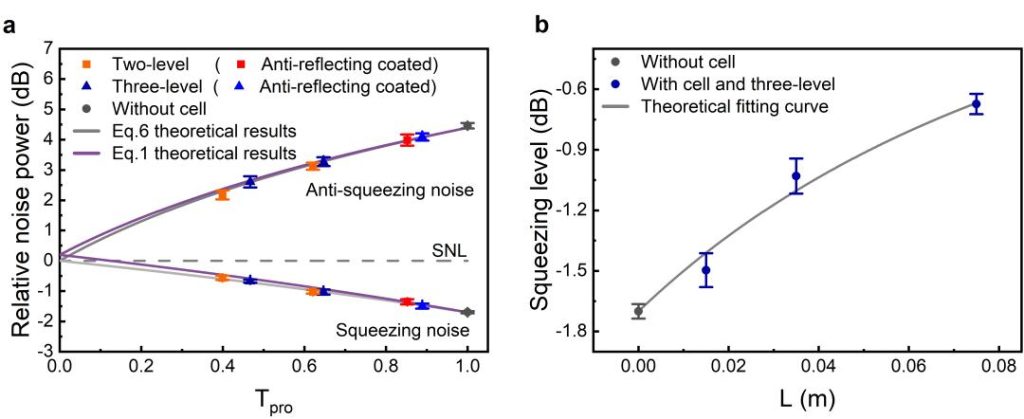
Fig. 2:
(a) Relative noise levels under different Tpro. Orange and red squares represent measurement results for the two-level system, while blue and light blue triangles indicate three-level system results; red squares and light blue triangles correspond to the vapor cell arm with anti-reflective coating. Dark grey dots denote measurements taken with the Cesium vapor cell removed. Grey and purple curves represent theoretical simulation results.
(b) Squeezing levels at different cell lengths. Dark grey dots represent data without the cell, and blue dots represent measurements in the three-level system with the cell. The dark grey line is the fitting curve, with each data point representing the average of three experimental runs.
Conclusion and Outlook
This paper utilizes the Rydberg EIT effect for the first time, using a prepared Cesium D2-line squeezed vacuum state as the probe light. Combined with a Doppler-matched velocity selection mechanism and two-photon resonant excitation of the coherent coupling light, the atoms were constructed as a medium with tunable loss. Under the condition of 88.9% atomic medium transmittance, a 90.4% noise squeezing maintenance efficiency was achieved during the propagation of the squeezed light field.
By fitting experimental data with the noise spectrum formula derived from Heisenberg–Langevin equations, quantitative analysis shows that atomic absorption loss contributes 15.7% to squeezing degradation, while extra atomic noise contributes only 2.4%. This study not only demonstrates high-fidelity transmission of a squeezed light field in a Rydberg atomic medium but also provides an important reference for precision measurement technologies such as quantum-enhanced atomic sensing and high-sensitivity microwave measurement. Looking forward, displacing the squeezed vacuum state into a bright squeezed state could directly enable quantum-enhanced Rydberg atom microwave electric field measurements, opening new technical paths for related quantum precision measurement applications.
The material in this article originates from the team of Prof. Linjie Zhang at Shanxi University, China. The primary authors include: Hongmei Yan (Ph.D.), Mingyong Jing (Master’s Supervisor), and Linjie Zhang (Ph.D. Supervisor, National High-level Talent, and Chief Scientist of the National Key R&D Program of China).