
Laser Linewidth vs Phase Noise: What Really Matters for FMCW LiDAR?
When comparing the lasers used in frequency-modulated continuous-wave (FMCW) lidar, linewidth is usually one of the first indicators that engineers pay attention to. Suppliers may provide parameters such as 1 kHz, 10 kHz, or 100 kHz for linewidth, so many people think that the smaller the linewidth, the better.
However, linewidth alone does not fully reflect the noise characteristics of the laser.
For two lasers with similar linewidths, there may be significant differences in phase noise and frequency noise, and these differences will directly affect the performance of the coherent ranging system. Therefore, when choosing a laser for FMCW lidar, both linewidth and phase noise should be considered simultaneously.
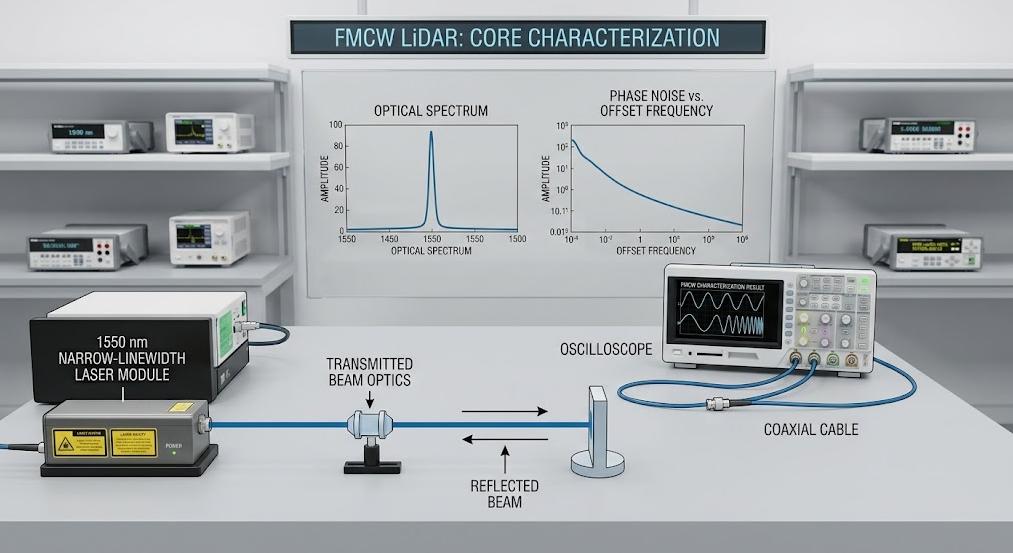
A Narrow Linewidth Is Important—but It Is Only Part of the Picture
The linewidth describes the width of the optical spectrum and is usually expressed in hertz (Hz), kilohertz (kHz), or megahertz (MHz). A narrower linewidth typically indicates a longer coherence time, which is beneficial for FMCW laser radar to maintain a stable phase relationship over long optical paths.
Therefore, narrow-linewidth lasers are widely used in high-performance coherent sensing.
However, linewidth is usually represented by a single value and cannot reflect the distribution of frequency or phase noise at different offset frequencies.
This difference is particularly important for FMCW laser radar.
What Does Phase Noise Tell You That Linewidth Does Not?
Phase noise describes the fluctuations of the laser’s phase relative to the ideal state and is a function of the offset frequency. Phase noise or frequency noise spectrum does not simplify the laser’s stability to a single value; instead, it shows the noise distribution and its variation with the offset frequency.
This can reveal noise characteristics that cannot be captured by just the linewidth.
For example, if the linewidths of two lasers are both 1 kHz, but one of them has a higher noise level within the offset frequency range relevant to FMCW detection and signal processing, there may be significant differences in the system-level performance of the two lasers.
In summary:
The linewidth provides a single indicator, while phase noise analysis reflects the distribution of noise at different offset frequencies.
The two are related but cannot replace each other.
Why This Difference Matters in FMCW LiDAR
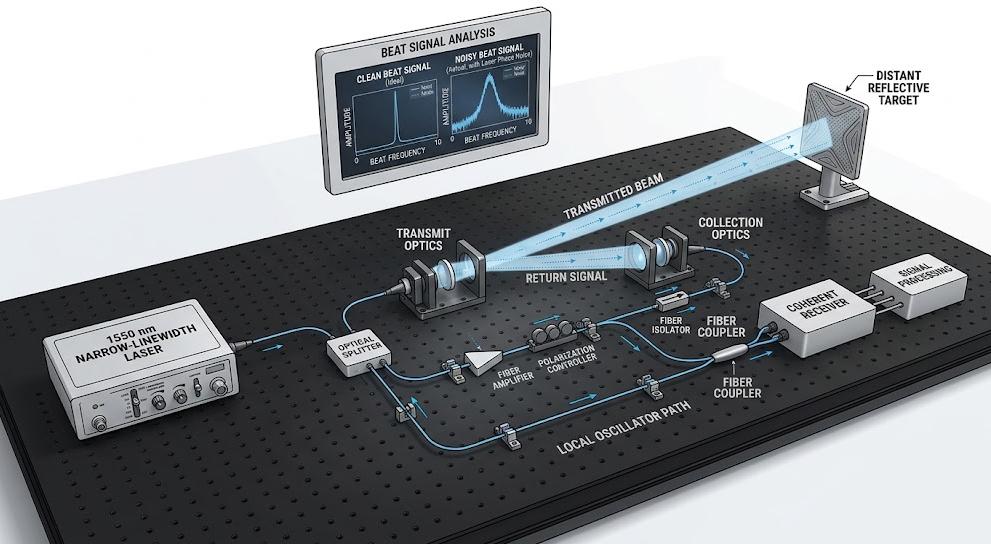
The FMCW laser radar determines the distance by using the beat frequency signal generated by the mixture of the transmitted light and the reflected light.
Ideally, the beat frequency signal has a clear frequency and can be precisely measured. However, in actual systems, the phase and frequency fluctuations of the laser will introduce additional noise, resulting in a broadened beat frequency spectrum or increased noise, thereby increasing the difficulty of frequency estimation.
For coherent laser radars, the impact chain can be summarized as follows:
Laser noise → Phase/frequency fluctuations → Degradation of beat frequency signal → Increased difficulty in frequency estimation → Possible decrease in ranging accuracy
Narrow linewidth helps maintain optical coherence, especially for systems with large optical path differences. However, linewidth is only one of the factors affecting the overall performance. Phase noise, frequency stability, chirp linearity, output power, and relative intensity noise also affect the final result.
Therefore, when choosing an FMCW laser radar laser, merely pursuing a narrower linewidth is not necessarily the best solution.
Does a 1 kHz Laser Always Beat a 10 kHz Laser?
Not necessarily.
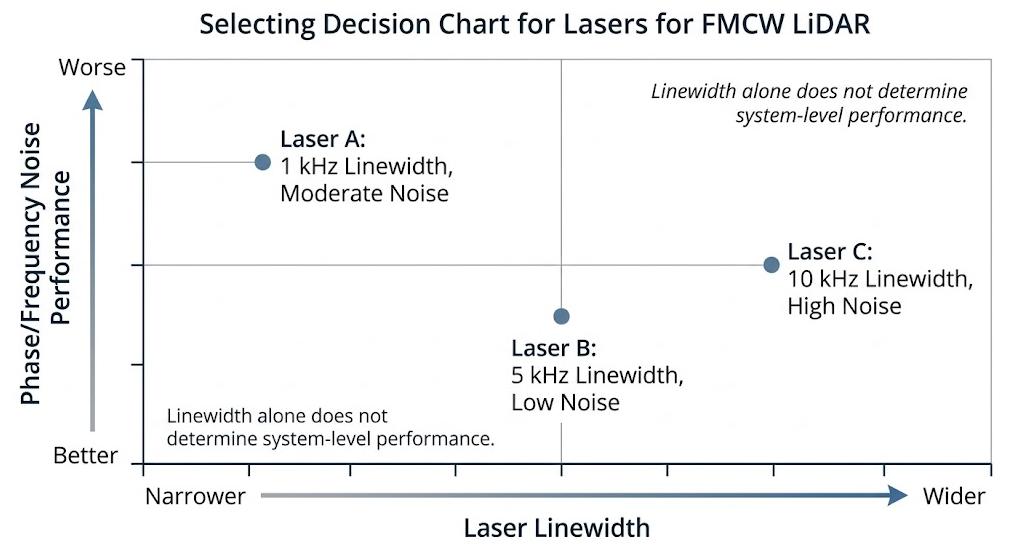
A 1 kHz bandwidth is highly attractive for coherent optical systems. However, if a laser only provides a 1 kHz bandwidth but lacks data on phase noise and frequency stability, while another laser has a 5 kHz bandwidth but offers lower phase noise, stable frequency response, and good chirp linearity, then the latter might be more suitable for a specific FMCW laser radar architecture and performance requirements.
The key point is not whether the 5 kHz laser is superior to the 1 kHz laser, but that the bandwidth alone is not sufficient to predict the system-level performance.
For FMCW laser radars, a more reasonable approach is to comprehensively evaluate the laser specifications:
- Bandwidth: How narrow is the optical spectrum?
- Phase/Frequency Noise: What is the noise level at the correlated offset frequency?
- Frequency Stability: How stable is the optical frequency over time?
- Chirp Linearity: How well does the laser track the target frequency scan?
- Output Power and Relative Intensity Noise (RIN): Can it meet the power and noise requirements of the system?
The importance of each parameter depends on the specific laser radar architecture and target performance.
What Should You Actually Ask a Laser Supplier?
If you are evaluating the laser for FMCW lidar, the nominal linewidth should be the starting point of the discussion, not the end point.
You can ask the supplier the following questions:
- What is the nominal linewidth? How is it measured?
When comparing the specifications of different suppliers, the measurement method and test conditions are equally important.
- Does the supplier provide phase noise or frequency noise data?
The linewidth cannot reflect the complete noise characteristics. You should request the supplier to provide noise data within the offset frequency range relevant to the application.
- How is the frequency stability of the laser?
For systems that require long-term coherence, frequency stability is crucial.
- How is the linearity of frequency chirp?
For FMCW lidar, the chirp linearity will directly affect the accuracy of frequency-to-distance conversion.
- Which wavelengths, output powers, and configurations are available?
The laser should be evaluated as part of a complete optical and detection architecture, rather than comparing individual metrics in isolation.
Choosing the Right Laser for Your FMCW LiDAR
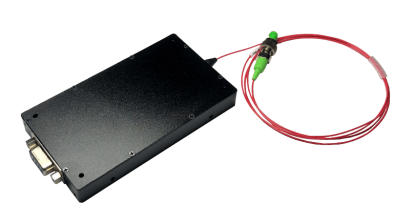
For the 1550 nm FMCW lidar system, the appropriate laser specifications depend on factors such as target distance, chirp bandwidth, detection architecture, ranging accuracy, and system noise budget.
Therefore, comparing lasers solely based on linewidth may not be accurate. A more reasonable assessment should take into account linewidth, phase/frequency noise, chirp characteristics, output power, and long-term stability.
SMART SCI & TECH provides 1550 nm narrow-linewidth laser solutions for FMCW lidar and other coherent optical sensing applications, and offers different linewidth and output power configurations to meet the needs of different systems.
If you are looking for a 1550 nm narrow-linewidth laser suitable for FMCW lidar, please contact SMART SCI & TECH to discuss your specific requirements.