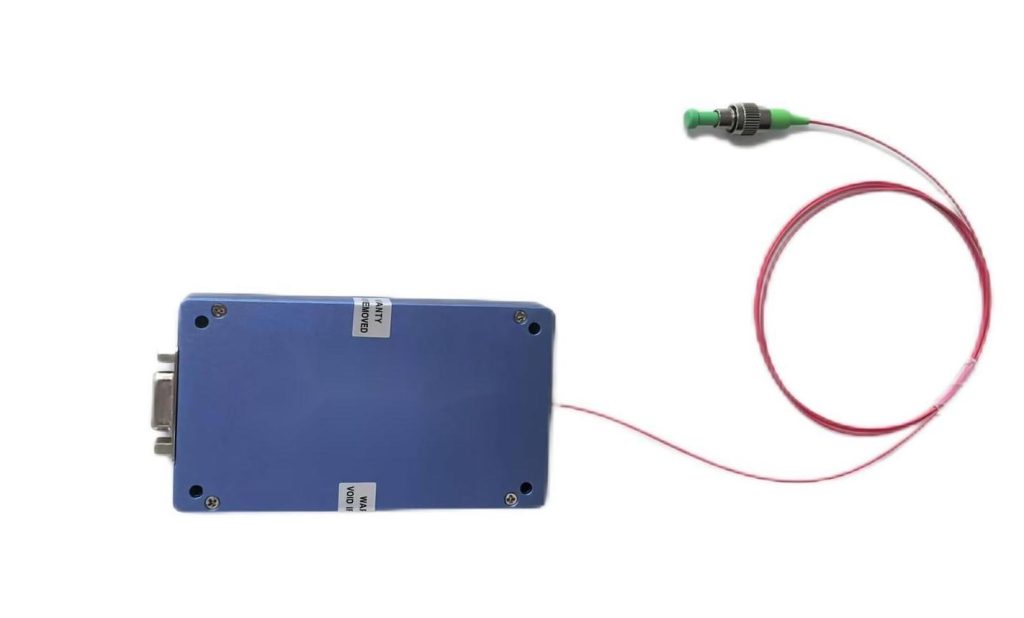
Phase Noise Suppression of Narrow Linewidth Lasers in Distributed Acoustic Sensing Systems
Indeed, distributed acoustic sensing (DAS) is highly effective for real-time, long-range surveillance of vital infrastructure, including oil pipeline networks, power grids, and high-speed railroads. The accuracy of such devices relies greatly on the ability to detect subtle phase changes in the reflected light due to vibrations in the surroundings. To ensure that high spatial resolution and accurate data can be acquired for areas extending more than 50 km, certain technical criteria should be observed when constructing the optical laser.
This blog examines the technical necessity of utilizing narrow linewidth lasers to suppress phase noise, ensuring a high Signal-to-Noise Ratio (SNR) and long-term operational stability in Distributed Acoustic Sensing architectures.
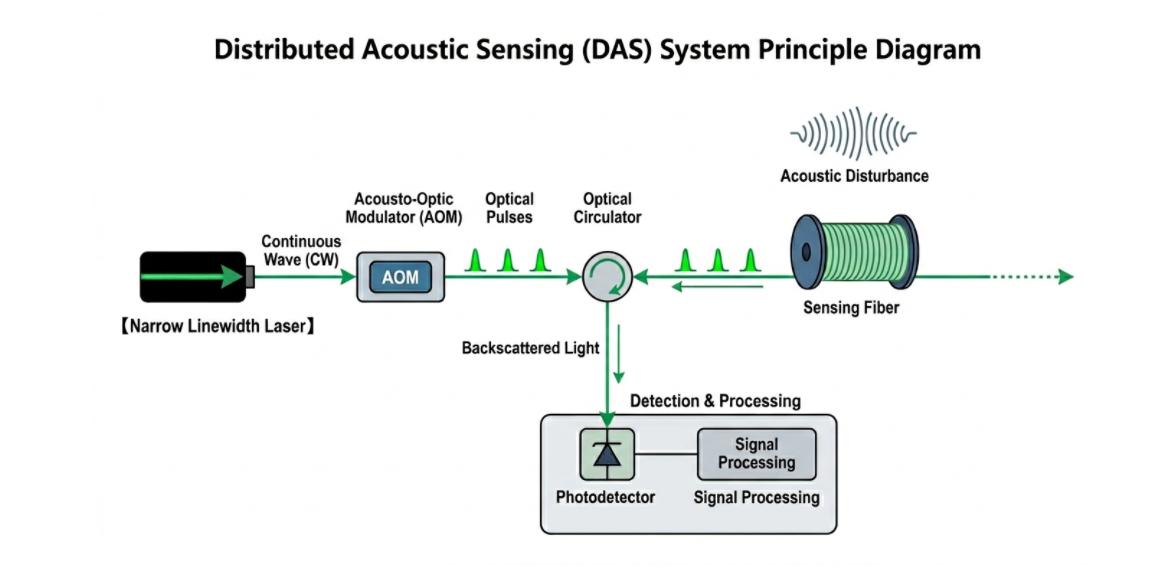
Core Requirements for Light Sources in Distributed Acoustic Sensing Systems
The Distributed Acoustic Sensing (DAS) technology uses the phase of the back-scattered signal from an optical fiber for sensing acoustic signals in remote locations. The basic technique uses Phase Sensitive Optical Time Domain Reflectometry (Phi-OTDR). To ensure that the sensor maintains its sensitivity, the probe pulse should have a constant phase across its whole sensing range.
Connection between Rayleigh Scattering and Phase Sensitivity
The sensitivity of a DAS system depends linearly on the interference contrast generated from Rayleigh-scattered light. In a fiber, when narrow pulses of light pass through, there will be small changes in the refractive index, which lead to Rayleigh scattering. The light that reaches the receiver is the result of the interference of different scattering sites inside the light pulse. An external vibration creates a change in optical path length, which gives rise to a phase change. Small phase changes can only be resolved by using sources with long coherence lengths, hence narrow line widths.
Effects of Phase Noise on Sensing Range and Linearity
The phase noise of the semiconductor laser is the key determinant of the SNR of the sensor system. For distant sensing applications, including pipe leak and submarine cable monitoring, the optical path length differential from scattering sites may be considerable. If the phase of the laser varies randomly during the duration of the pulse transmission time, the phase noise becomes intensity noise in the receiver. The interference from such noise obscures the true acoustic signal, resulting in a reduction in the maximum range and linearity of the vibration measurement.
Technical Mechanism of Phase Noise Suppression via Narrow Linewidth Lasers
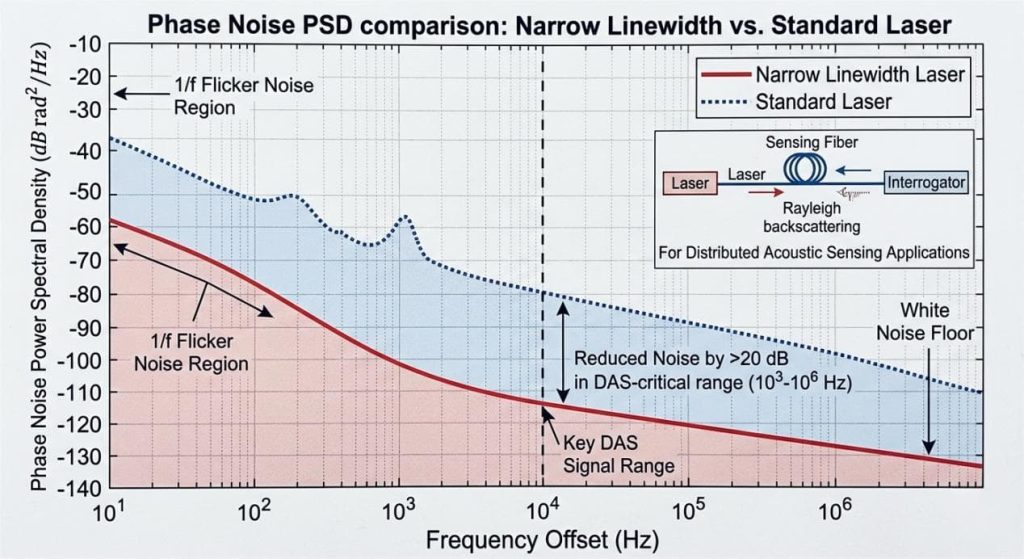
Distributed Acoustic Sensing systems need lasers whose linewidth is lower than 3 kHz in order to obtain sub-meter spatial resolution and range of kilometers. This kind of performance calls for certain design approaches of the laser structure in order to eliminate any noise from the spontaneous emission or thermal effects.
External Cavity Feedback Approach and Frequency Stability Control
The typical DFB laser usually displays a linewidth ranging between one and several Megahertz. This kind of performance level is not enough for a high-quality Distributed Acoustic Sensing system. Therefore, our method involves the use of the External Cavity Laser technique. Using this approach provides us with certain advantages that can be outlined as follows:
- Life Extension of Photons: Increasing the effective length of the laser cavity directly reduces the Schawlow-Townes linewidth limit.
- Active Frequency Locking: Application of an active temperature control scheme with an accuracy of 0.01 degrees Celsius to avoid frequency changes due to heating.
- Phase Fluctuation Damping: Using optical feedback to lock the instantaneous phase of the laser light.
All these factors make sure that the interference pattern stays constant throughout the integration process. Also, using low-noise current drivers ensures that there is no contribution of electrical noise into phase fluctuations.
Optimization of System Signal Gain by Lorentzian Linewidth
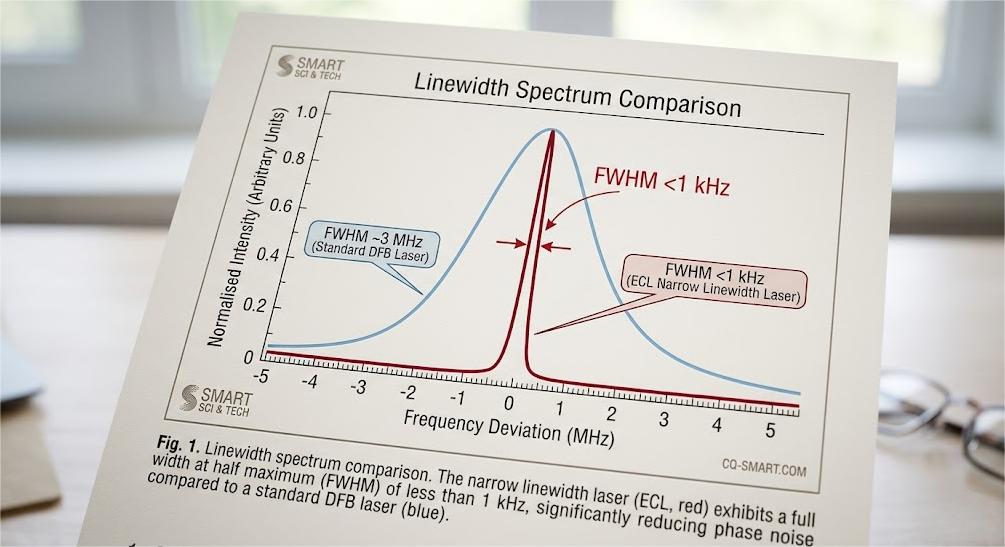
The spectral profile of a laser is generally described by a Lorentzian shape, and in a Distributed Acoustic Sensing architecture, the “wing” noise of this profile is a critical bottleneck. If the side-mode suppression is inadequate, the off-center frequency components bleed into adjacent sensing channels, effectively raising the system noise floor and reducing the effective gain.
- Grating Optimization: Dedicated Fiber Bragg Gratings (FBG) are used to reduce the transmission bandwidth and eliminate the non-resonant modes.
- Side Mode Suppression Ratio (SMSR): Ensuring SMSR is above 50 dB to prevent ghost signals from appearing in the acoustic data stream.
- Power Spectral Density Decay: Engineering the cavity to ensure the power spectral density drops off sharply away from the center frequency.
By suppressing these spectral wings, the system ensures that the signal gain in the middle range is maximized. The filtering of the spectral lines will facilitate the difference between the intrinsic noise generated by the fiber and the actual mechanical signals, thus enabling an accurate reconstruction of the vibrations.
Performance of Low-Noise Light Sources in Long-Range Monitoring
In the practical deployment of the system, the light source is crucial in determining its performance under highly attenuated conditions. This section presents an overview of how a narrow-linewidth laser performs better than regular sources in long-distance DAS systems.
Effect of Linewidth on System Sensitivity
The effects of phase noise were investigated using a 40 km fiber loop sensing experiment. The outcome shows that the narrower the linewidth of the laser, the lower the noise floor of the system, which enables the detection of weak acoustic signals.
| Laser Source Type | Spectral Linewidth | Sensing Range | Vibration Sensitivity Improvement |
| Standard DFB Laser | 10 kHz to 100 kHz | < 15 km | Baseline (Reference) |
| Narrow Linewidth Laser | 0.1 kHz to 1 kHz | > 40 km | +15 dB to +20 dB |
Stability and Efficiency of Signal Capturing
Processing of information in the distributed optical acoustic sensor (DAS) systems is dependent on stability in the interference pattern. Highly reliable lasers ensure two key benefits in the operational environment:
- Weak Signal Extraction: The system can extract acoustic signals by ensuring low PSD Phase Noise levels, allowing it to detect any acoustic signals amidst thermal noise, including from the end of the fiber.
- Reduced Computational Load: Enhanced frequency stability, with drift below 100 MHz within 24 hours, reduces the necessity for complicated algorithms that compensate for frequencies. The digital signal processing (DSP) component is, therefore, capable of handling more sensors.
Operational Stability over Time
The constant surveillance of the infrastructural systems demands that the laser functions at set parameters without the need for constant readjustments. The high stability external cavity laser guarantees that any occurrence of “false positive” alarms, which are usually attributed to laser frequency hopping, is kept at bay.
Summary
With the growth of applications for Distributed Acoustic Sensing in critical infrastructure and geophysics monitoring, laser performance becomes a factor that will make the decisive difference. Accurate acoustic reconstructions demand moving from a state of high phase noise to improved frequency stability.
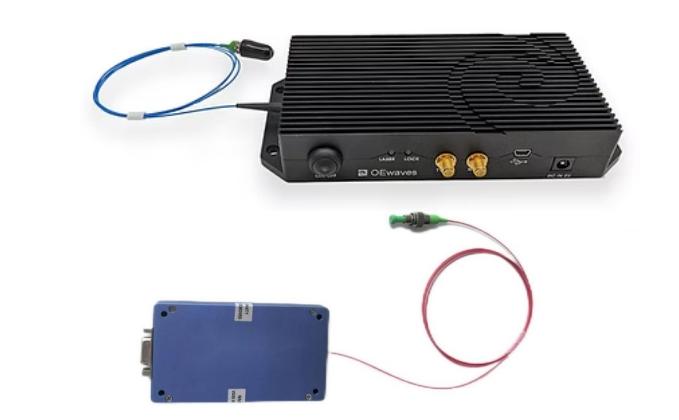
Selecting a Narrow Linewidth Laser with superior characteristics will be a critical move that will dictate what spatial resolution, range, and accuracy the distributed acoustic sensing system will be capable of achieving. By removing phase noise from the equation, it is possible to build highly accurate DAS instruments that generate fewer false alerts.