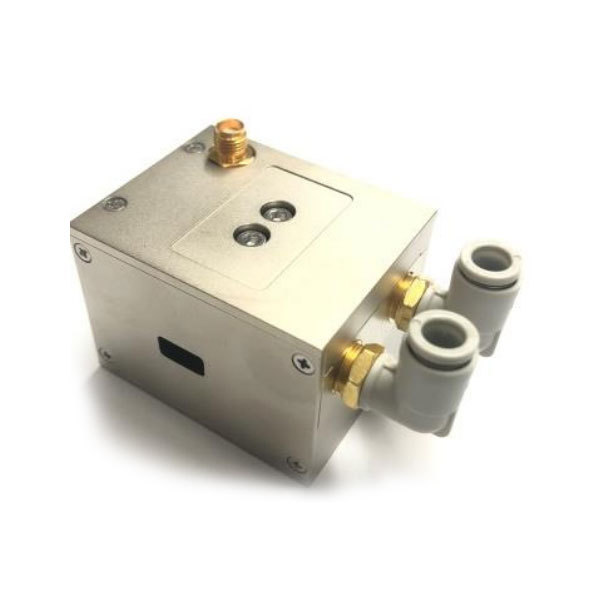
Practical Applications and Advantages of Acousto-Optic Q-Switches in High-Power Lasers
If you have been working with solid-state lasers for a while now, you’d understand that it is not just a matter of “switching the beam on and off” when it comes to creating giant pulses. It is also about precision timing and dealing with the stresses involved with working with high-power density. Of course, there are many ways of creating giant pulses. Among these, the Acousto Optic Q-Switch (AOQS) is the gold standard for creating giant pulses at high repetition rates. Now, how do you get the best out of it in practice? Let’s get practical.
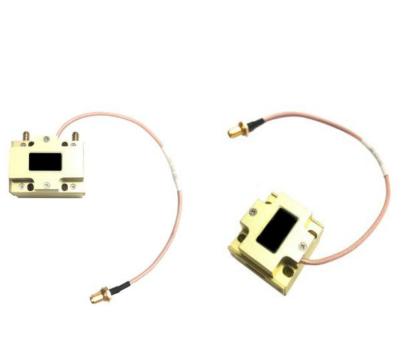
The Core Advantage: Why High-Power Systems Lean on AOQS
The first and foremost reason why engineers prefer sticking with acousto-optic technology for high-power DPSS lasers is due to their inherent robustness. While EO Q-switches demand high-voltage electronics and can suffer from optical damage in humid or dusty environments, AO Q-switches are relatively simple transmission elements. They involve the interaction of a sound wave with a crystal material—usually high-purity Synthetic Silica or TeO2. The beauty of AO Q-switches is that you don’t have piezoelectric ringing or polarization problems associated with EO Q-switches.
Reliability is everything in a high power situation, and the AOQS can handle these high average powers—sometimes above 100W or even several hundred Watts—without the crystal degrading or the alignment changing every time the room temperature changes. Because it diffracts light into a “first order” beam to produce the loss in the cavity, it provides a very clean way to hold off the laser gain until the precise time you’re prepared to release the pulse.
Heat Mitigation: Preventing Performance Drift in High-Duty Cycles
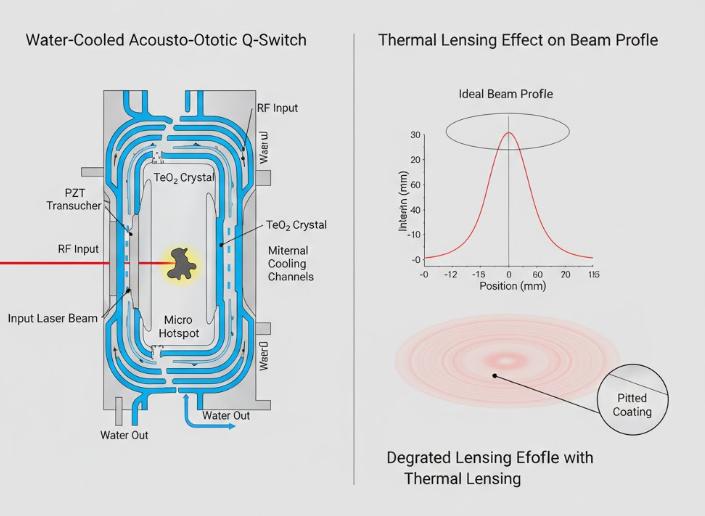
In high-power laser systems, the biggest challenge to achieving stable performance is heat. In an AOQS, the source of thermal energy is the “double-whammy” effect of absorbing the high-intensity laser beam and the RF energy being pumped into the transducer. If this heat is not removed quickly enough, you experience “thermal lensing.” This phenomenon effectively reduces your high-quality Q-switch to a poor-quality lens, which affects the beam profile (M-squared degradation) and causes the diffraction efficiency to plummet when you need it to perform best. This is why the first actual decision you have to make is choosing the proper cooling design.
| Feature | Air-Cooled AOQS | Water-Cooled AOQS |
| Power Handling | Low to Medium (Typically < 20W) | High Power (50W to 200W+) |
| Stability | Susceptible to ambient temp | Highly stable with a chiller |
| Maintenance | Low (no plumbing needed) | Requires clean, treated water |
| Typical Use | Marking, small-scale engraving | Industrial cutting, deep engraving |
However, for high-power usage, water cooling is a must, and it is in this “set-up” part where most people go wrong. One piece of advice from experienced engineers in the field is: “Don’t use untreated tap water, as mineral deposits accumulate inside the internal cooling system. This results in micro-hotspots on the crystal, which cause variations in refractive index.”
If you notice your beam is taking an elliptical form, and your “holding power” is decreasing, it is not necessarily because your optics are not aligned. First, check your chiller’s temperature stability and flow rate. Keeping your coolant between 1 degree above and below your ambient room temperature is sometimes the “magic formula” for pulse stability.
Key Considerations for High-Power Acousto-Optic Q-Switch Integration
When it comes to integrating an AOQS with a high-power system, it is not merely a matter of mounting it on the rail. You must take into consideration how the RF driver and optical cavity behave under stress. If the system is slightly misaligned, you will immediately notice a loss of pulse energy or, in the worst-case scenario, physical damage to the transducer. Based on our experience with industrial customers, the key to successful integration typically lies in the following factors:
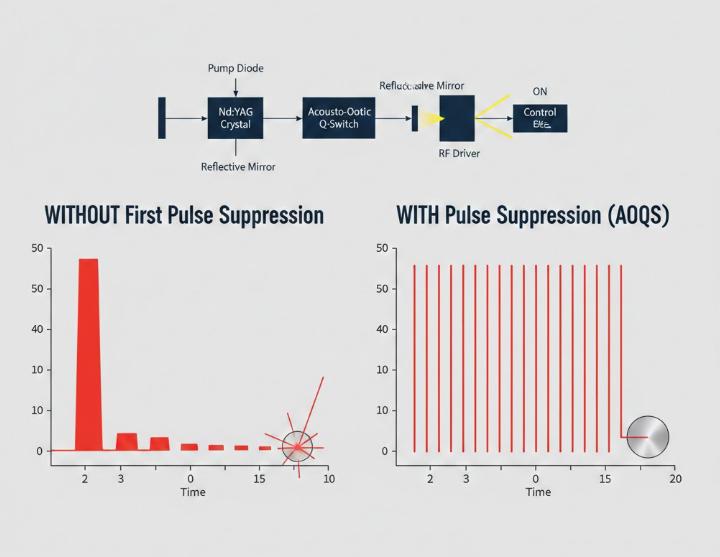
- First Pulse Suppression: In high-power marking or drilling, the first pulse in a burst can often contain significantly more energy than the remaining pulses, which can be destructive to the workpiece. A well-designed AOQS system employs RF modulation to “pre-damp” the first pulse, providing a consistent energy level across the entire pulse train.
- Bragg Angle Alignment: This is where most efficiency is lost. You cannot simply align the laser based on eyesight alone. You must maximize the diffraction into the first order with the RF on. If you are off by 0.5 degrees, you will still get leakage in the “off” position, causing the laser to “self-lase” and ruin the quality of the pulse.
- RF Driver Impedance Matching: If your driver and your q-switch are not both 50 ohms, you will get “reflected power.” This causes heat to build up in the driver, which is the number one cause of failure in the field. Be sure to check your VSWR (Voltage Standing Wave Ratio) during installation.
Outside these specific points, the environment is important. High-powered lasers produce a great deal of EMI, or “Electromagnetic Interference.” If your RF cables are not properly shielded, you might experience “jitter” in your pulse shape. These are the sorts of “nuts and bolts” issues that distinguish a laboratory prototype from a production device.
RF Driver Performance: Optimizing Switching Speed and System Stability
You can purchase the most expensive TeO2 crystal in the world, but if your RF driver is noisy and/or has a slow fall time, your laser output will be poor. The Fall Time of your RF signal is what determines how fast your Q-switch can “open.” When it comes to high-power lasers, a slow fall time can cause your laser to oscillate as it is not fully closed, wasting valuable energy and creating an inefficient, “fat” pulse width.
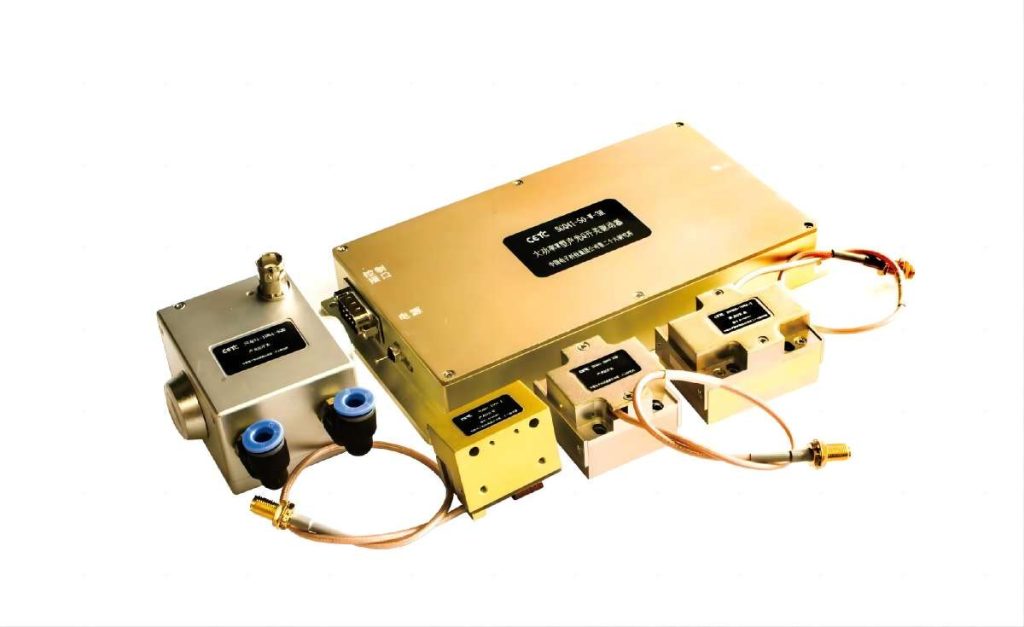
Most modern AOQS configurations consist of a matched pair, a transducer, and a digital RF driver. The main technical challenge associated with AOQS is matching the RF driver to your Q-switch. This is a critical step, as if your RF driver is not perfectly matched to your Q-switch, you can expect a significant amount of reflected power. This not only reduces your efficiency but can cause your RF driver’s electronics to “fry.” When building a new system, you must always use a power meter to validate that your RF energy is actually being absorbed by your crystal.
Practical Tips for Longevity and Performance
If you want to keep your AOQS running for years instead of months, there are a few unwritten rules to follow that you won’t always find in the manual. These are the habits that long-term laser operators swear by to avoid downtime:
- Interlock Sequencing: Never turn on the RF power before the water chiller is running. A few seconds of high RF power without cooling will delaminate the transducer from the crystal due to rapid thermal expansion.
- Polarization Orientation: AO Q-Switches are highly polarization-sensitive devices. If your laser beam polarization changes, as it does in many fiber-to-free-space transitions, your diffraction efficiency will drop like a stone. Be sure to orient your linear polarization in the proper direction for your crystal.
- Routine Window Cleaning: If you are using a high-powered laser, a speck of dust on the AOM aperture can become a “burn point.” Once the coating is pitted, you’ll lose your ability to use a high-peak-power laser. Reagent-grade acetone and the “drop and drag” method are recommended for cleaning.
By following these steps, you can ensure that the Q-switch is always the most reliable component of your laser. It is tempting to consider these as “set and forget” components, but a quick monthly check of coolant flow and RF cable connections can prevent catastrophic failures that bring a production line to a standstill.
Conclusion and Final Thoughts
The Acousto-Optic Q-switch is a highly resilient device, as long as you are prepared to show it a little bit of engineering TLC. By focusing your efforts on thermal management, the appropriate cooling solution, and a precisely matched RF driver, you can obtain the kind of stability and pulse energy required for demanding industrial applications.
Here at SMART SCI&TECH, our area of expertise is in providing high damage threshold AO Q-switches and RF drivers, which are specifically designed to withstand the rigors of 24/7 high-power laser operation. If you are experiencing thermal lensing problems or require customized first pulse suppression timing, our engineers are here to assist you in optimizing your laser cavity performance.
Are you looking to improve the stability of your laser system? Contact our technical team today to discuss your specific wavelength and power requirements, or browse our full range of AO products.