
How to Choose the Right Q-Switch for a Laser?
When choosing the Q-switch of a laser, one should not only consider the wavelength. Even if the wavelengths are the same, differences in beam size, power, polarization characteristics and operating conditions among different lasers may prevent the Q-switch from being universally applicable.
Therefore, the selection should start from the parameters of the laser. After identifying the key parameters, it is possible to determine the matching Q-switch and RF driver more quickly.
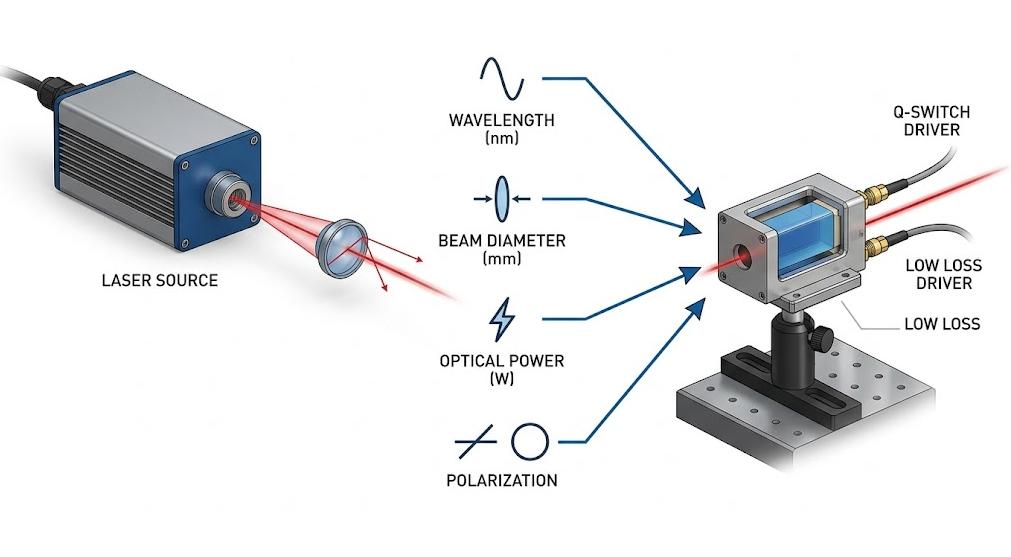
Start with the Laser, Not the Q-Switch
Wavelength is the primary parameter for Q-switch selection. Its design and optical coating must be optimized for the laser wavelength. For instance, one cannot simply choose a Q-switch suitable for the near-infrared band just because 1064 nm belongs to that band; the actual working wavelength and coating specifications must match.
However, wavelength can only serve as a preliminary screening criterion. When determining the specific model, the following factors also need to be considered:
- What is the laser power?
- What is the beam diameter at the Q-switch?
- Is the laser continuous wave (CW) or pulsed?
- What is the pulse energy and repetition frequency?
- What is the polarization state?
- Is the Q-switch inside or outside the resonator?
These parameters determine the optical and thermal loads that the Q-switch needs to withstand.
Check the Beam Size and Optical Power
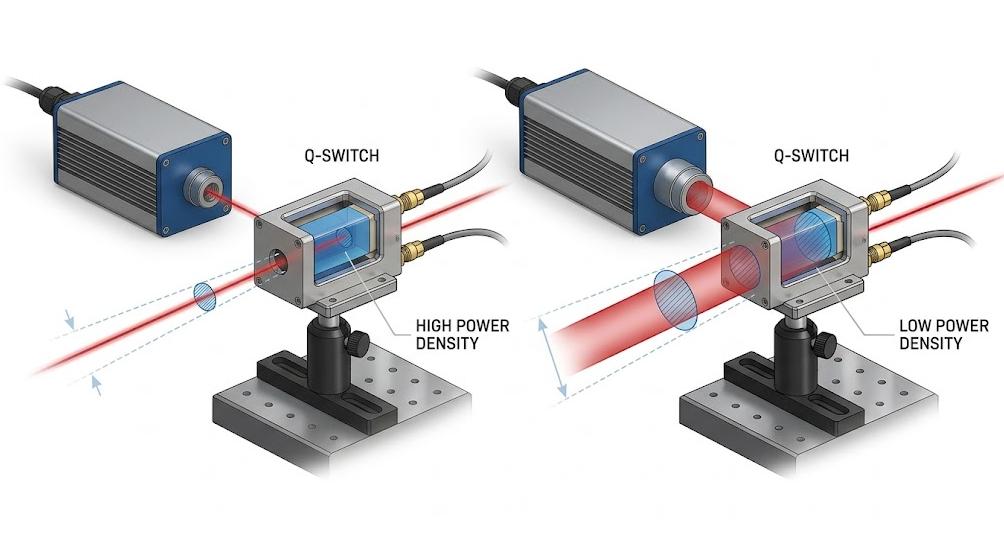
The beam diameter is one of the parameters that are easily overlooked in the selection of a Q-switch.
The optical aperture of the Q-switch must accommodate the actual beam, but a larger aperture is not necessarily better. The aperture affects the size of the device, the optical design, and the required radio frequency (RF) power. The ideal selection should ensure sufficient beam clearance while avoiding unnecessary increases in the performance requirements of the device.
The beam size also needs to be evaluated in conjunction with the laser power. For approximately circular beams, the power density can be estimated using the optical power and the beam area:
Power density ≈ Optical power / Beam area
Therefore, even if two lasers have the same output power, if the beam diameters are different, the load that the Q-switch will bear may be significantly different.
For pulse or intracavity applications, only the average power is not sufficient. The pulse energy, repetition frequency, beam diameter, and actual optical conditions within the cavity must also be considered. The Q-switch should maintain a reasonable working margin rather than operating constantly near the specification limit.
Read more: How to Increase the Damage Threshold of Acousto-Optic Q-Switches
Make Sure the Optical Specifications Match
After determining the wavelength, beam size and power, other optical specifications also need to be checked.
For the acousto-optic Q-switch, the polarization characteristics are particularly important. The polarization state of the laser must be consistent with the design and specified working direction of the Q-switch. Even if the wavelength and aperture size meet the requirements, polarization mismatch may still affect the performance of the switch.
Diffraction efficiency is also a key parameter, but it cannot be judged alone. The Q-switch requires sufficient diffraction efficiency to provide the required intracavity loss during the switching action. At the same time, the light transmission rate and loss under specific working conditions should also be considered.
Therefore, one cannot merely pursue the highest diffraction efficiency as stated in the data sheet. If the RF power, aperture size or overall system design do not match, this model may still not be applicable.
The selection of the Q-switch should take into account all the specification parameters comprehensively, rather than simply pursuing the maximum value of a single indicator.
Choose the Q-Switch and RF Driver as a Pair
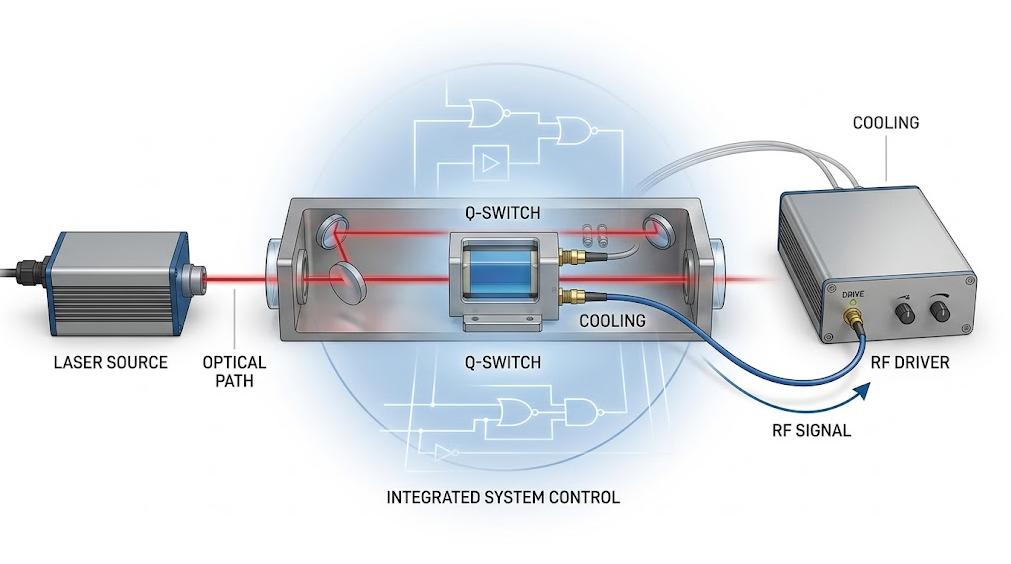
The Q-switch should not be selected independently of the RF driver.
The driver provides the RF signal that controls the acoustic-optical interaction, so these two components must be properly matched. Key parameters include RF frequency, drive power, modulation signal, repetition frequency, and electrical matching.
For example, if the RF drive power required by the selected Q-switch exceeds the power that the driver can provide, the device may not achieve its nominal diffraction efficiency. Conversely, simply using a more powerful RF driver does not automatically improve system performance.
The driver should be selected based on the specific requirements of the Q-switch and the laser operation.
Therefore, when evaluating the Q-switch, it is best to consult the recommended RF driver at the same time. Using a matched Q-switch and driver combination not only simplifies system integration but also reduces unnecessary testing during the laser development process.
Consider Cooling for Higher-Power Applications
As the optical power, RF (Radio Frequency) driving power and operating frequency increase, the cooling requirements also rise.
Low-power applications can typically use conduction cooling, while high-power systems may generate heat that requires more effective solutions, such as water cooling.
The cooling configuration depends on the actual working conditions rather than solely being determined by the laser power. Continuous operation, high repetition frequency and high RF driving power all increase the heat load.
Therefore, the cooling method should be determined during the Q-switch selection stage, rather than being considered after the optical design is completed.
What Information Do You Need Before Selecting a Q-Switch?
If you need assistance with Q-switch selection, providing the supplier with basic laser parameters will help expedite the selection process. At a minimum, you should prepare the following:
- Wavelength
- Laser type: Continuous Wave (CW) or pulsed
- Average power
- Pulse energy
- Repetition frequency
- Beam diameter
- Polarization state
- Required optical aperture
- Cooling conditions
These parameters are more helpful for quickly determining the appropriate Q-switch and further matching the corresponding RF driver and cooling configuration than simply providing the wavelength.
At SMART SCI&TECH, our acousto-optic Q-switch range covers different wavelength and optical-aperture requirements, including 2 μm, 2.7 μm, and 10.6 μm laser applications. The product range also includes different cooling configurations and is designed around key selection factors such as optical power density, beam diameter, polarization, diffraction efficiency, and thermal management.
The Q-switch can also be paired with a dedicated RF driver. For example, we offer V-type drivers for Q-switches requiring less than 40 W drive power and W-type drivers for applications requiring less than 70 W, with digital and analog modulation functions available for different pulse-control requirements.
So, when selecting a Q-switch, the most useful starting point is not a product model number. Start with the laser parameters. Once the wavelength, beam size, optical power, polarization, repetition rate, and cooling conditions are clear, the suitable Q-switch and RF driver can be matched much more efficiently.