
How to Replace Discontinued or Long-Lead-Time Fiber AOMs?
When a Fiber AOM is discontinued or has an excessively long lead time, finding a suitable replacement can be challenging. For laser equipment manufacturers and system integrators, choosing the wrong replacement can affect optical performance, increase integration work, or delay production.
But in some instances, replacing an existing Fiber AOM may not require a complete redesign of the system. In order to do that, one must understand the requirements of the original device and find a compatible replacement.
This article guides you on how to find a replacement and when a custom Fiber AOM should be considered.
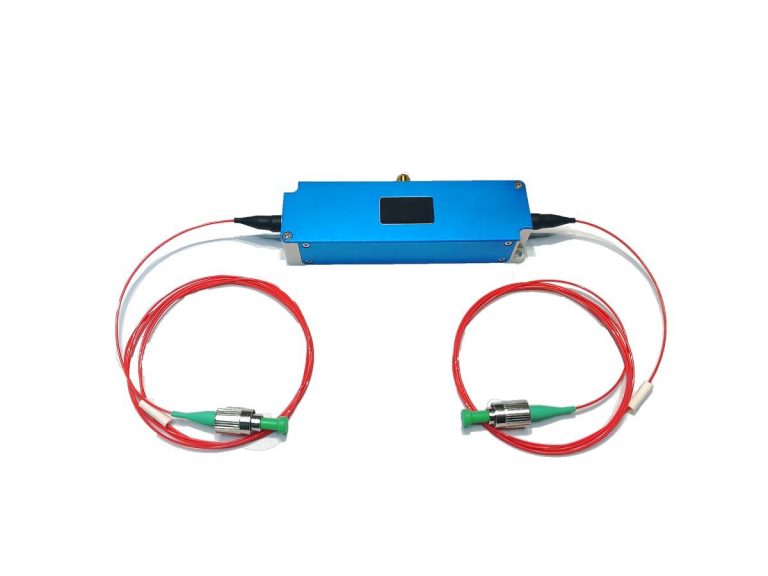
Start With the Original AOM and Your System Requirements
Before looking for alternatives, gather as many details as you can regarding the original Fiber AOM and its surrounding system.
This should begin with the part number and datasheet. Where the original datasheet is not available, equipment documentation, past test data, and system design data will prove useful for determining the necessary specifications.
The necessary information is:
- Operating wavelength and necessary frequency shift
- Optical input power and allowable insertion loss
- Necessary extinction ratio and switch speed
- Fiber type, connectors, and pigtail length
- RF drive frequency, power, and impedance
- Control electrical interface and physical package sizes
It is important to differentiate between the specs of the original device and the actual requirements of the system. In some cases, the spec may be flexible, whereas in other cases it will be critical to system functionality.
For example, the new device may provide similar optical performance specs but differ in RF drive and fiber connections. Identifying these differences early helps narrow the list of potential replacements and avoids spending time evaluating devices that are incompatible with the existing system.
Decide Which Specifications Must Match
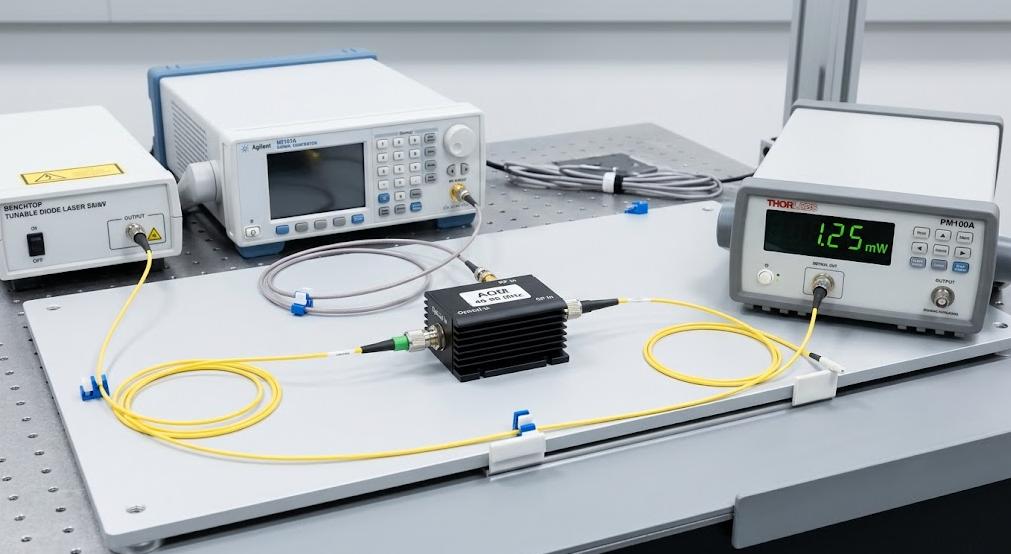
Two Fiber AOMs might look the same on a product page but they can act in a different way when implemented into a real system. An adequate comparison needs not only to include optical parameters but also system considerations.
| Specification | What to Check |
| Operating wavelength | Confirm that the replacement supports the system’s laser wavelength. |
| Frequency shift | Verify the required shift frequency and whether the system depends on a specific frequency configuration. |
| Insertion loss | Check whether the optical loss fits within the system’s power budget. |
| Extinction ratio | Confirm that the device can meet the required modulation and suppression performance. |
| Rise and fall time | Determine whether the switching response meets the application’s timing requirements. |
| Optical power handling | Ensure that the device is suitable for the actual operating power and conditions. |
| Fiber and connectors | Check fiber type, polarization requirements, connector type, and pigtail configuration. |
| RF drive requirements | Compare drive frequency, RF power, impedance, and driver compatibility. |
| Package and mounting | Verify dimensions, mounting constraints, thermal conditions, and cable routing. |
All the specifications don’t need to be equal to the ones used in the original part. Acceptable deviations will depend on the requirements and performance capabilities of the application/system.
For example, a minor difference in insertion loss can be fine for a system with enough power margin, but unacceptable in the power-critical one. The same about the response time – it can be acceptable or not depending on application requirements.
It’s necessary to find out which of the specifications can’t be changed and which can be negotiated.
You can have a look at all available Fiber AOM products for candidates’ consideration.
Choose a Replacement Path That Fits Your Constraints
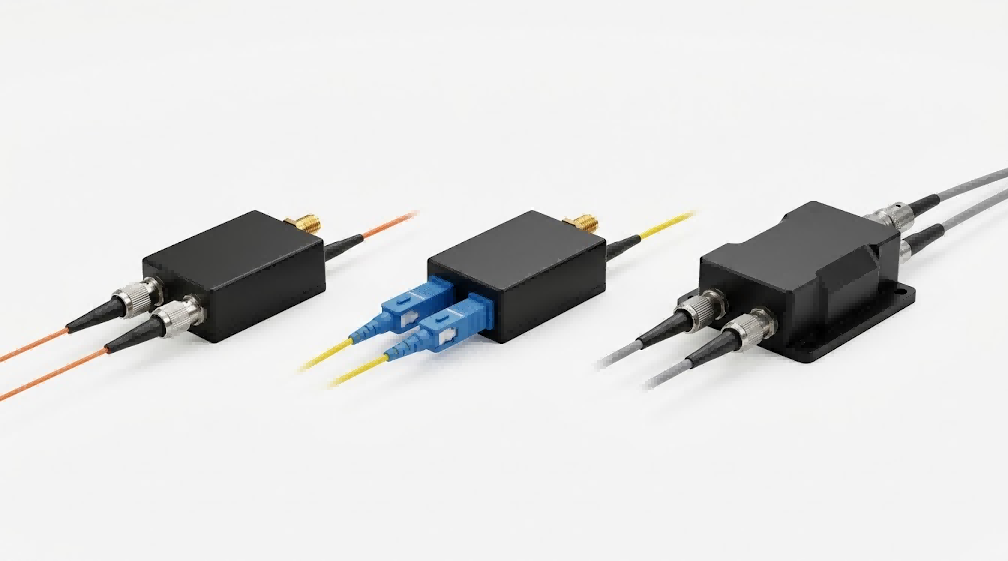
Upon determining what the key requirements are, there are three main alternatives to choose from.
Option 1: Select the Suitable Standard Fiber AOM
It makes sense to use a proven product if its optical specifications, RF specifications, fiber configuration, and packaging are compatible with the system at hand.
This option could help to keep both procurement and engineering efforts simple. But meeting the headline specifications does not necessarily mean that the device can be treated as a true drop-in replacement for your system.
Option 2: Adapt the Existing System to a Compatible Alternative
There are situations where the substitute device will satisfy the optical criteria but differs from the current one through its RF driver, interface, connectors, or mechanics.
In such situations, the substitution might be appropriate as long as the modifications in the system are not too difficult. Check if the current driver is suitable to run at the frequencies of RF power levels required by the substitute device.
If a new driver is needed, compare its specifications with the replacement device’s requirements and explore our range of acousto-optic modulator drivers for potential options. For more on this, refer to this article on choosing the appropriate acousto-optical modulator driver.
Option 3: Consider a Customized Fiber AOM
If no readily available standard product can satisfy important optical, fiber, or package needs, a customized product might be considered.
A customized solution could solve needs like a certain wavelength, fiber type, connector, or packaging. The feasibility of each need should be checked with the manufacturer.
Learn more about our customized Fiber AOM solutions and explore options for application-specific optical, fiber, and packaging requirements.
A customized solution is not necessarily faster by default. It would require design, prototyping, testing, and qualification that may take additional time. Compare the anticipated development time and effort required for a product validation process to the time and costs associated with using standard products.
Validate the Replacement Before Full Deployment
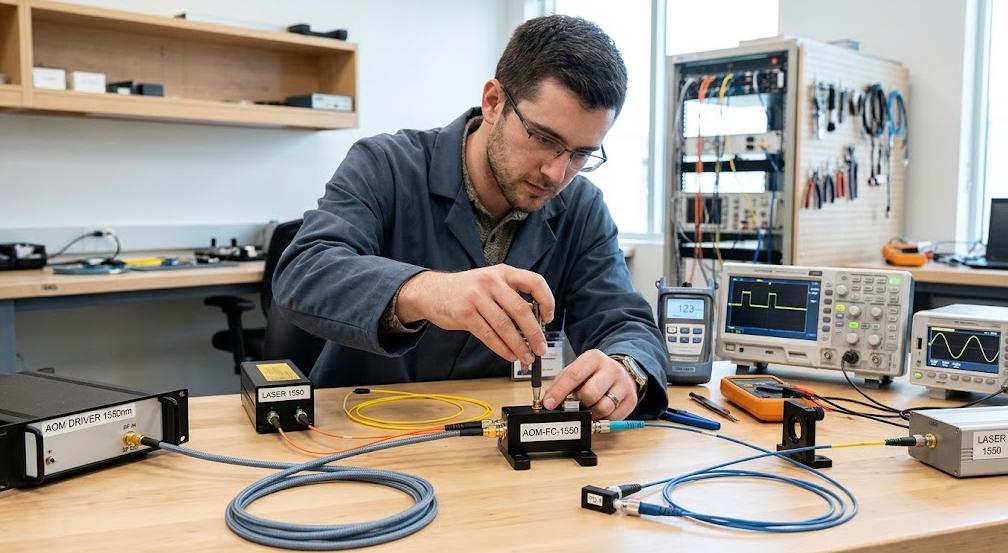
While a datasheet comparison will help select potential components, nothing beats the test of the component when run in its operating environment.
Whenever possible, it is a good idea to test a sample first and use this as a basis for the final acceptance decision and the selection of the final order quantity. Decide what your acceptance criteria are according to the application’s needs and compare the performance of the replacement to that of the original component under the same conditions.
Some tests may include:
- Optical performance: Measure insertion loss, extinction ratio, output power, and switching response, as applicable to the system’s requirements.
- RF compatibility: Verify whether the driver will run the replacement under the manufacturer’s specifications.
- System compatibility: Test the fiber connections, control inputs/outputs, and mounting of the component if necessary.
- Operating stability: Test performance throughout the required operating range under system conditions.
- Supply reliability: Confirm sample availability, production lead times, minimum order quantities, and expected production capacity with the supplier.
Document the results and identify any required system changes before approving the replacement for use.
It is just as critical to check the commercial aspects. Even a technically good fit will not solve the original problem if the delivery time frame is unclear or the supply capacity is inadequate to meet future demands.
For OEMs and system integrators, the perfect replacement does not need to be the one that matches the datasheet most closely. It needs to be a fit that qualifies and can be supplied under the given conditions.
If a replacement Fiber AOM causes unexpected performance issues during integration, read our guide on troubleshooting Fiber AOM problems during system integration.
Find a Fiber AOM Replacement for Your Application
In the event that an original Fiber AOM is no longer available or has a long lead time, conducting an evaluation of possible alternatives may prove helpful in minimizing the chances of production delays and additional integration work.
SMART SCI&TECH provides Fiber AOM products and customized solutions for diverse optical and system integration needs. We can evaluate your original device specifications and assist you in identifying possible alternatives, including the required RF driver specifications.
For an easier evaluation process, please provide the original AOM model number/datasheet, operating wavelength, frequency shift, optical specifications, fiber arrangement, RF driver specifications, quantity needed, and desired delivery date.
Need help evaluating a replacement for your Fiber AOM?
Share your original device specifications and target delivery date with our team. Contact our optoelectronics team to discuss potential replacement options for your application.