
How to Select a High-Power Fiber Isolator for MOPA Systems?
When choosing a high-power fiber isolator for the MOPA system, it is not only necessary to consider the rated power.
The selection also needs to take into account the installation location of the isolator, the type and wavelength of the optical fibers, the working principle of the laser, as well as the actual optical power and thermal load it can withstand.
For high-power systems, several key parameters can quickly narrow down the selection range.
High-Power Fiber Isolator Position in a MOPA System
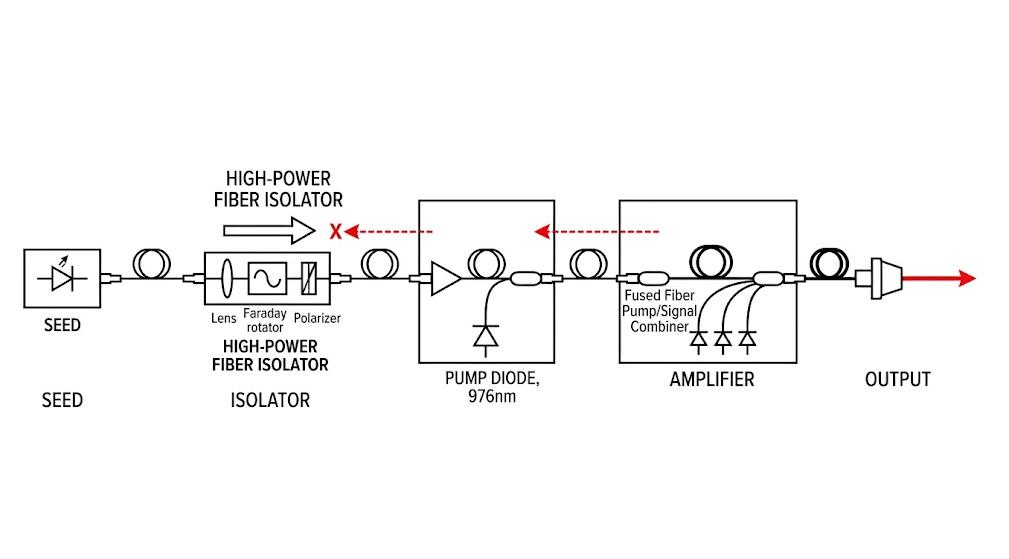
The position of the isolator in the optical path determines the actual optical power it needs to handle.
Common installation locations in a MOPA system include:
- Between the seed laser and the first amplifier
- Between different amplifier stages
- After the high-power amplifier
- At other locations where reflected light needs to be blocked
Therefore, when selecting an isolator, attention should be paid to the actual optical power at the location of the isolator, rather than the maximum output power of the entire MOPA system.
For example, an isolator installed after a low-power seed source has different requirements for power handling capacity compared to an isolator installed between the pre-amplifier and the power amplifier.
The installation location also determines the components that need to be protected. Before comparing different isolator models, it is necessary to first clarify which component the isolator needs to protect.
Fiber and Wavelength Selection for MOPA Fiber Isolators
The isolator should be matched with the existing optical path of the MOPA system.
When selecting the component, the following parameters should be carefully confirmed:
- Working wavelength: 1064 nm, 1080 nm, 1550 nm or other target wavelengths
- Fiber type: Polarization-maintaining (PM) or non-polarization-maintaining (non-PM)
- Fiber configuration: Fiber-to-fiber (F2F) or Fiber-to-free-space (F2S)
- Fiber characteristics: Core size and mode field requirements
For polarization-maintaining MOPA, a polarization-maintaining fiber isolator should typically be selected. An incompatible component with the polarization architecture may introduce polarization-related issues in the subsequent system.
Wavelength is a hard selection criterion. An isolator designed for a specific wavelength range cannot be assumed to have the same performance at other wavelengths.
Therefore, the focus of selection is to ensure that the isolator is compatible with the existing MOPA optical path, rather than merely meeting the power requirements.
Power Rating of High-Power Fiber Isolators
This is also the reason why the selection of high-power lasers is rather complex. The nominal power of a laser cannot reflect all working conditions; the actual operating status is equally important.
| MOPA condition | What matters |
| CW | Continuous thermal load |
| Pulsed | Peak power and average power |
| High duty cycle | Long-term heat accumulation |
| Low duty cycle | Average thermal load may be lower |
| Short pulses | Peak optical power becomes more important |
Consider two systems with a nominal power of 100 W each:
- A 100 W continuous-wave master power amplifier (CW MOPA) will continuously output approximately 100 W of power to the isolator.
- A pulsed system may have a higher peak power, but the average power is much lower than 100 W.
Therefore, the requirements for high-power fiber isolators for these two systems are not the same.
During actual selection, a certain margin of power should also be reserved to avoid components operating continuously at the rated power limit. For production environments or long-term operation, stable thermal performance is more important than passing high-power tests briefly.
Isolation and Insertion Loss in High-Power Fiber Isolators
The isolation degree and insertion loss are two indicators that high-power optical isolators need to pay attention to simultaneously.
The isolation degree determines the ability of the isolator to suppress the reverse-propagating light. In MOPA systems, it relates to whether the seed light source and the upstream amplifier can avoid the interference of reflected light.
The insertion loss directly affects the thermal load of the device. At low power levels, a smaller loss is usually not noticeable, but at high power levels, the loss will be converted into significant heat.
For example:
- 100 W × 1% insertion loss ≈ 1 W heat
- 500 W × 1% insertion loss ≈ 5 W heat
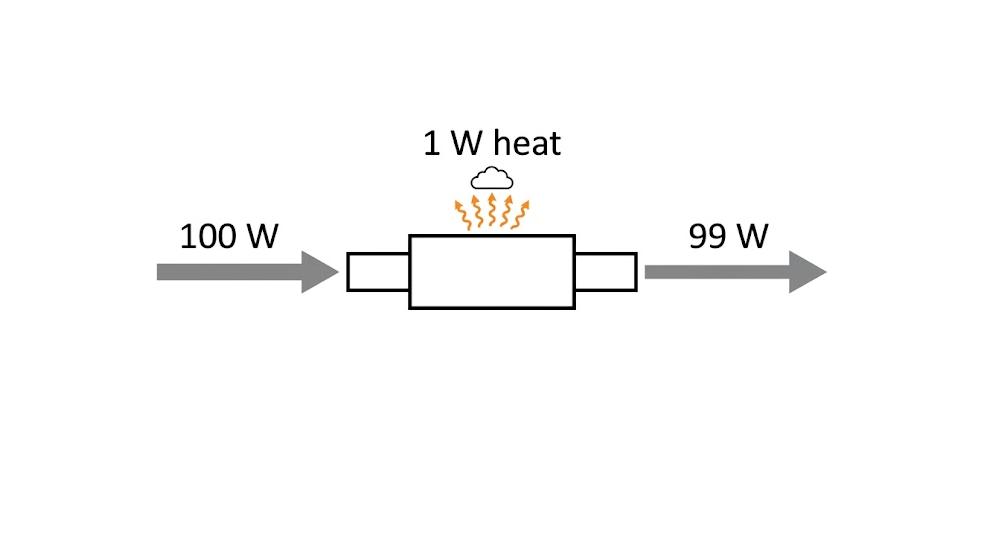
Therefore, when choosing a high-power optical fiber isolator, one should not only consider the isolation degree. An isolator with a high isolation degree but high insertion loss may cause greater heat dissipation pressure in a high-power MOPA.
For continuous operation, the combined performance of the following indicators is more important than a single parameter:
- Isolation degree
- Insertion loss
- Power handling capacity
- Heat dissipation design
High-Power Fiber Isolator Integration in MOPA Systems

After confirming the optical parameters, it is also necessary to ensure that the isolator matches the physical architecture of the MOPA.
For high-power systems, heat dissipation and fiber interfaces are two important integration factors. The isolator should support continuous operation under the actual power, and the fiber configuration should also match the existing optical path. All-fiber systems can adopt a fiber-to-fiber design; if it is necessary to connect to a downstream free-space optical path, a fiber-to-free-space configuration should be selected.
Before determining the components, the packaging size, fiber wiring, installation method, and cooling conditions should also be considered.
For high-power MOPA applications, SMART SCI&TECH provides a variety of high-power fiber isolators with fiber and power configurations, including polarization-maintaining and fiber-to-free-space solutions. Users can choose the appropriate isolator based on the actual wavelength, fiber type, and working power, without being limited by standard components. For more information, please contact us.