
Off-the-Shelf vs. OEM Custom Fiber AOMs: Cost & Lead Time Comparison
Ordering ready-made Fiber Acousto-Optic Modulators (Fiber AOM) often encounters delivery delays: The so-called “in-stock” often requires a production cycle of 8 to 12 weeks, and performance compromises can also slow down system integration.
When building precision photonic systems or conducting OEM-scale production, mastering the procurement logic of optical components is crucial for ensuring the timely delivery of projects and maintaining system performance.
Why “In-Stock” Fiber AOMs Are Rarely in Stock
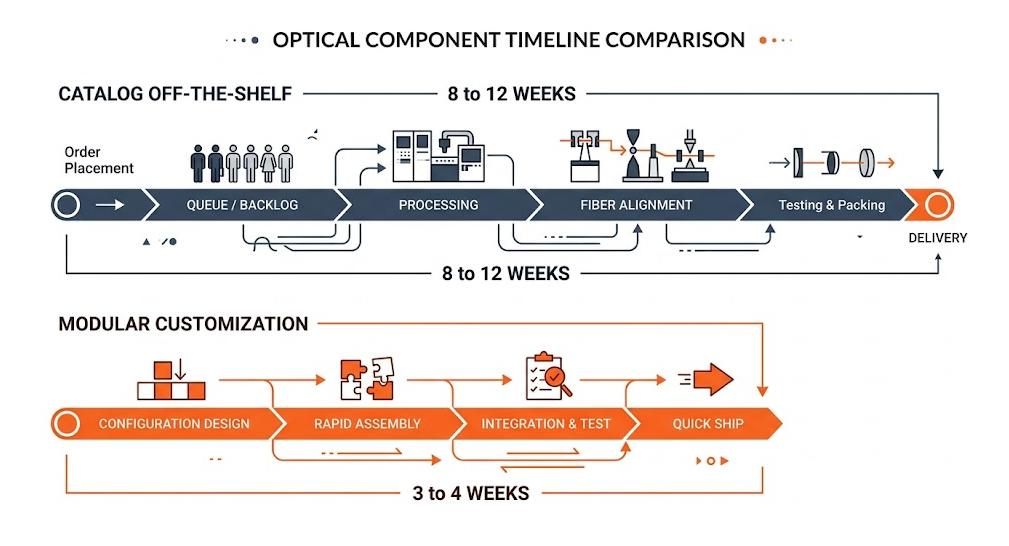
In the field of electronic distribution, “in stock” (OTS) refers to the finished products stored in the warehouse. However, in the precision optical industry, catalog-type Fiber Acousto-Optic Modulators (Fiber AOM) – especially those for non-1550nm communication bands – rarely have in-stock availability.
The manufacturing of Acousto-Optic devices relies on complex micro-assembly processes, including:
- Precise polishing of crystals (TeO2 / Fused Silica)
- Bonding of transducers and impedance matching
- Sub-micron-level active alignment of fibers (to control insertion loss)
- Packaging, curing, and aging tests
Affected by diverse requirements such as fiber pigtails, fiber types (PM/SM), and driving frequencies, manufacturers mostly adopt the “order-based production” model. “Catalog-type” merely indicates that the design drawings are mature and does not mean that an 8 to 12-week production cycle can be eliminated.
The Unseen Trade-offs of Forcing a Catalog Spec
In the face of tight deadlines, engineers often opt for standard catalog-based AOMs to save on customization time. However, in high-precision laser systems, this compromise often leads to a series of system-level problems:
- Cumulative insertion loss: Using a 2.5dB high-loss standard AOM will result in insufficient detection light power, forcing additional time to reconfigure the gain stage or optical amplifier.
- Polarization Extinction Ratio (PER) deterioration: If a 1064nm PM-AOM is mistakenly used in the 1030nm band, polarization crosstalk will cause the PER to drop below 18dB, weakening pulse contrast and interference quality.
- Back reflection and thermal instability: Inconsistent power can easily cause end-face damage or thermal lensing. Under high-power continuous-wave driving, the crystal temperature rise will cause a shift in the diffraction angle and beam pointing drift.
The conclusion is that the time saved on customization by choosing an incompatible off-the-shelf product will ultimately be doubled in the process of optical path debugging and troubleshooting.
What Actually Drives Customization Lead Time
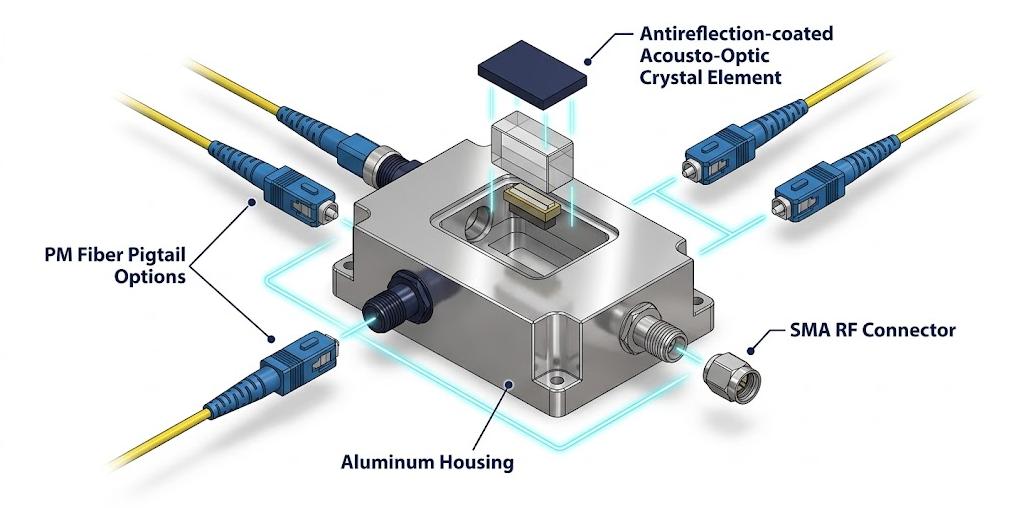
In the field of Fiber AOM, customization is not limited to only “standard products” and “High-NRE deep customization.” By differentiating between the following two customization modes, the delivery cycle can be significantly shortened:
- Deep customization (16 weeks+): Requires redesigning crystal cutting, transducer structure or housing tooling. Not only does it incur NRE costs, but also has a long verification period.
- Modular customization (3-4 weeks): Uses standard crystal blanks and housings, and only makes flexible adjustments to key optical variables:
- Specific wavelength anti-reflection coating (AR): such as 399nm, 461nm, 780nm, 2000nm
- Specific Polarization-Maintaining (PM) optical fiber: such as Panda, PM980, PM1550
- Customized radio frequency (RF) frequency and interface direction: such as 80MHz, 200MHz
By adopting modular customization, it can not only precisely match system indicators, but also significantly shorten the delivery time.
How to Specify a Fiber AOM Without Paying NRE
If you want to quickly obtain customized components without incurring additional engineering setup costs, when preparing the Request for Quotation (RFQ), you should refer to the manufacturer’s existing basic platform:
- Lock the Form Factor: Use the standard housing dimensions of the supplier (i.e., “package footprint”). Unless there are strict requirements, avoid specifying customized installation hole positions or non-standard enclosure dimensions.
- Define Optical Tolerances Realistically: Based on the actual optical budget requirements, clearly define the minimum acceptable Polarization Extinction Ratio (PER, for example, set to ≥ 20dB instead of ≥ 25dB) and the maximum insertion loss. If the indicators are set too high, it often requires the development of customized alignment fixtures.
- Specify Fiber Pigtails & Connector Styles Upfront: Specify the use of polarization-maintaining (PM) optical fibers and FC/APC connectors in the initial RFQ stage, which can avoid delays caused by re-termination and re-testing after assembly.
- Leverage Pre-Coated Crystal Inventory: Ask the supplier about which wavelengths of crystal blanks (crystal substrates) are in stock currently. If specifications can be formulated based on the existing material inventory, the delivery cycle can be significantly shortened.
Pre-Shipment Pairing with RF Drivers
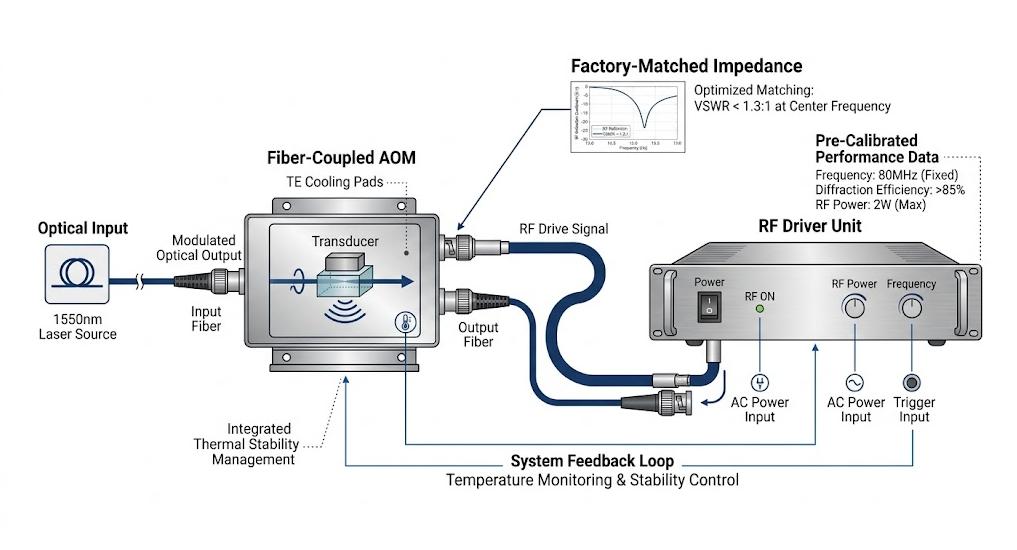
Pairing an AOM with a third-party RF driver is highly prone to causing malfunctions. Impedance mismatches or excessive power levels can lead to crystal heating, reduced diffraction efficiency, or even permanent damage to the piezoelectric transducer.
Using the original manufacturer’s paired “AOM + RF driver” combination can effectively avoid risks, and its advantages include:
- RF power pre-calibration: Precise calibration (including VPP and RF power) for the target wavelength before leaving the factory to ensure the highest diffraction efficiency.
- Optimized thermal performance: Targeted calibration prevents the crystal from overheating during continuous-wave (CW) operation.
- Plug-and-play convenience: Eliminates the complex, time-consuming process of assembling and debugging external components such as RF attenuators and directional couplers.
Send Us Your System Constraints
If your project faces delays due to long lead times (8+ weeks) or if off-the-shelf products fail to meet your performance requirements, please contact our optical engineering team directly.
Simply provide the following key parameters, and we will leverage our modular platform to deliver a feasibility assessment and quotation within 24 hours:
1. Center Wavelength: (e.g., 461nm, 780nm, 1064nm, 1550nm, 2000nm)
2. Performance Specifications: Target Polarization Extinction Ratio (PER) and maximum insertion loss
3. Fiber/Connector: Fiber type (e.g., PM / polarization-maintaining) and connector type (e.g., FC/APC)
4. RF Requirements: RF frequency and driver preferences