
Optical Delay Line Resolution vs Accuracy vs Repeatability
When comparing optical delay lines, you may come across specifications such as a 10 fs resolution, ±10 fs accuracy, and ±10 fs repeatability. These values are similar, but they represent different performance indicators.
For example, when you need to set the optical delay to 100 ps, does a 10 fs resolution mean that the actual delay will have an error less than 10 fs from the target value? Not necessarily.
The difference lies in:
- Resolution indicates how finely the delay can be adjusted.
- Accuracy indicates how close the actual delay is to the target value.
- Repeatability indicates whether the delay line can return to the same position stably.
Understanding these differences helps you choose an optical delay line based on experimental requirements, rather than simply comparing the minimum values in the data sheet.
What Is the Difference Between Resolution, Accuracy, and Repeatability?
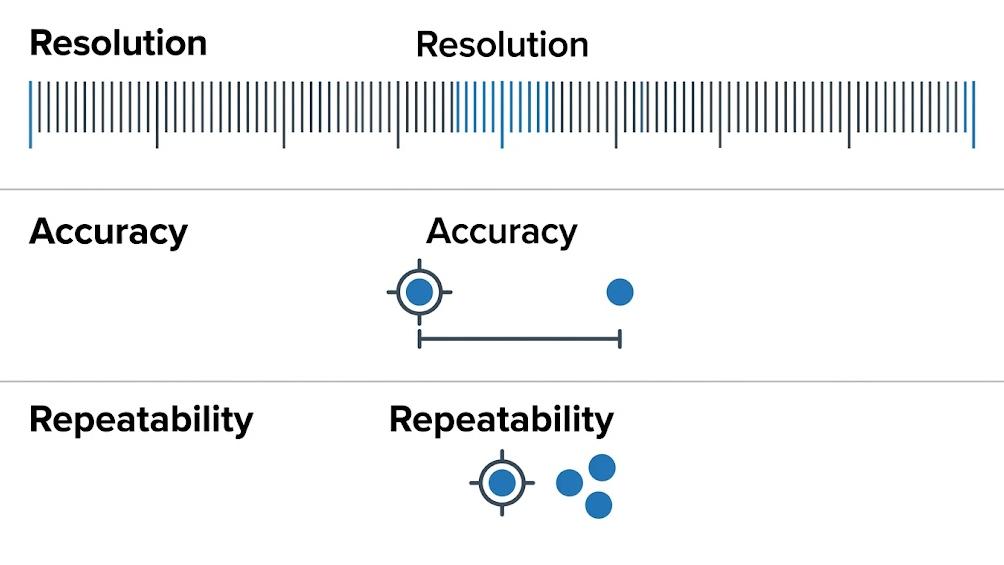
Consider an optical delay line with a target delay of 100,000 ps.
Resolution indicates the smallest incremental delay that the system can adjust or display. If the resolution is 10 fs, the delay can be controlled or read in steps of 10 fs.
However, this does not mean that the accuracy of the actual delay is also 10 fs.
Precision represents the closeness of the actual delay to the target value or reference value. For example, if the set delay is 100,000 ps and the actual value is 100,000.015 ps, the deviation is 15 fs.
Repeatability concerns another issue: Can the delay be moved away and then set back to the same position and return to the previous position?
For instance, multiple measurements might yield:
100,000.012 ps → 100,000.013 ps → 100,000.012 ps
Although there is a deviation from 100,000.000 ps, the positioning results are highly consistent.
These three indicators can be remembered as follows:
- Resolution: How finely can I adjust?
- Precision: How close am I to the target value?
- Repeatability: Can I return to the same position again?
The three are interrelated, but the excellence of one indicator does not imply the excellence of the others.
Why High Resolution Does Not Always Mean High Accuracy
Assume that the resolutions of both delay lines are 10 fs. Both of them can be finely adjusted, but one of them may have a higher calibration or positioning accuracy. Although the resolutions are the same, the actual delay errors may be different.
This is similar to using a ruler with fine graduations. Fine graduations make it easier to read the measurement values, but they do not guarantee that the ruler itself is perfectly calibrated. The same is true for optical delay lines.
The actual delay accuracy may be affected by the following factors:
- Calibration
- Mechanical positioning
- Optical path difference
- Wavelength
- Temperature
- Systematic error
Therefore, the actual performance of the delay line cannot be judged solely based on the resolution. A 10 fs resolution indicates that the delay can be adjusted very precisely, but it does not mean that the actual delay accuracy is ±10 fs.
For precise applications, both resolution and accuracy should be taken into consideration.
Why Repeatability Matters More Than You Think
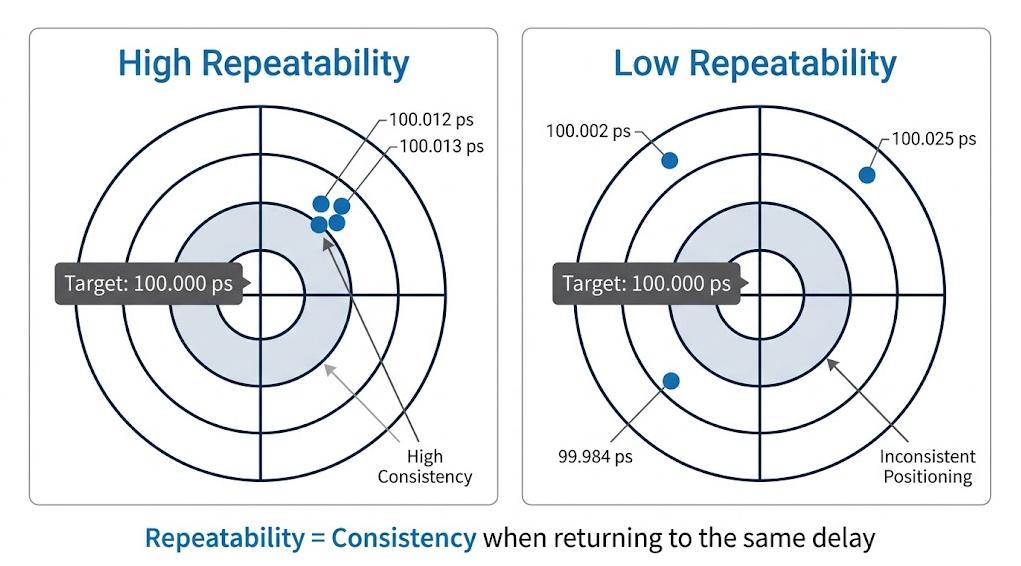
When the optical delay line needs to be repeatedly positioned rather than being set only once, repeatability becomes extremely important.
Suppose the system completes the measurement at a certain delay position, then moves to another position, and returns to the initial setting. If the delay line can always return to an almost identical optical delay each time, the measurement results will remain stable.
For example:
100.012 ps → 100.013 ps → 100.012 ps
Although there is a slight deviation from 100.000 ps, the positioning results are highly consistent.
Let’s look at another situation:
100.002 ps → 100.025 ps → 99.984 ps
Even though the average value is close to the target value, the deviation between different measurements will reduce the predictability of the system.
This difference is particularly important in interferometry, repetitive optical scanning, calibration, fiber testing, and automated measurement.
Stable systematic errors can usually be compensated by measurement and calibration, while poor repeatability is more difficult to handle because the error will change with each measurement.
In a single sentence, accuracy tells you how close the result is to the true value; repeatability tells you whether you can reliably return to the same result.
Which Specification Matters Most for Your Application?
The most important specifications of the optical delay line depend on the specific application.
If precise adjustment of the delay or detailed scanning is required, resolution is more important because it determines the minimum adjustment amount.
If the actual optical delay must be close to the target value, accuracy should be the focus. This is particularly important for precise timing or optical path calibration.
For systems that need to repeatedly move between the same delay positions, repeatability may be more crucial. Small stable deviations can usually be compensated for through calibration, while unpredictable positioning errors are difficult to eliminate.
Therefore, these three indicators should be considered together:
- Resolution: Determines how fine the adjustment can be.
- Accuracy: Determines how close the actual value is to the target value.
- Repeatability: Determines whether the same position can be returned stably.
The correct choice depends on which indicator has the greatest impact on the actual measurement.
How Should You Read an Optical Delay Line Datasheet?
When comparing optical delay lines, read the specifications as a group rather than focusing on a single number.
First, look at the resolution: What is the minimum increment of delay that the system can set or read?
Second, look at the accuracy: How close is the actual delay to the set value or reference value?
Then, look at the repeatability: Can the system consistently reproduce the previous delay after reverting to the same setting?
Also, pay attention to the test conditions, including wavelength, temperature, delay range, and measurement method. Under different test conditions, two products may give similar specifications, but their actual performance may differ.
For applications with higher requirements, factors such as temperature drift, long-term stability, insertion loss, and polarization performance should also be considered.
When reading the data manual of the optical delay line, remember:
Resolution indicates the smallest change that the system can distinguish or adjust; accuracy indicates the closeness of the actual value to the set value or reference value; repeatability indicates whether the system can consistently reproduce the same result.
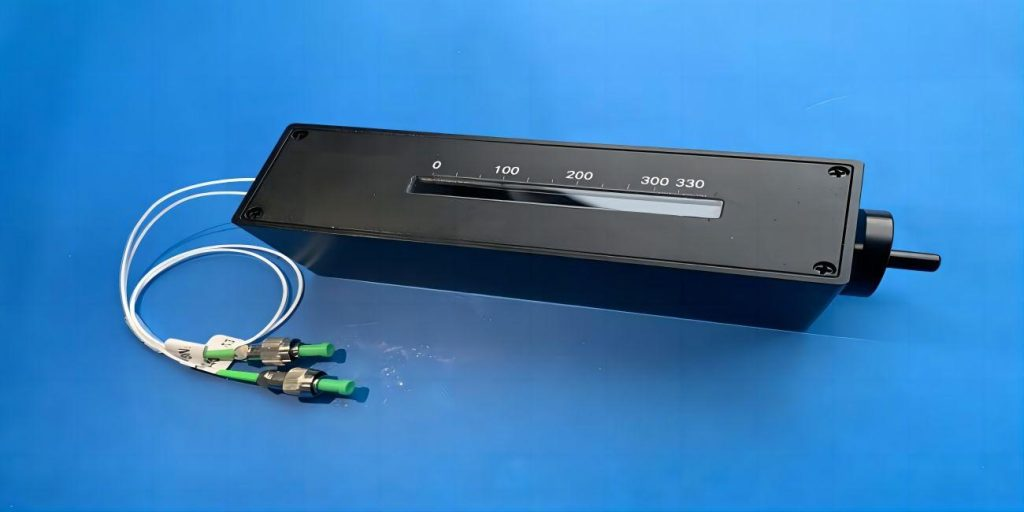
Final
Resolution, precision, and repeatability respectively reflect the different performances of the optical delay line. Resolution determines the fineness of delay adjustment, precision indicates the closeness of the actual delay to the target value, and repeatability represents whether the system can return to the same position stably.
High resolution does not necessarily mean high precision, and high precision does not imply excellent repeatability. Therefore, when evaluating these parameters, the actual application requirements should be taken into consideration.
When choosing an optical delay line, factors such as temperature stability, long-term drift, insertion loss and working conditions should also be considered.
If you are looking for an optical delay line that combines resolution, precision and repeatability, you can further learn about our optical delay line solutions and select the configuration that suits your application.