
Optimizing the Fiber AOM for Quantum Computing and Atom Trapping Systems
The commercialization of quantum computing has driven the transformation of quantum optical architectures. Whether in neutral atoms or ion trap systems, expanding quantum bits to the scale of data centers requires extremely high optical stability. In the past, free-space acousto-optic modulators (AOMs) were the main tool for controlling lasers. However, when thousands of components are densely arranged, the free-space structure encounters severe bottlenecks: large volume, high insertion loss, and being highly susceptible to vibrations and temperature changes.
To achieve the latest expansion indicators, system integrators are rapidly replacing free-space layouts with all-fiber architectures. The integration of fiber-optic acousto-optic modulators has become a key breakthrough. It confines laser control within sturdy, pre-aligned fiber packages, eliminating the cumbersome alignment process and fundamentally reducing drift, providing the core reliability for commercial quantum applications.

Core Applications of Fiber AOMs in Atom Trapping & Manipulation
Optical Tweezers & Sorting
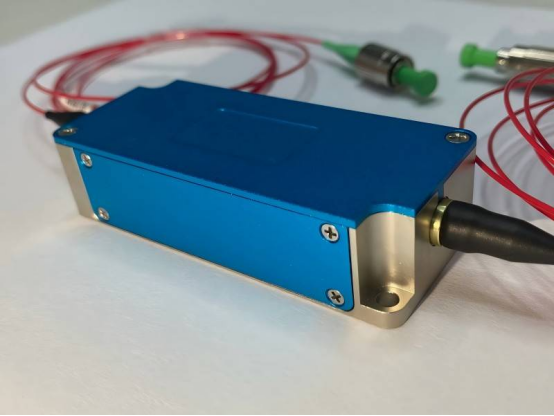
Neutral atomic quantum computing cannot do without optical tweezers. Optical tweezers use highly focused lasers to fix individual atoms in multi-dimensional grids. A high-quality fiber AOM (acoustic-optic modulator) is the “core engine” that controls these optical grids. It can precisely achieve the following functions:
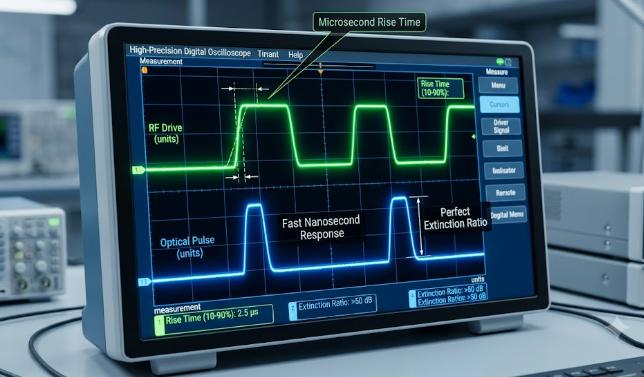
- Microsecond-level spatial steering: By altering the driving radio frequency (RF), engineers can change the frequency of the diffractive laser within just a few microseconds, thereby precisely adjusting the deflection direction of the laser beam.
- Dynamic defect filling: If an atomic deficiency is detected in the quantum bit array, the fiber AOM will immediately adjust the laser and control the optical tweezers to capture the excess atoms to fill the vacancies.
- Maintain coherence: This device responds extremely quickly and maintains an extremely stable direction. It can complete atomic manipulation in a very short time, avoiding the generation of unexpected heat, thereby effectively protecting the coherence state of the atoms.
Rydberg State Excitation & Coherent Control
To achieve multi-qubit logic gates, high-precision laser pulses are required to excite neutral atoms from the ground state to the Rydberg state. This process utilizes the electromagnetically induced transparency (EIT) technique. The requirements for the laser are as follows:
- Microsecond-level frequency fine-tuning: Utilizing a high-performance fiber acousto-optic modulator (AOM) to precisely adjust the laser frequency, with an error control within sub-MHz, ensuring perfect alignment with the atomic resonance frequency.
- Nanosecond-level rapid response: Due to the extremely short lifetime of the Rydberg state, the modulator must complete the laser switching and state transition within nanoseconds to prevent the atoms from decaying prematurely.
- Strictly control phase errors: By reducing pulse delay and distortion, prevent quantum bit decoherence, thereby ensuring the high fidelity required for complex quantum algorithms.
Stimulated Raman Transitions
Ion-based quantum computing often utilizes stimulated Raman transitions to drive quantum gates. This technique requires two locked lasers with a frequency difference precisely equal to the hyperfine splitting energy level of the ions:
- GHz-level frequency shift: Utilizing a dedicated optical fiber acousto-optic modulator (AOM) as a high-precision frequency converter, this crucial gigahertz (GHz) level frequency difference is precisely generated.
- Common-path isolation: Allows two beams of light to be transmitted through the same optical fiber. This way, they will experience the same temperature and vibration variations, naturally canceling out environmental interference.
- High-fidelity drive: This “simultaneous advance and retreat” stability prevents the relative phase drift between the beams, enabling the drive fidelity of the quantum gate to exceed 99.9%.
Key Optimization Strategies for Quantum-Grade Fiber AOMs
In quantum computing, the performance requirements of optical fiber acousto-optic crystals (AOM) are much higher than those of ordinary industrial laser marking. This is because quantum states are highly susceptible to interference, and even minor optical anomalies can lead to quantum decoherence (loss of information).
- Phase noise and residual amplitude modulation (RAM) suppression
Quantum coherence is highly sensitive to phase changes. When a radio frequency signal drives a crystal, temperature variations or impedance mismatches can cause small phase fluctuations or residual amplitude modulation (RAM). RAM alters the intensity of the laser pulse, thereby leading to errors in the rotation angle of the quantum bit. To solve this problem, advanced crystal bonding techniques and precise radio frequency matching are required to ensure uniform propagation of sound waves, thereby minimizing phase noise and suppressing RAM to the greatest extent.
- Maximizing Polarization Extinction Ratio (PER) Stability
The laser polarization must be kept stable; otherwise, it will not be able to trigger atomic transitions effectively. Therefore, the quantum-level optical fiber AOM must use high-quality polarization-maintaining (PM) optical fibers. To maintain a polarization extinction ratio (PER) of over 23 dB in various environments, the stressed area of the fiber must be separated from the internal encapsulation material. This can prevent long-term mechanical stress from altering the birefringence characteristics of the fiber.
- High Power Handling & Insertion Loss Reduction
To capture and cool hundreds of atoms, extremely high laser power (covering the ultraviolet to visible light spectrum, such as 397nm/461nm/780nm) is required. At high power levels, ordinary coatings will cause severe insertion loss and result in beam distortion due to local heating. Therefore, the quantum-level fiber acousto-optic modulator adopts materials with high damage threshold (such as fused silica or tellurium dioxide), and is equipped with a special anti-reflection (AR) coating. This enables the device to control insertion loss to below 1.5 dB while withstanding high continuous-wave power.
Fiber AOM Technical Specification Benchmark Matrix for Quantum OEM Buyers
When selecting optical fiber AOMs for bulk procurement or for quantum system integration, the OEM engineering team needs to focus on comparing the following key performance indicators:
| Key Performance Parameter | Quantum-Grade Target Benchmark | Critical Impact on Qubit & Optical Fidelity |
| Available Wavelength Ranges | 397 nm, 461 nm, 532 nm, 780 nm, 1064 nm | Must provide high-transmission options matching atomic cooling and Rydberg lines. |
| Polarization Extinction Ratio (PER) | >= 22 dB to 25 dB (PM Fiber) | Eliminates polarization cross-talk to preserve quantum logic gate fidelity. |
| Rise / Fall Time (Modulation Speed) | <= 10 ns to 30 ns | Enables microsecond-scale pulse shaping and agile optical switching. |
| Optical Insertion Loss | <= 1.2 dB to 1.8 dB | Prevents optical power degradation across multi-channel distribution networks. |
| Dynamic RF Extinction Ratio | >= 50 dB (Single), >= 80 dB (Cascaded) | Blocks background photon leakage, preventing unwanted off-resonance atomic transitions. |
| RF Driver Frequency Stability | <= +/- 0.1 ppm | Ensures sub-megahertz laser shifting accuracy for long-term coherent control. |
Summary
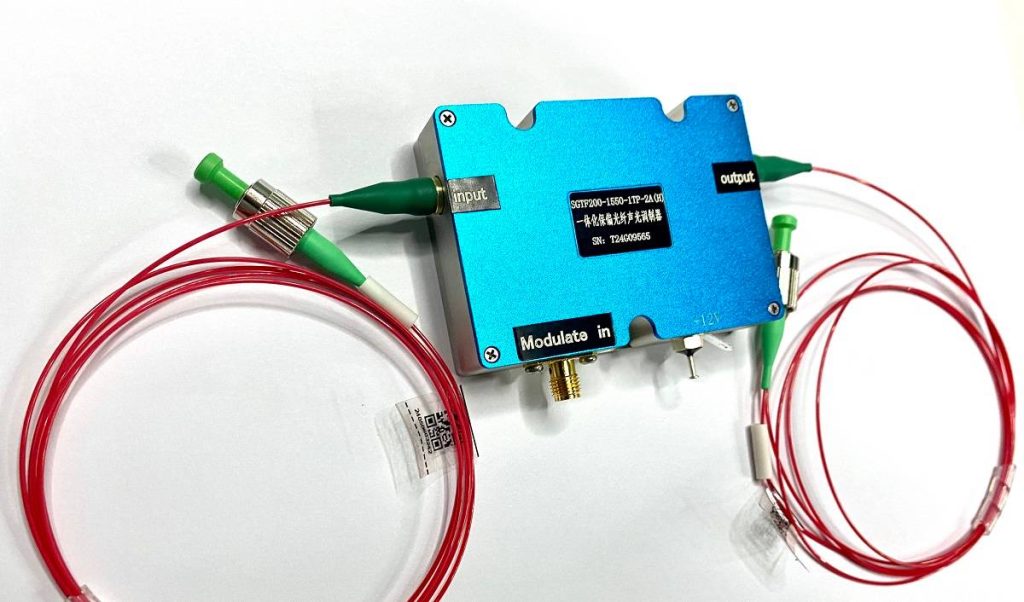
For quantum computers to scale up, they must shift from unstable spatial optical paths to robust high-performance optical fiber components. Therefore, optimizing the optical fiber acousto-optic modulator (AOM) to meet the precise requirements such as atomic trapping and optical tweezers is a crucial step for hardware manufacturers. Optical designers need to focus their efforts on reducing phase noise, stabilizing polarization, and selecting materials with high damage thresholds, in order to ensure the long-term stability required for commercialization. For laser system integrators (OEMs), choosing such high-performance optical fiber components is no longer an option but the core foundation for building future quantum data centers.