
VPP-dBm Conversion
When using RF amplifiers and some RF drivers, an RF signal needs to be input. Sometimes the magnitude of the input signal is marked as the VPP voltage amplitude, and sometimes it is marked as the power magnitude in dBm. So, what is the relationship between Vpp and dBm?
This article introduces the conversion formula between the voltage peak-to-peak (Vpp) and decibel milliwatts (dBm) of a sine wave under a 50Ω impedance condition. This specifically includes how to calculate the corresponding dBm value based on the given Vpp value, help with RF impedance matching, and analog signal processing.
Vpp stands for peak-to-peak value. Peak-to-peak value refers to the difference between the highest and lowest values of a signal within a period, which is the range between the maximum and the minimum. It is used to describe the magnitude of the signal’s variation range.
If the input is a sinusoidal signal, the peak value of the sinusoidal wave is √2 times the effective value. The magnitude of the Vpp value is twice the amplitude value. Therefore, the amplitude of the sine wave should be Vpp/2, the effective value is Vpp/(2√2), and at a 50Ω impedance, the power is
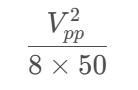
convert to dBm:
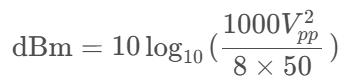
When Vpp=1V, the corresponding dBm value should be 3.97944dBm.
Therefore, under a 50Ω impedance, the conversion formula between the sine wave signal dBm and Vpp is as follows:

Further calculation reveals:

The above is the conversion relationship between Vpp and dBm. I would be honored if it could be of help to you.