
Why 780nm and 461nm Fiber AOMs Are Critical for Cold Atom and Quantum Research
For researchers in quantum research laboratories and developers of atomic clocks, laser cooling and trapping ultimately boil down to an eternal challenge: maintaining absolute control over the frequency and intensity of light without introducing instability. Whether through frequency modulation for sub-Doppler cooling or using fast shutters to maintain coherence in magnetic optical traps (MOTs), mechanical shutters and manual alignment cannot meet the microsecond-level timing requirements.
At this point, the acoustic-optical modulator (AOM) or the acoustic-optical frequency converter (AOFS) becomes the critical bottleneck in the optical path.
Although free-space AOM has always been a standard component in laboratories, the current trends in portable atomic sensors and industrial quantum computing require a more stable and alignment-free solution: all-fiber-coupled AOM. In this article, we will discuss why precise resonance lines of rubidium at 780 nm and strontium at 461 nm need specialized fiber-coupled hardware, and how to select the appropriate specifications to avoid the decline in optical performance in the setup.
The Crucial Role of AOMs in Laser Cooling

To understand the significance of acoustic-optic modulators (AOMs), one must first grasp the working principle of magnetic optical traps (MOTs). Laser cooling relies on the Doppler effect, where atoms moving towards the laser beam perceive a blue-shifted light, absorb photons, and lose momentum.
To ensure the effectiveness of this process, the laser frequency must be precisely “red detuned” (slightly below the atomic resonance frequency).
Furthermore, at different stages of the experiment – such as transitioning from the Doppler cooling stage to the sub-Doppler cooling (Sisyphus cooling) or loading the atoms into the optical lattice – the laser frequency and power must be dynamically adjusted within microsecond intervals.
The acoustic-optic modulator (AOM) achieves this function by utilizing the photovoltaic effect. The radio frequency driver injects a radio frequency signal into the piezoelectric transducer connected to the acoustic-optic crystal (such as tellurium dioxide (TeO2) or fused quartz). This causes a traveling wave acoustic wave to be generated inside the crystal, which serves to move the phase grating.
When the laser passes through the crystal, Bragg diffraction occurs, resulting in the following effects:
- Frequency offset: The offset of the diffracted beam is exactly equal to the RF frequency, thereby achieving real-time frequency tuning.
- Ultra-fast switch: Turning on or off the radio frequency power is equivalent to a super-fast optical switch (with a rise time of less than 20–50 ns), and its performance is far superior to that of mechanical shutters, which introduce vibrations and delays.
- Intensity control: By adjusting the radio frequency power, researchers can precisely reduce the laser intensity, thereby balancing the laser beam of the magnetic optical trap (MOT).
780nm vs 461nm in Specific Quantum Systems
780nm Fiber AOM
Rubidium (Rb-87) is a widely studied alkali metal atom in quantum physics. It is the fundamental element for Bose-Einstein condensates (BEC), atomic interferometers, as well as commercial quantum gyroscopes or magnetometers.
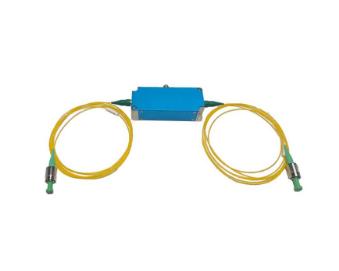
The main D2 resonance line of rubidium is located at 780.24 nm.
In a typical rubidium quantum device, the 780 nm fiber acousto-optic modulator (AOM) plays several key roles:
Re-pumping and cooling line: Using AOM to continuously switch and shift the frequencies of the main cooling laser and the repumping laser, so that rubidium atoms remain in the required cooling transition state and cycle.
Why choose fiber coupling? The traditional 780 nm free-space optical path is extremely sensitive to thermal drift, airflow, and mechanical vibration. A single misalignment of a mirror could result in weeks of data loss. Integrating a 780 nm fiber-coupled AOM into the optical path allows the alignment to be permanently locked within the polarization-maintaining fiber (PM), enabling on-site deployment of quantum sensors and highly stable laboratory environments.
461 nm Fiber AOM
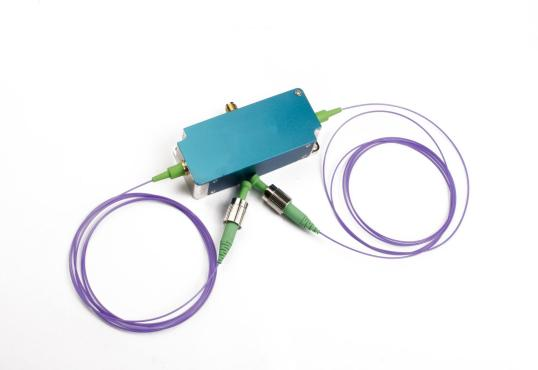
The main broadband pumping and main cooling transitions of strontium require a blue light wavelength of 460.86 nm (often referred to as 461 nm).
Operating within the blue light visible spectrum range will bring about serious technical bottlenecks, posing challenges for the design of the 461 nm acoustic optical modulator (AOM):
- High photon energy and photodarkening: The energy of blue photons is much higher than that of near-infrared (780 nm) photons. This significantly increases the risk of optical degradation (photodarkening) in optical fibers and crystal coatings, resulting in an increase in insertion loss over time.
- Thermal lensing effect: At a wavelength of 461 nm, even if the absorption of the acousto-optic medium is extremely small, a local temperature gradient will still be generated. This will change the refractive index of the crystal, causing the profile of the laser beam to be distorted (thermal lensing effect), thereby significantly reducing the efficiency of coupling to the output optical fiber.
Therefore, for the high-performance 461 nm optical acousto-optic modulator (AOM), special crystals with extremely low blue light absorption, high damage threshold anti-reflection (AR) coatings, and reliable thermal management need to be selected to ensure stable diffraction efficiency in the continuous wave (CW) operation mode.
Key Technical Metrics Researchers Actually Care About
When choosing an optical fiber-coupled acousto-optic modulator (AOM) for systems with wavelengths of 780nm or 461nm, the following three optical performance indicators should be given priority consideration:
- Scattering ratio (ER): The high-scattering-ratio models must achieve 50 dB or higher. When the AOM is switched to the “off” state, any leaked residual photons could lead to unnecessary optical frequency shifts or accidental heating of the trapped atoms, thereby prematurely destroying quantum coherence.
- Polarization extinction ratio (PER): When using polarization-maintaining (PM) optical fibers, the target specification should be 20 dB or higher. Due to the highly state-selective atomic transitions in laser cooling, a lower polarization extinction ratio will introduce polarization crosstalk, thereby reducing the capture efficiency.
- Insertion Loss (IL): Maximizing power efficiency is crucial because high-power single-frequency lasers at 461nm and 780nm are expensive. Keeping the insertion loss below 2.0 to 2.5 dB ensures that the maximum light flux reaches the vacuum science chamber.
Optimizing these precise benchmark parameters can ensure high diffraction efficiency and reproducible experimental results in a demanding quantum environment.
Conclusion
The future of quantum technology lies in miniaturization. Transitioning from large and complex optical platforms to modular, fiber-integrated subsystems is beneficial for the commercialization of quantum computers and portable atomic clocks.
The 780 nm and 461 nm fiber-coupled acousto-optic modulator (AOM) addresses the vulnerability of free-space alignment, providing the exceptional frequency stability, ultra-fast switching speed and high extinction ratio required for processing the complex physical properties of rubidium and strontium atomic systems.
Need High-Performance Acousto-Optic Solutions?
SMART SCI & TECH specializes in the R&D and manufacturing of high-reliability acousto-optic devices. We offer specialized 780 nm and 461 nm Fiber-Coupled AOM / AOFS Series featuring high damage thresholds, premium Polarization-Maintaining (PM) fibers, and customizable frequency shifts tailored to your exact quantum research or industrial laser specifications.
Looking for a custom configuration or a technical datasheet? Contact our Optical Engineering Team today or submit a request via our Product Selection Page for a free quotation!