
Optical Delay vs. Phase Delay: What Is the Difference?
The optical delay is closely related to the phase delay, but they are not the same. Optical delay indicates the lag in the signal arrival time, while phase delay represents the deviation of the signal phase from the reference baseline.
This difference is particularly important in systems such as optical communication, fiber radio frequency transmission (RF-over-fiber), interferometry, sensing, and phased arrays. For single-frequency signals, the phase shift can directly correspond to the time delay; however, for broadband or pulse signals, the optical time delay is usually more practically significant.
Optical Delay vs Phase Delay: The Key Difference
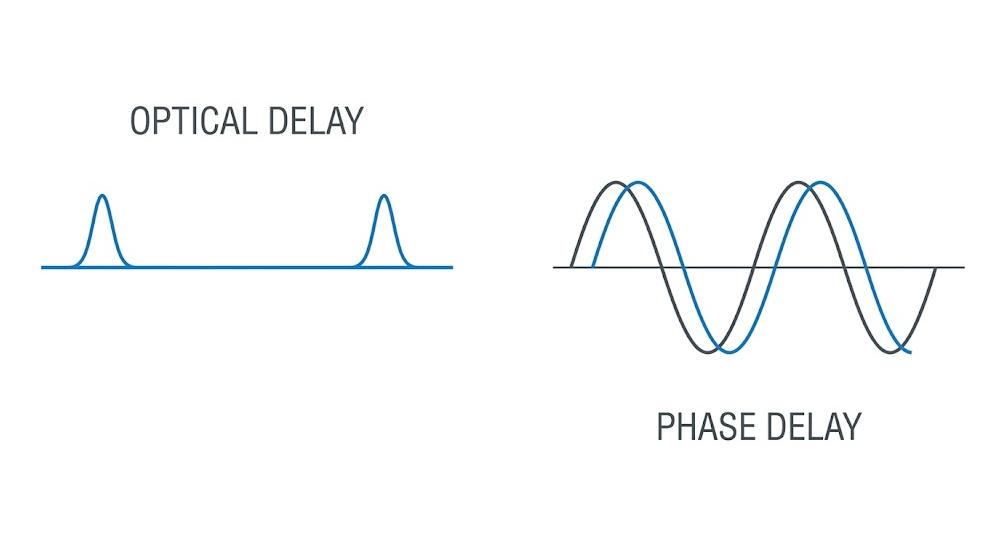
The simplest way to distinguish them is to look at what each parameter measures.
| Parameter | Optical Delay | Phase Delay |
| What it describes | Signal arrival time | Phase shift |
| Typical unit | ps, ns, us | Degree, rad |
| Main factor | Optical path length | Frequency and phase response |
| Best suited for | Timing and synchronization | Phase control |
| Broadband performance | Can provide true time delay | Phase shift varies with frequency |
At a specific frequency, the relationship between phase and time delay is:
Δφ = 2πfΔt
Here, Δφ represents the phase difference, f is the frequency, and Δt is the time delay.
The same time delay will result in different phase differences at different frequencies. A fixed optical delay may correspond to a smaller phase difference at low frequencies, while it may cause a larger phase difference at high frequencies.
Therefore, the phase difference at a specific frequency cannot directly represent the actual time delay over a wide frequency range.
Why Phase Delay Is Not the Same as True Optical Delay
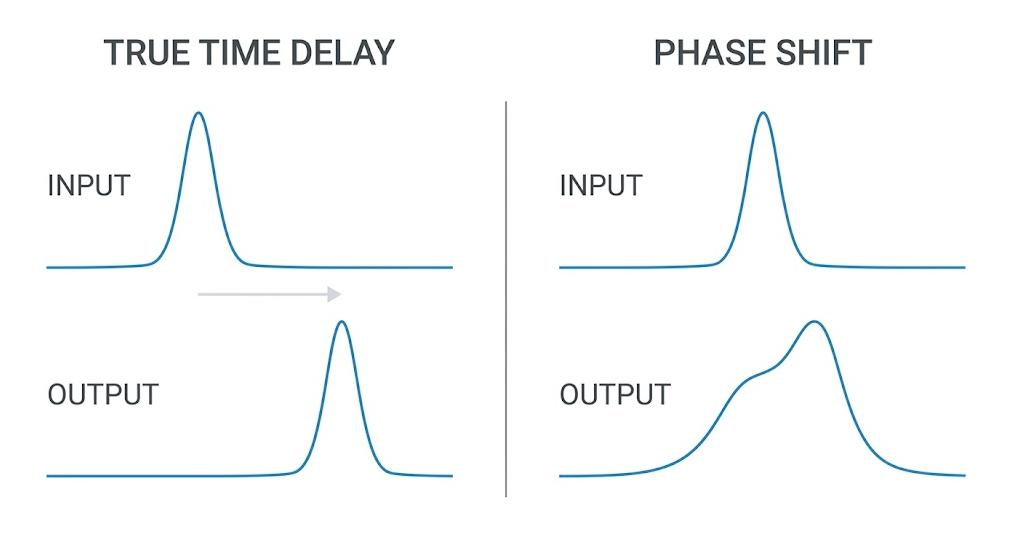
For narrowband or continuous wave signals, phase adjustment is usually sufficient. With a known and stable operating frequency, the desired signal relationship can be achieved by setting the corresponding phase offset.
However, for broadband signals or short optical pulses, relying solely on phase shift may not meet the requirements.
Broadband signals contain multiple frequency components. If different frequencies experience different delays, the signal waveform will change. The phase shift in a single frequency cannot guarantee the temporal consistency throughout the entire bandwidth, which may lead to:
- Pulse distortion
- Frequency-related timing errors
- Beam squint in phased array systems
- Decreased synchronization accuracy
- Broadband phase relationship distortion
Therefore, for systems that need to maintain consistent timing over a wide frequency range, the True Time Delay (TTD) technology is very important.
Phase shift alters the phase relationship at a specific frequency, while true light delay changes the actual arrival time of the signal.
This distinction is an important basis for choosing the appropriate delay technology.
Read more: How to Build a Fiber-Based True Time Delay System?
Optical Delay or Phase Delay: Which One Do You Need?
The appropriate choice depends on whether the application focuses more on timing or phase.
Optical delay is more suitable for:
- Precise pulse synchronization
- Real-time delay
- Optical path matching and compensation
- Interferometer adjustment
- Broadband phased array and radar
- Fiber optic sensing and measurement
- Precise time control
When the requirements are expressed in nanoseconds, picoseconds, or specific optical path differences, optical delay lines are usually more appropriate.
Phase delay or phase shift is more suitable for:
- Continuous wave laser phase adjustment
- Narrowband radio frequency (RF) or microwave phase control
- Coherent light detection
- Interference phase tuning
- Phase locking
- Specific frequency phase offset
A simple engineering judgment is: if you need “to make the signal arrive later”, consider optical delay;
If you need “to shift the phase by X degrees”, then consider phase control.
When both time and phase need precise control, controllable optical delay lines can achieve direct control of the signal propagation time by adjusting the optical path.
How an Optical Delay Line Creates Phase Delay
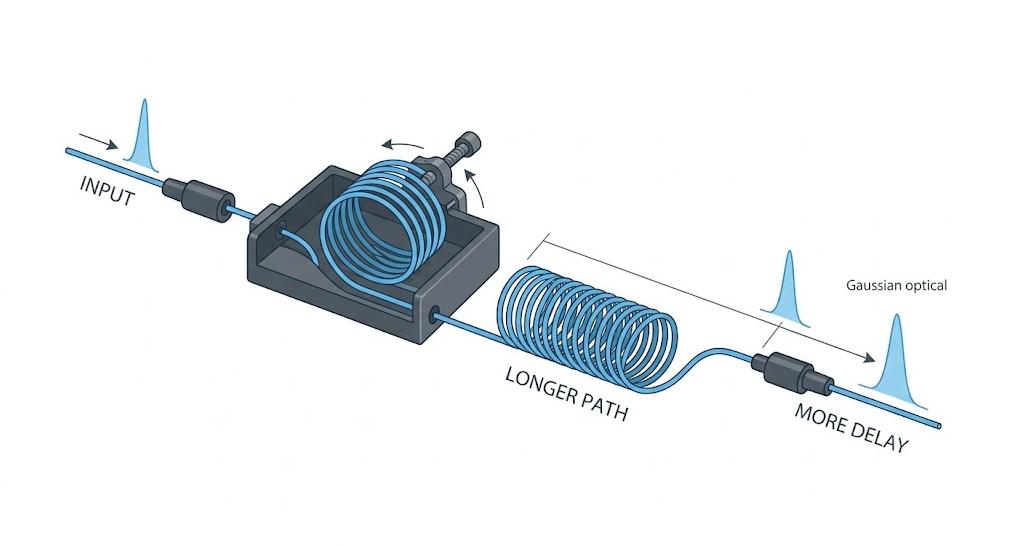
The optical delay line achieves delay by altering the optical path that the signal travels through. The longer the optical path, the longer the time required for the signal to propagate, thereby resulting in an optical time delay. Since the phase accumulation is related to the propagation distance and frequency, changes in the optical path also cause changes in the phase.
The basic relationship is:
Change in optical path → Change in propagation time → Change in phase
Therefore, the optical delay line can be used for time adjustment as well as phase compensation.
According to the application requirements, the optical delay can be achieved through mechanical adjustable optical path, fiber delay structures, or electronic control methods. For applications that require precise and repeatable adjustment, the performance of the delay mechanism and the nominal delay range are equally important.
What to Check When Selecting an Optical Delay Line
The maximum delay is just one of the factors to be considered during the selection process. For actual optical systems, the following parameters need to be comprehensively evaluated:
1. Delay range: Determine the minimum and maximum delays that the delay line can achieve, and ensure that the range covers the required optical path difference while leaving sufficient margin.
2. Delay resolution, accuracy, and repeatability: These three aspects respectively reflect different positioning performances. High resolution does not mean high accuracy, and high accuracy does not necessarily imply high repeatability. For precise timing or phase compensation applications, these three indicators should be comprehensively evaluated.
3. Insertion loss: An increase in optical path may bring additional losses, so it is necessary to ensure that the delay line provides sufficient optical power to the receiver or downstream optical components within its operating range.
4. Wavelength and bandwidth: The delay line should match the working wavelength and the required optical bandwidth, especially for broadband and pulse applications.
5. Response speed and stability: Manual adjustment is suitable for laboratory optical path alignment and calibration; for dynamic systems that require automatic or remote adjustment, electrical control delay methods are more appropriate.
Read more: 7 Key Parameters to Check Before Buying a Variable Optical Delay Line
Final
The concepts of optical delay and phase delay describe two related but distinct parameters in the propagation of signals.
Optical delay corresponds to the propagation time, while phase delay corresponds to the phase change. At a specific frequency, there is a mathematical relationship between the two; however, for wideband signals, the phase shift at a single frequency cannot directly represent the actual time delay.
For applications such as broadband signals, pulse synchronization, optical path matching, or true time delay (TTD), the actual optical delay performance should be prioritized over merely focusing on the phase shift.
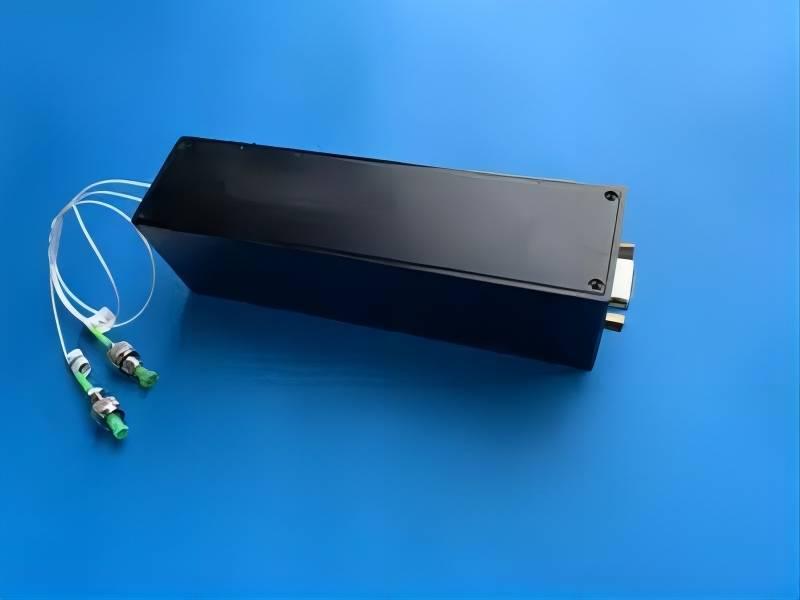
If you require controllable optical path for precise timing, phase compensation, or optical path matching, you should explore SMART SCI & TECH‘s optical delay line solutions. Choose the appropriate configuration based on the required delay range, resolution, wavelength, and control method.