
What Determines the Damage Threshold of an AOM?
Optical acousto-optic modulators (AOMs) are widely used in precision laser applications such as laser modulation, frequency offset, pulse selection, Q-switching, etc. As laser power increases, the high optical power tolerance of AOMs has also become an important selection criterion.
But what determines the damage threshold of AOMs?
The answer is not just to look at the maximum optical power in the data sheet. The anti-damage capability of AOMs is affected by multiple factors, including acoustic-optic materials, optical power density, wavelength, pulse conditions, thermal management, optical coating, and RF driving conditions.
Understanding these factors can help select the appropriate AOM and reduce performance degradation and optical damage risks.
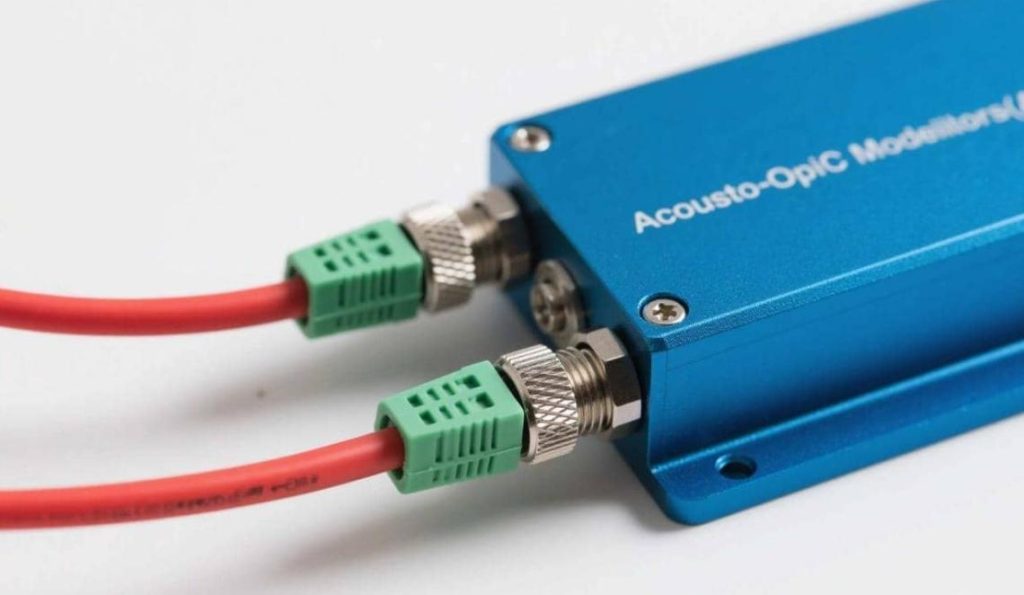
What Is the Damage Threshold of an AOM?
The damage threshold of an acoustic-optic modulator (AOM) refers to the maximum optical load that the device can withstand under specific operating conditions. Exceeding this threshold may lead to permanent physical or performance damage.
Common damages include:
- Optical coating damage
- Crystal damage
- Thermal stress or deformation
- Decreased diffraction efficiency
- Increased optical loss
- Decreased long-term stability
It should be noted that the damage threshold of an AOM is closely related to the specific operating conditions. The nominal power is only of reference value when combined with wavelength, beam size, working mode, and other test conditions.
Therefore, even if two AOMs have the same nominal power, their performance in actual high-power laser systems may still differ.
Key Factors That Determine AOM Damage Threshold
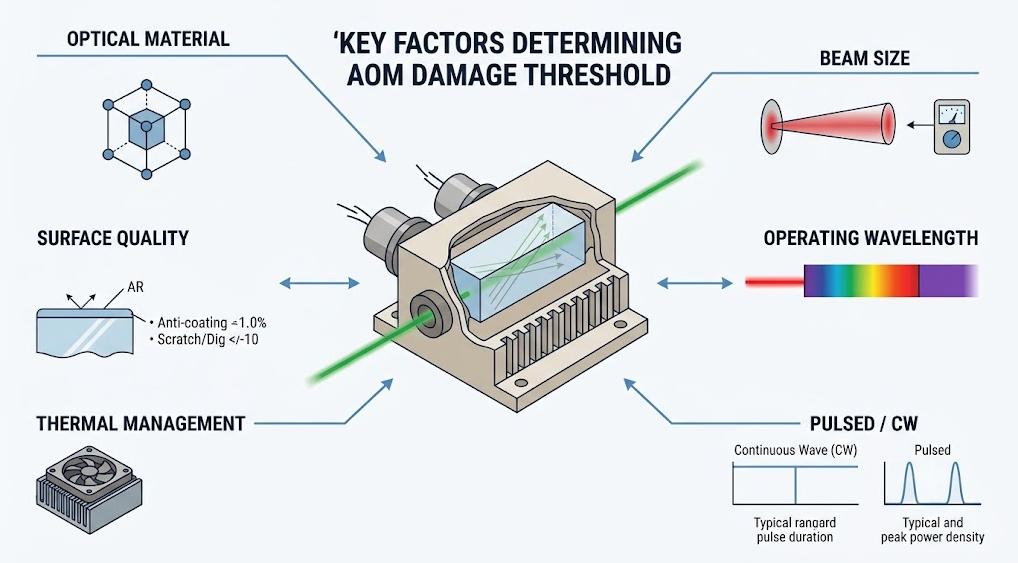
1. Acousto-Optic Material
The AOM crystal material is one of the key factors influencing its power handling capacity.
Different acoustic-optic materials have different light absorption rates, thermal conductivities, thermal expansion coefficients, and acoustic-optic properties. After absorbing some laser energy, the material generates heat, which may form temperature gradients and thermal stresses under high light power, causing a change in refractive index and ultimately leading to permanent damage.
Therefore, material selection needs to take into account both acoustic-optic efficiency and high-power performance.
For high-power applications, engineers not only consider the acoustic-optic quality factor of the material, but also need to pay attention to its light absorption rate and thermal performance at the target wavelength.
2. Optical Power Density and Beam Size
The total laser power is only one of the factors that affect the performance of the AOM; the optical power density is usually more crucial.
When the optical power remains constant, reducing the beam diameter will concentrate the energy in a smaller area, thereby significantly increasing the local power density. For example, with the same 10 W laser, a larger beam diameter may have a much less significant impact on the AOM than a tightly focused beam.
The beam-related factors to be considered include:
- Beam diameter
- Beam profile
- Focus position Beam quality
- Alignment accuracy
For Gaussian beams, the local intensity in the central region is usually higher than the average power density. Therefore, when selecting an AOM, it is necessary to evaluate based on the actual beam size and optical geometry structure, rather than just considering the total optical power.
3. Operating Wavelength
The laser wavelength significantly affects the damage resistance of AOM.
The light absorption rate of the crystal and the anti-reflection coating performance vary with the wavelength. Therefore, an AOM optimized for a specific wavelength does not necessarily mean it has the same power tolerance in other wavelengths.
When evaluating high-power AOM, engineers should confirm:
- Working wavelength
- Crystal material
- Coating wavelength range
- Light absorption rate
- Maximum recommended light power
For systems operating at wavelengths with high crystal absorption rate or limited coating performance, these parameters require particular attention.
4. CW, Pulsed, and Peak Power
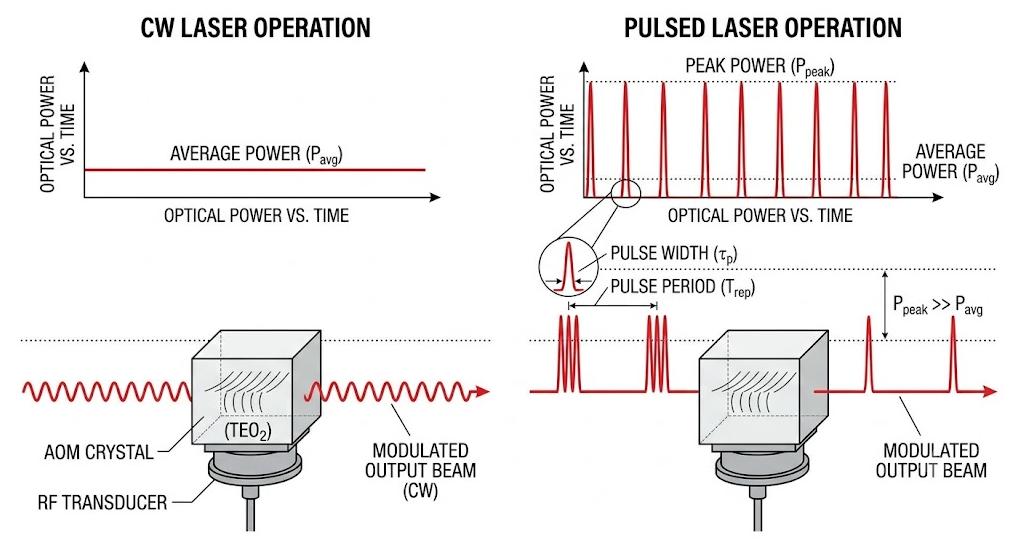
The working mode of the laser is also an important factor affecting the performance of the AOM.
Even if the average optical power is similar, continuous wave (CW) and pulsed lasers will exert different stress states on the AOM.
For pulsed laser systems, engineers should pay attention to:
- Pulse energy
- Pulse duration
- Repetition frequency
- Peak power
- Average power
Short pulses can generate extremely high instantaneous optical intensity; even if the average power is low, it may still cause optical damage.
Therefore, for high-power AOMs used for Q-switching, pulse selection, or pulsed laser modulation, they should be evaluated based on both the average optical load and the peak optical load.
5. Thermal Management
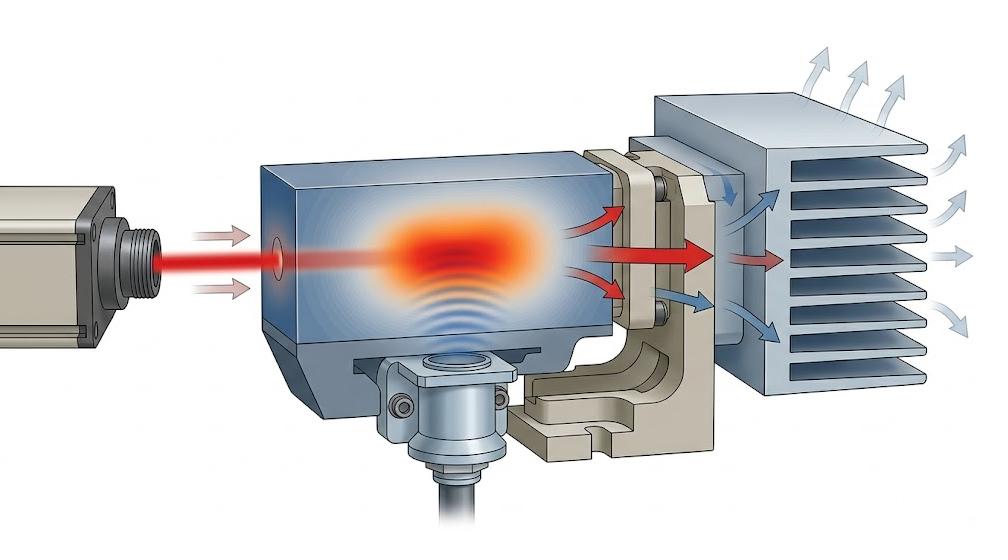
As the optical power and radio frequency power increase, thermal management becomes increasingly important.
Even if the acoustic-optic modulator (AOM) does not immediately suffer optical damage, the absorbed optical energy and radio frequency energy will generate heat within the device. Excessive temperature will alter the refractive index and acoustic properties of the crystal, thereby affecting the diffraction efficiency and beam stability.
Therefore, poor thermal management can lead to:
Heat generation → Temperature increase → Refractive index change → Performance degradation → Potential damage
The overall thermal performance of the AOM depends on the following factors:
- Crystal thermal properties
- Installation structure, heat dissipation
- Radio frequency power
- Operating duty cycle, environmental temperature
For high-power applications with strict requirements, thermal design should be considered as an integral part of the AOM system, rather than being an afterthought.
6. Optical Coating and Surface Quality
The optical surface of the AOM also affects its actual damage threshold.
Anti-reflective coatings are used to reduce reflection at the working wavelength, but coating defects, contamination, surface flaws, or specification mismatches can form local high-intensity areas, becoming the starting point of optical damage.
Therefore, the performance of high-power AOM not only depends on the crystal, but also is related to the following factors:
- Optical coating quality
- Surface smoothness
- Cleanliness
- Coating wavelength range
- Optical component quality
For high-power applications, the coating specifications should match the laser wavelength and the expected light intensity.
How to Select an AOM for High-Power Applications
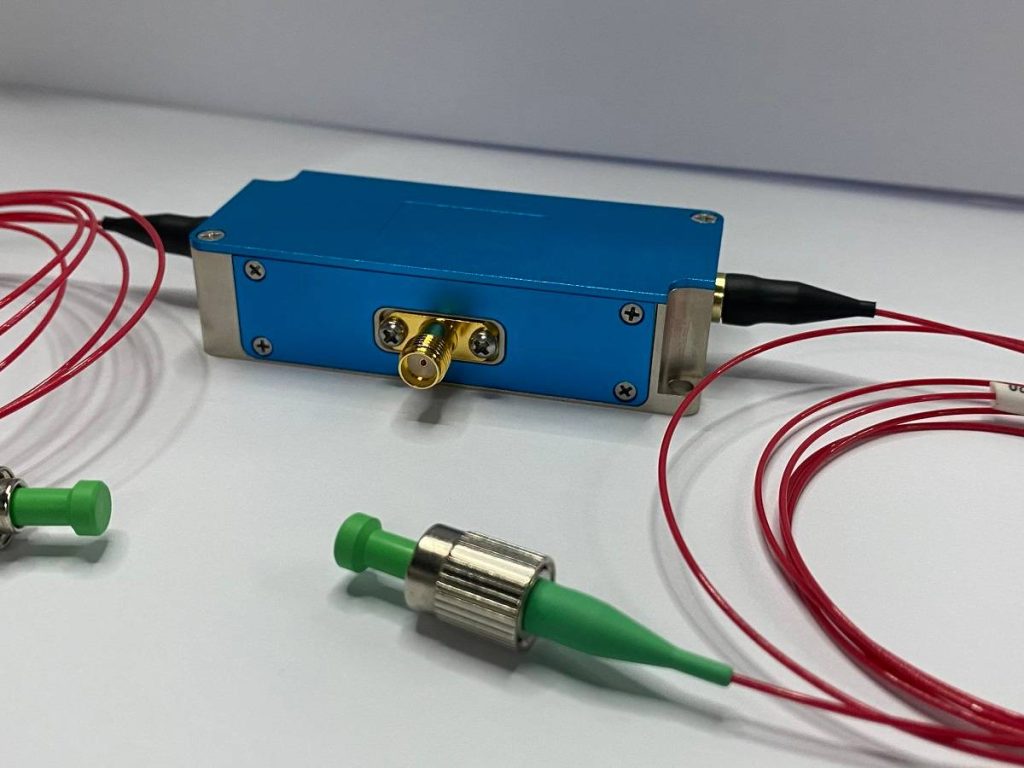
When selecting an AOM for a high-power laser system, one should not merely focus on the single maximum power value, but rather conduct an assessment based on the complete working conditions.
| Parameter | Why It Matters |
| Wavelength | Determines crystal and coating compatibility |
| Average Optical Power | Defines the average optical load |
| Beam Diameter | Determines local power density |
| Pulse Conditions | Determines peak optical intensity |
| Crystal Material | Affects absorption and thermal performance |
| Diffraction Efficiency | Indicates optical performance |
| Thermal Design | Affects temperature and long-term stability |
| Optical Coating | Influences transmission and damage resistance |
At the same time, it is necessary to confirm with the manufacturer the test conditions for the specified damage threshold. This value may be related to the working wavelength, beam diameter, pulse duration, repetition frequency, exposure time, and testing method.
Therefore, if there are no clear test conditions for the damage threshold, its value may not accurately reflect the actual power-bearing capacity of the AOM.
Conclusion
The damage threshold of AOM is influenced by various factors such as material properties, optical power density, wavelength, laser operating conditions, thermal management, and the quality of optical coating.
For high-power laser applications, simply choosing an AOM based on its rated optical power can be misleading. The actual selection should be evaluated in conjunction with complete optical and thermal operating conditions.
Matching the crystal material, beam size, wavelength, pulse conditions, thermal design, and optical coating with the specific application helps improve the reliability of the AOM and reduce the risk of optical damage.
If you are selecting an AOM for high-power laser modulation, frequency conversion, Q-switching, or pulse control, SMART SCI & TECH can assist in evaluating the appropriate AOM specifications based on the laser wavelength, optical power, beam size, and application requirements.