3 Key Factors Affecting Thermal Drift in High-Power AOM Modulators
Thermal drift is the main limiting factor in the integration of high-power AOM modulators. In precision laser systems, the drift caused by temperature can lead to fluctuations in diffraction efficiency and beam pointing stability. Therefore, understanding the mechanical and physical causes of these drifts is crucial for maintaining system calibration of the laser over a long period of operation.
In optical and acoustic modulation, a portion of the optical energy and the RF driving power inevitably gets converted into heat within the device. As the average power increases, the resulting temperature gradient alters the refractive index of the crystal and the physical dimensions of the component. This paper analyzes three technical factors that determine the thermal stability of the acoustic modulator: material properties, RF efficiency, and mechanical packaging.
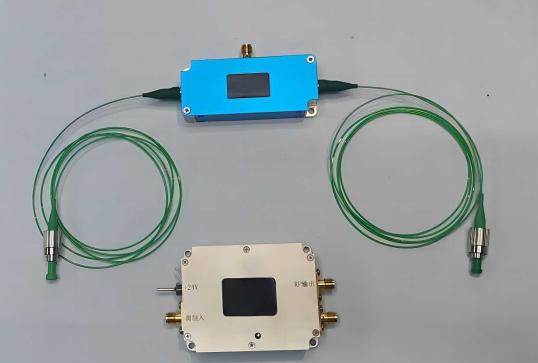
Factor 1: Material Science – The Thermal Conductivity of AO Crystals
The selection of acoustic-optic (AO) media is the primary bottleneck in thermal management. Because each material has its specific thermal conductivity (k) and refractive index that varies with temperature (dn/dT), both of these factors jointly determine the heat dissipation method of the device.
Thermal Lensing Effect
When high-power laser passes through a low thermal conductivity crystal (such as tellurium dioxide (TeO2)), the heat cannot escape quickly along the light path. This creates local “hot spots” in the optical path, resulting in an uneven refractive index distribution on the light aperture. This gradient refractive index acts like a lens, causing the laser beam to be defocused or the waist position to shift.
Comparison of Materials for High-Power Applications
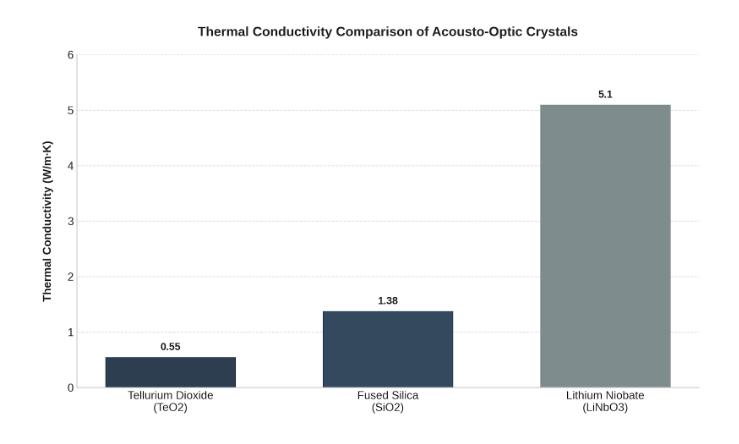
- Tellurium Dioxide (TeO2): Although it is recognized for its high Figure of Merit (M2), the material’s low thermal conductivity (about 3 W/m.K) makes it unsuitable for high average power systems. After a specific power level, the diffraction efficiency will be reduced owing to the change in the Bragg condition caused by thermal expansion.
- Fused Silica: Mostly used in high-power UV and visible lasers’ modulations. This material offers good thermal stability and damage resistance, making it suitable for high power density, although it demands more RF power input in order to modulate efficiently.
- Lithium Niobate (LiNbO3): This material is commonly used in high-powered AOM fiber-coupled systems, especially those that operate on the wavelength of 1550nm, which is employed in telecommunications and LiDAR.
Factor 2: RF Power Management & Transducer Efficiency
A considerable amount of thermal drift actually comes not from the laser but from RF energy that drives the device. The principle of operation of an AOM involves using RF power supplied to a piezoelectric transducer to produce the necessary acoustic waves.
Conversion Losses of Transducers
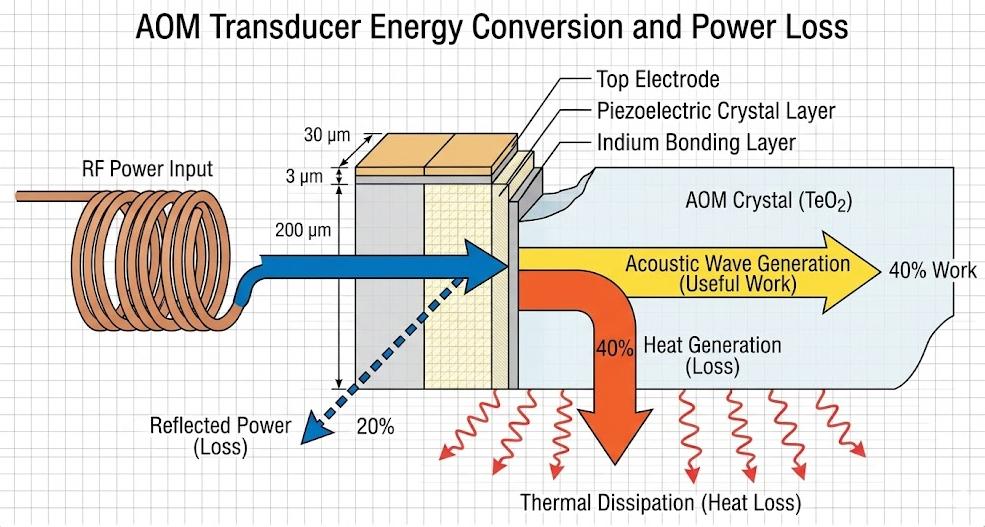
This process of conversion from electrical to acoustic energy is always imperfect. Some amount of RF energy is wasted as heat due to losses at the transducer boundary layer. Moreover, if there is no impedance matching of 50 ohms between the RF source and the AOM, then there is extra reflection of power, which heats both the housing and the crystal body.
Sensitivity of the Bragg Angle
With increasing temperature, the velocity of sound (Va) through the crystal will be altered. Because the Bragg angle is determined by the wavelength of the acoustic wave, this variation due to temperature will alter the angle that gives optimal diffraction efficiency.
Theta_B = (Lambda * f) / (2 * Va)
A small change in Va can lead to a significant drop in diffraction efficiency if the mechanical alignment remains fixed.
Factor 3: Precision Packaging & Mechanical Cooling Design
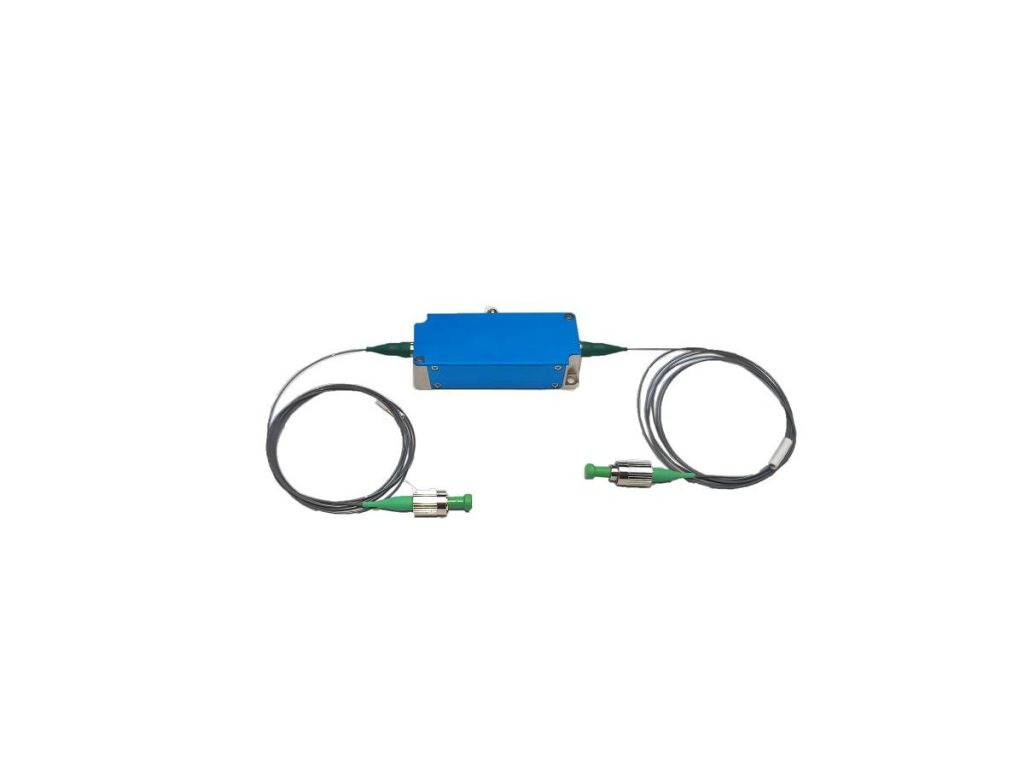
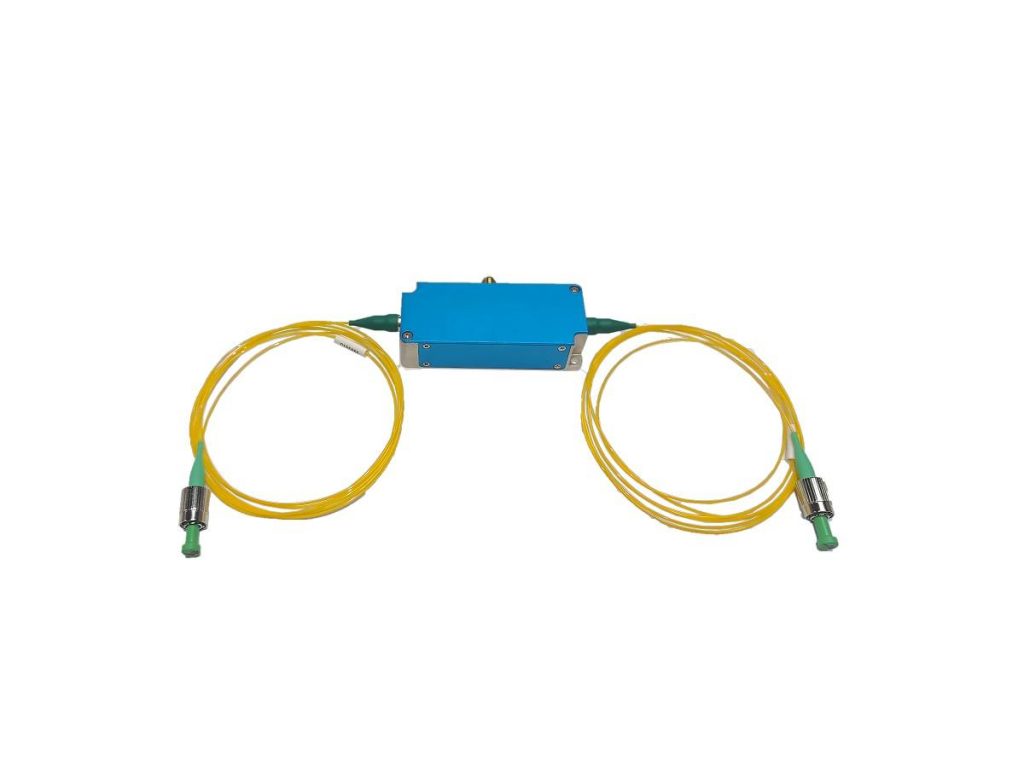
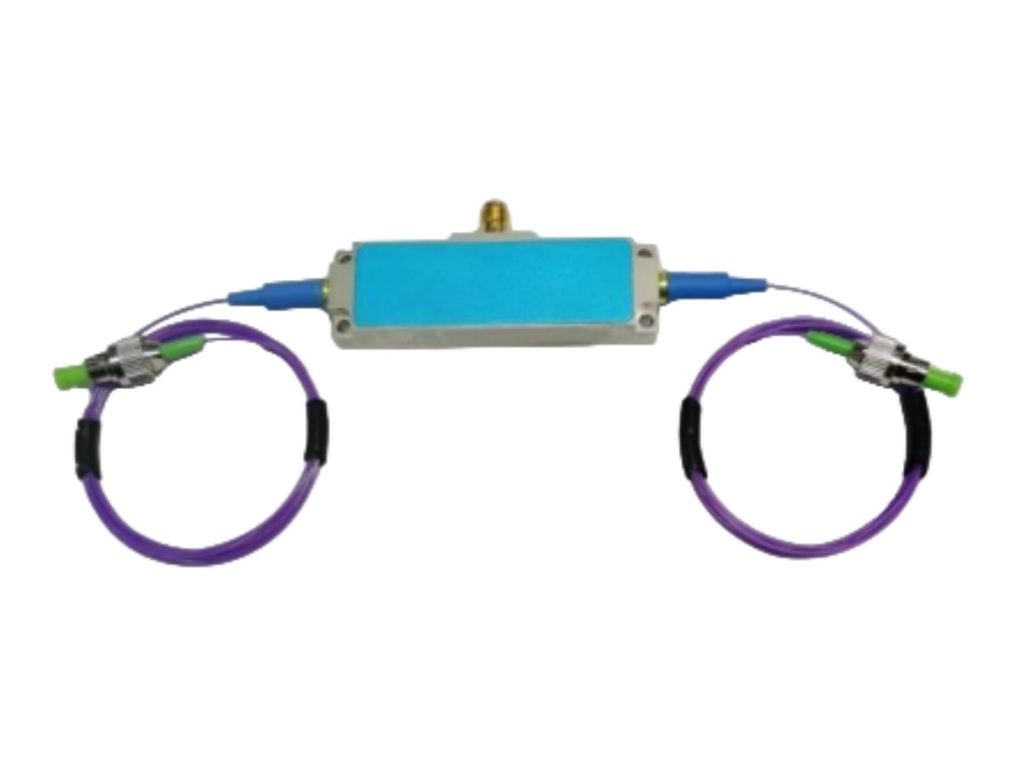
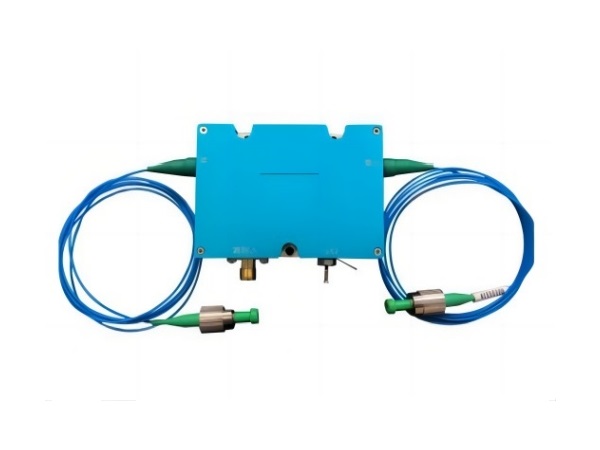
The mechanical configuration of the AOM enclosure is the first major mechanism for heat removal. For fiber-optic coupled AOMs, the reduced size leads to higher power densities, necessitating effective packaging.
Thermal Interface and Attachment
High-power AOMs need a high-conductivity thermal interface between the crystal and the surrounding environment.
Vacuum Attachment: Modern technology uses vacuum attachment of the transducer to the crystal via metal layers (e.g., Indium). This results in a much better thermal connection than conventional organic epoxy bonding.
Contact Surfaces: The internal fixation should maximize contact between the crystal and the heat sink. Air pockets act as thermal insulators, causing fast heating.
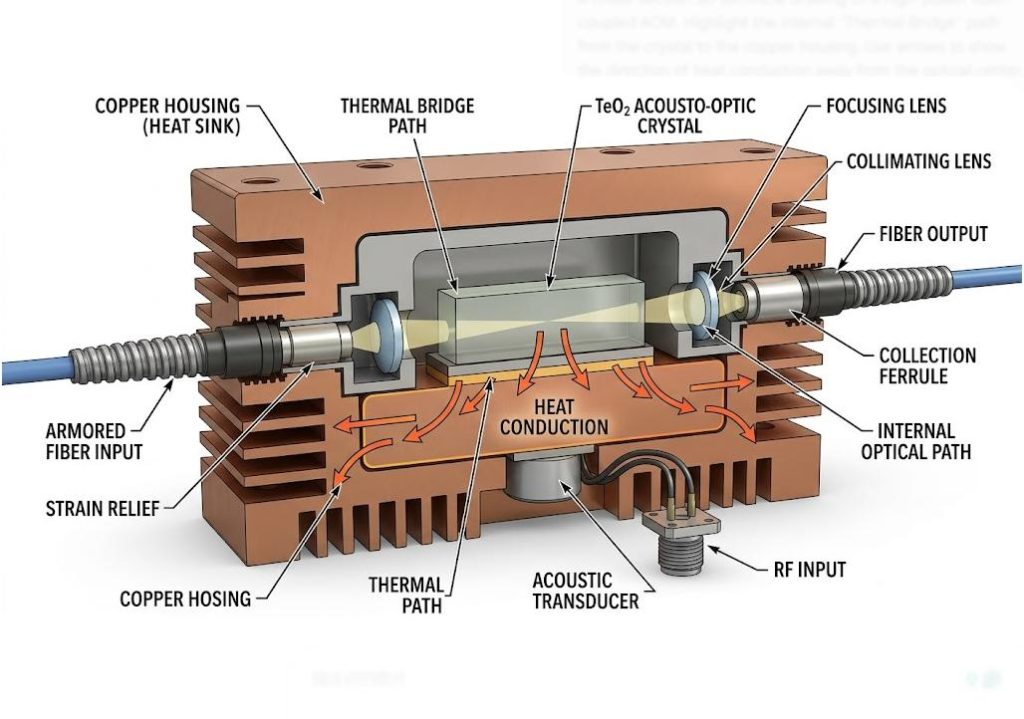
Heat Dissipation: Active vs. Passive
Conductive Cooling: The most common arrangement in industry involves mounting the AOM on top of a TEC or a sizable aluminum block. Flatness and the choice between silicone-free and silicone TIM are critical in determining the efficiency of heat dissipation.
Water Cooling: For free-space AOMs rated at over 100 watts, water cooling inside the copper casing is typical practice. It ensures that the crystal stays at an almost constant temperature irrespective of the RF power input.
Comparing Stabilized vs. Unstabilized AOMs
In order to assess the extent to which these factors affect the device, a comparison between a regular acousto-optic modulator and a specially designed one was made over a period of one hour.
| Performance Metric | Standard AOM | CQ-Smart High-Stability AOM |
| Output Power Drift (1 hr) | 10% – 15% | < 1.5% |
| Pointing Stability | > 0.4 mrad | < 0.05 mrad |
| Diffraction Efficiency at Steady State | Declining | Constant |
| RF Power Limit | 2.0 Watts | 5.0 Watts |
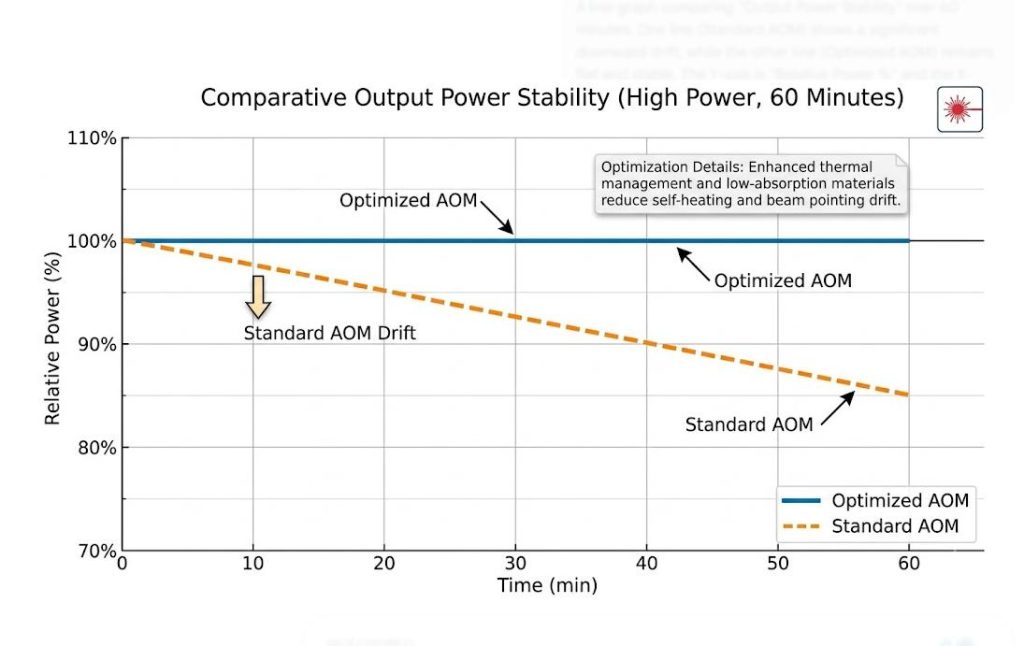
It has been found that without thermal optimization, the time required for reaching a stable thermal state is significantly higher, resulting in continued fluctuation of optical performance. The optimized version stabilizes rapidly, offering constant optical output in just minutes.
How to Minimize Thermal Drift in Your Setup?
Regardless of having top-of-the-line hardware, the integration process determines the ultimate stability. Employ these four technical steps to reduce thermal instability:
- Prioritize Heat Sinking: Attach the AOM to heat sinks made of highly conductive materials such as copper or bare aluminum. Make sure the heat sink is flat and use thermal grease that does not contain silicone to prevent tiny air pockets.
- RF Warm-Up Procedure: To ensure instant accuracy, use the RF signal 5-10 minutes before laser processing. This will allow the crystal to achieve thermal stability and stabilize the speed of sound.
- Duty Cycle Control: Reduce RF power consumption by applying pulsed operation instead of CW operation whenever feasible.
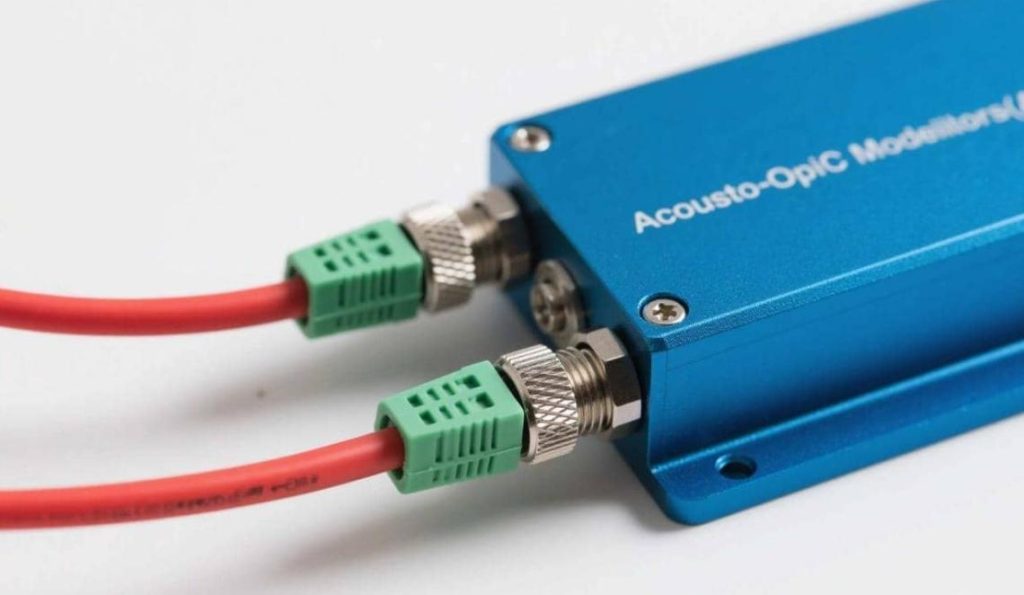
- Matching Impedance: Use high-quality coaxial cables and connectors to achieve a low VSWR. Low reflection will prevent unnecessary heating inside the enclosure.
Thermal drift in high-power AOM modulators is one factor that is under control. Thermal considerations, such as choosing the right materials, having good conversion from RF to acoustic and mechanical cooling, ensure that the device operates stably over time. In terms of high-power lasers, thermal considerations are equally important as optical considerations.