
How Does Q-Switch Aperture Affect Pulse Performance?
The optical aperture of an acousto-optic Q-switch plays a role in the interaction between the laser beam and the acoustic wave in the device. Where the aperture is smaller than what the beam needs, some of the light will fail to be modulated. Where it is larger than what is needed, it will consume more RF power and provide slower switching.
What should be taken into account is not to select the largest possible aperture, but the one that corresponds to the effective acoustic aperture. This relationship influences switching speed, diffraction efficiency, intracavity loss, and pulse consistency.
What Does Optical Aperture Mean in a Q-Switch?
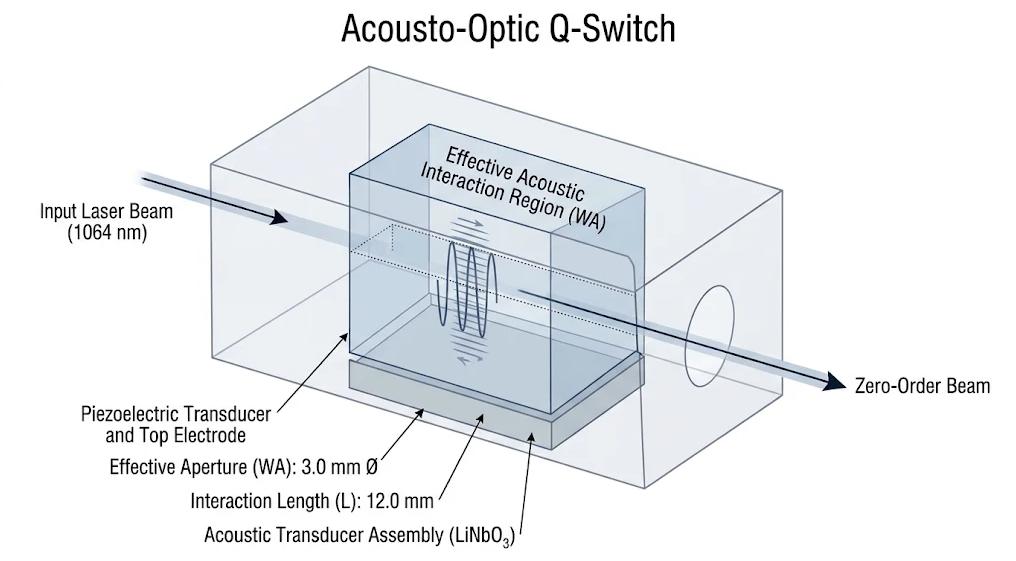
While talking about the Q-switch aperture, it is necessary to consider two factors.
First, there is clear aperture – the optical opening through which laser light can pass without any interference from the device construction.
Second, there is active aperture – the area where the interaction of light and sound waves occurs.
In particular, for the acousto-optic Q-switch, the latter is crucial, since it affects the part of the light beam that is actually modulated.
The beam may fit within the physical opening while extending beyond the effective acoustic interaction region.
In this case, part of the beam may not undergo the intended diffraction. So while selecting the Q-switch, it is not enough just to take a look at the outside dimensions or clear aperture.
It is necessary to compare the beam diameter at the real Q-switch point with the active aperture of the device.
How Does Aperture Size Affect Q-Switching Speed?
The switching time depends on the time taken by the acoustic wave to pass through the laser beam. The RF switch turns on the Q-switch, whereby the acoustic wave passes through the optical interaction region and affects the beam diffraction.
A larger laser beam will have an increased time taken by the acoustic wave to pass through the beam. Thus, the optical rise time will increase with the beam size.
For a Gaussian laser beam, the optical rise time is given by:
Rise time ≈ 0.65 × beam diameter / acoustic velocity
Where:
- Beam diameter is the 1/e² diameter of the laser beam at the Q-switch.
- Acoustic velocity is the speed of sound in the acousto-optic medium.
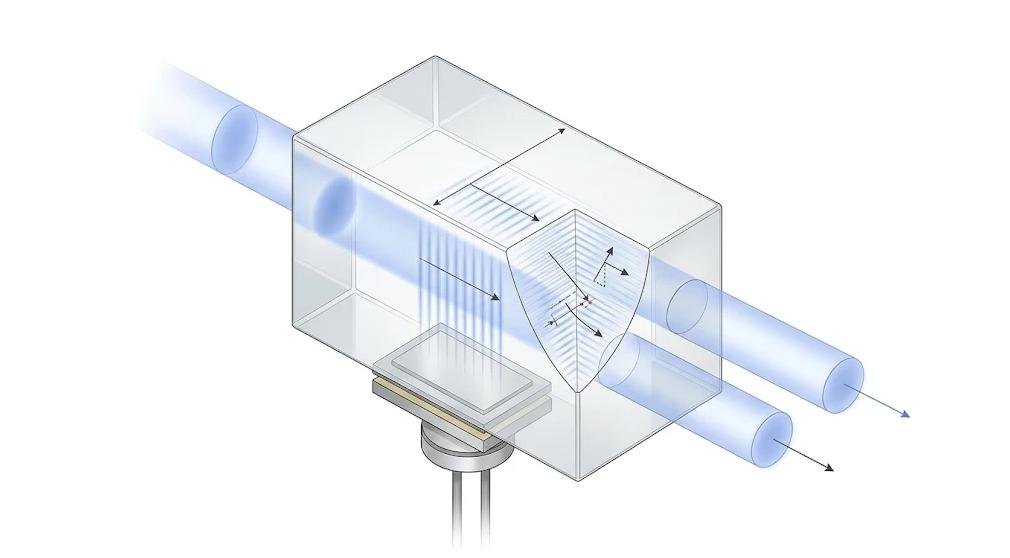
For instance, if there is an increase in the beam size while the material and acoustic mode are constant, there will be an increase in the acoustic transit time. This can lead to a sluggish switching response.
The aperture, in itself, does not directly influence the rise time. The real beam size and acoustic properties play a more significant role in this regard. Nevertheless, a bigger active aperture might provide room for a larger beam, which could indirectly influence switching speed.
This explains the importance of analyzing the beam size, active aperture, and acoustic velocity as a set, and not as separate parameters.
What Happens When the Aperture Does Not Match the Laser Beam?
An unsuitable aperture-to-beam relationship can affect several aspects of Q-switch performance.
| Aperture and beam relationship | Possible effects |
| Active aperture is too small | Partial beam modulation, reduced effective diffraction, and residual intracavity light |
| Beam nearly fills the active aperture | Less alignment tolerance and greater sensitivity to beam position |
| Active aperture is unnecessarily large | Higher RF power requirements and potentially greater thermal load |
| Beam and active aperture are properly matched | More complete beam interaction and more predictable Q-switching performance |
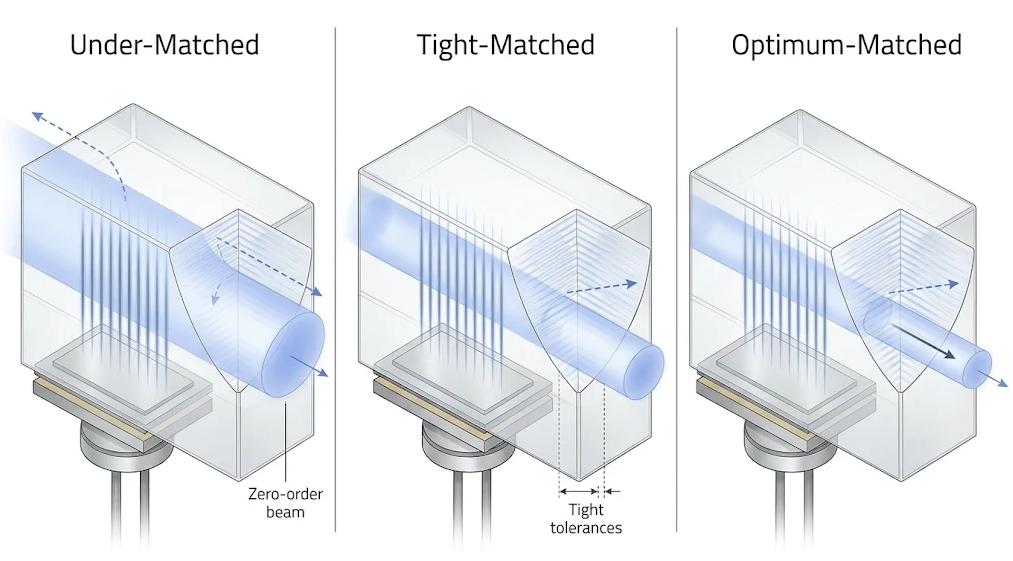
Where the active aperture is not adequate, some of the beam will fall out of the effective acoustic field. This means there will be less light that will be diffracted by the Q-switch and therefore insufficient intracavity loss modulation.
This may lead to poor modulation, poor loss modulation, or inconsistent pulses.
Having an aperture that is much larger than what is needed does not necessarily translate to better performance of the pulse. Larger apertures need more acoustic power to provide the needed modulation. This increases the RF power and heat production, making the thermal management difficult.
Alignment is also important. Where the beam nearly fills the active aperture, there is less margin for alignment error or beam drift. Any slight misalignment may result in some of the beam not interacting effectively with the acoustic wave.
How to Match Q-Switch Aperture to Your Laser Beam
The choice of the right aperture depends on the real optical state in the laser cavity, not just its laser rod diameter.
The following must be taken into consideration:
1. Find out the size of the beam at the point where it is Q-switched
The size of the beam may vary depending on the resonator configuration. The beam size should be measured at the Q-switched point, not at the laser rod.
2. Determine whether there is sufficient active aperture, not clear aperture
Check whether the acoustics can work with the beam size. Clear aperture being sufficient does not mean that the beam will be switched properly.
3. Ensure proper alignment tolerance
It should not be aligned in such a manner that small tolerances lead to partial clipping or non-interaction with the beam due to proximity to the active aperture edge. This tolerance will vary according to the shape of the beam as well as the stability of the cavity.
4. Look at the speed of switching and the RF power in relation to one another
A smaller beam diameter is capable of supporting a fast acoustic response and reduced acoustic power. Too much focusing on the beam would result in higher intensity of light and potential damage and beam quality issues. Appropriate settings will depend on the switching response, intensity of light, diffraction efficiency, and temperature.
There is no single aperture-to-beam-size ratio that works for all Q-switched lasers.
Choosing an Acousto-Optic Q-Switch for Stable Pulse Performance
Aperture matching is not all that goes into Q-switch selection. In order to ensure pulse performance, the Q-switch has to comply with the laser system specifications regarding wavelength, optical power density, polarization, diffraction efficiency, RF drive power, and cooling.
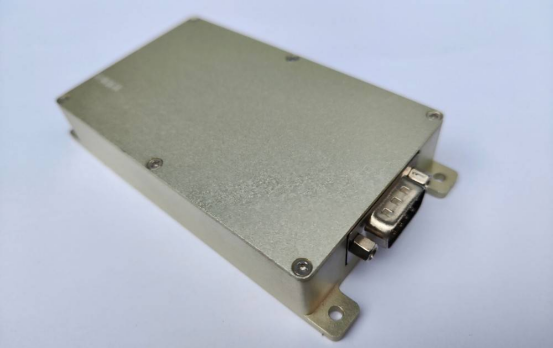
The SMART SCI&TECH company produces acousto-optic Q-switches in several wavelength ranges and optical aperture combinations: 10.6 μm, 2.7 μm, and 2 μm series. The devices employ proprietary manufacturing and packaging technologies aimed at better heat dissipation and beam stabilization.
Moreover, we provide the RF drivers to operate the Q-switches. Proper matching of the driver and the Q-switch and cavity parameters is important in order to obtain the desired modulation performance.
When you are choosing the acousto-optic Q-switch, assessment of the beam diameter, switching response, optical power density, and aperture is likely to prevent incomplete modulation and unnecessarily high RF power requirements.
Explore SMART SCI&TECH’s acousto-optic Q-switch modulators to find a configuration suited to your laser system.